Industrial UFO LED High Bay Lights for High-Ceiling Spaces
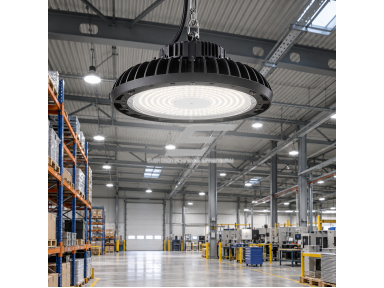
UFO LED High Bay luminaires are compact, high-output industrial LED lights designed for tall production halls, warehouses, logistics centres, sports facilities and other large-volume spaces. Their circular housing, controlled light distribution and high luminous flux make them suitable for efficiently illuminating work areas from greater mounting heights.
Different models may vary in power, luminous flux, luminous efficacy, beam angle, colour temperature, IP and IK protection ratings, control options and mounting method. For this reason, industrial lighting should not be selected by wattage alone, but according to the required illuminance level and the geometry of the specific space.
UFO LED High Bay – lighting for high-ceiling spaces
These luminaires are commonly installed where standard ceiling lights cannot provide sufficient light levels at the working plane. Depending on the selected model, mounting height and optics, UFO luminaires can be used in medium-height warehouses as well as high production and logistics buildings.
LED
Light source technology
High Bay
For high-ceiling spaces
lm/W
Key efficiency indicator
IP / IK
Protection depends on model
What is a UFO LED luminaire?
The term UFO describes the characteristic circular, low-profile housing design, while High Bay describes the luminaire's application – illuminating spaces from greater mounting heights.
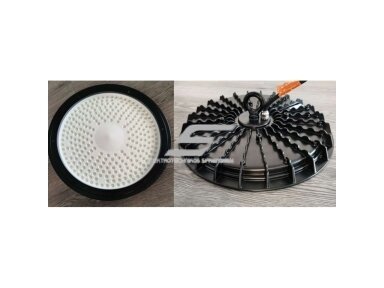
LED modules, the driver, optical system and heat-dissipation housing form a compact luminaire construction. This design is widely used when upgrading older industrial lighting installations.
Typical applications
-
Production halls – work areas, process lines and general lighting.
-
Warehouses – aisles, racking zones and storage areas.
-
Logistics terminals – loading, sorting and handling zones.
-
Workshops and service facilities – general and task lighting.
-
Sports halls – when the optics and other characteristics meet the project requirements.
-
Retail and large commercial spaces.
-
Hangars and technical areas – where environmental conditions match the luminaire specifications.
Key technical parameters
|
Parameter |
Meaning |
Why it matters |
|
Power, W |
Electrical input power |
Wattage alone does not determine actual lighting performance |
|
Luminous flux, lm |
Total emitted light output |
One of the main indicators of the amount of light produced |
|
Luminous efficacy, lm/W |
Ratio between luminous flux and power consumption |
Allows energy-efficiency comparison between LED luminaires |
|
Beam angle |
Defines the width of light distribution |
Must be matched to mounting height and luminaire spacing |
|
Colour temperature, K |
Describes the appearance of the light |
Selected according to room use and project requirements |
|
CRI / Ra |
Colour rendering index |
Important where correct colour recognition is required |
|
IP rating |
Protection against solids and water |
Must suit the actual environmental conditions |
|
IK rating |
Resistance to mechanical impact |
Relevant in industrial, sports and impact-risk areas |
|
Power factor, PF |
Electrical load characteristic |
Important when designing larger lighting installations |
|
Control / dimming |
Available only on compatible models |
Allows integration with sensors and lighting control systems |
Important: W is not the same as lm
Wattage indicates electrical power consumption, while lumens indicate the amount of light emitted. Two UFO LED luminaires with the same wattage can produce different luminous flux. When comparing models, luminous efficacy in lm/W should also be considered.
Mounting height and optic selection
The mounting height of High Bay luminaires must be considered together with luminous flux and beam angle. The greater the mounting height, the more important it becomes to correctly select the optics, number of luminaires and spacing.
A narrower beam can concentrate light from greater heights, but may increase the risk of uneven illumination. A wider beam distributes light over a larger area, but can produce lower illuminance on the working plane.
Professional lighting design requires more than lumens
A proper lighting design should consider required illuminance in lux (lx), room height, working-plane height, photometric data, surface reflectance, luminaire layout and lighting uniformity. Where defined lighting requirements apply, a lighting calculation is recommended.
Why is luminous efficacy important?
Luminous efficacy shows how much luminous flux a luminaire produces per watt of electrical power. When comparing luminaires of the same power, a higher lm/W value generally means a higher luminous flux.
When replacing older industrial lighting, LED wattage should therefore not be compared directly with the wattage of the previous luminaire. It is more accurate to compare luminous flux, light distribution, efficacy and actual illuminance at the working plane.
Uniformity and glare
High illuminance alone does not guarantee a good working environment. Light should be distributed as uniformly as possible, avoiding excessive contrast between bright and dark zones and unnecessary glare.
If the manufacturer provides UGR or other glare-related data, these should be considered in workplaces, sports facilities and other areas where visual comfort is important.
Service life and lumen maintenance
LED service life should not be assessed only by the declared operating hours. Where available, manufacturer data such as L70 or L80 lumen-maintenance values should also be considered because they describe how much luminous flux is expected to remain after a specified operating period.
Control and automation
Depending on the model, UFO LED High Bay luminaires may support different control options:
-
motion or presence sensors;
-
daylight sensors;
-
time schedules;
-
0–10 V or other analogue control, where supported by the driver;
-
DALI or another building-lighting control system, where supported;
-
central building automation.
Not all UFO luminaires are dimmable
Dimming, sensors and external control depend on the particular luminaire and LED driver. Always check the technical documentation before connecting external control equipment.
Mounting methods
A common installation method is suspension using the luminaire's mounting eye or another manufacturer-approved fixing point. Some models may also support optional adjustable brackets.
The mounting method should be selected according to the specific luminaire design, manufacturer's instructions, supporting structure, luminaire weight and mechanical conditions of the site.
How to select a UFO LED luminaire?
|
Criterion |
What should be known? |
|
Room height |
Mounting height above floor or working plane |
|
Room dimensions |
Length, width, obstacles, racking and structures |
|
Required illuminance |
Target lighting level at the working area, lx |
|
Luminous flux |
Lumens of the selected luminaire |
|
Beam angle |
Selected according to height, zone and luminaire layout |
|
Environmental conditions |
Dust, moisture, temperature and mechanical exposure |
|
Control |
ON/OFF, sensors, dimming or automation depending on model |
|
Electrical supply |
Supply voltage, circuit load, inrush current and protective devices |
For designers and engineers
Industrial LED lighting should be designed using the luminaire's photometric data, not only nominal electrical values. Lighting calculation software can be used to evaluate mounting height, layout, average illuminance, uniformity and other project criteria.
For installers
Before installation, verify the specific luminaire's supply voltage, wiring diagram, cable requirements, earthing, mounting method and manufacturer-specified clearances.
Where many LED luminaires are connected to one circuit, protective devices should not be selected only according to the total steady-state power. LED drivers may have significant inrush current at switch-on, therefore the circuit should be designed using the manufacturer's electrical data.
Advantages
-
High luminous flux from a compact luminaire.
-
Suitable for high-ceiling spaces when output, optics and layout are correctly selected.
-
High LED efficacy can reduce installed lighting power compared with older systems.
-
Compact design simplifies installation.
-
Reduced maintenance requirements when quality LED modules and drivers are used.
-
Multiple optic options may be available for different mounting heights and zones.
-
Control integration may be available on compatible models.
Limitations
-
An unsuitable beam angle can result in insufficient or uneven lighting.
-
Wattage alone is not sufficient for professional selection.
-
Excessive light output or poor layout can increase glare.
-
IP and IK ratings differ between models.
-
Not every model supports dimming or external control.
-
Maintenance at high mounting heights may require lifting equipment.
Important design and electrical safety information
Industrial UFO LED luminaires must be selected according to mounting height, required illuminance, environmental conditions and electrical system parameters. Installation must follow the manufacturer's instructions and use appropriate fixing hardware.
Electrical connection and installation of fixed lighting systems should be performed by a qualified electrical professional. Appropriate working-at-height safety requirements must also be followed.
Industrial UFO LED High Bay luminaires are designed for warehouses, production halls, logistics terminals, hangars, workshops, sports halls and other large-volume spaces. Selection should consider not only wattage, but also luminous flux, lm/W efficacy, beam angle, mounting height, IP and IK ratings, colour temperature and available control options.


 1 - 6 of 6UFO LED high bay light | 120W-160W-200W | 230V | 4000K | 34000lm | IP65Code: TCC-4-W002-OFU-BH
 UFO LED high bay light | 150W | 4000K | 80lm/W | IP65 | NewUFO High Bay | 4779041461915Code: NewUFO HighBay150W

 UFO type LED high bay light | 100W | 230V | 5700K | 13000lm | IP44 | Margo | 008796 | 5902216725362Code: 008796

 LED UFO High-Bay Light Optonica HB50-B1 | for industrial, commercial, technical premises | 50 W | 5000 lm | 4000 K | black | IP65Code: 3800156682405


