


Modular staircase lighting relays | for installation in electrical distribution boxes | panels
-
Modular Staircase Lighting Relays
Modular staircase lighting relays are designed to automatically switch the lighting on for a preset period after a push button is pressed and then switch it off without any additional user action. They are most commonly mounted on a DIN rail in electrical distribution boxes, panels and control cabinets.
These relays are used in stairwells, corridors, common areas, passageways, basements, storage areas and other places where lighting is only required for a short period of time. Depending on the model, the switch-on time may be adjustable, a permanent lighting mode may be available, a warning before switch-off may be provided, or additional control functions may be included.
Important regarding the load:
The output contacts of a staircase relay have a limited permissible load. Before connecting LED luminaires, electronic power supplies, contactors or other equipment, it is necessary to check not only the rated current, but also the inrush current of the specific load type and the switching characteristics specified by the manufacturer.Important regarding control buttons:
Staircase lighting relays are usually controlled by momentary, spring-return push buttons rather than standard latching wall switches. The exact control method must always be checked against the wiring diagram of the specific model.Key point:
Choose a modular staircase lighting relay when you need to switch common-area lighting on temporarily from one or more push buttons and automatically switch it off after a preset time. The appropriate model is selected according to the supply voltage, adjustable time range, contact load, control circuit and the type of luminaires used.Installation
DIN railPurpose
Temporary lighting activationControl
Push buttonsTime
Adjustable depending on modelLoad
Lighting circuitsApplication
Stairwells and common areasWhat is a staircase lighting relay?
A staircase lighting relay is an automation device with a timing function that switches on the lighting circuit after a control button is pressed and keeps it active for a preset period. When the preset time has elapsed, the relay contact automatically returns to its initial state and the lighting is switched off.
This solution is particularly useful in common areas where there is no need for the lighting to remain on continuously. The user only needs to briefly press a button, while the relay takes care of switching the light off automatically.
Depending on the design, several control buttons located on different floors or in different zones can be connected to one relay, allowing the same lighting circuit to be activated from multiple locations.
Difference from a standard switch:
A standard switch keeps the lighting on until the user switches it off. A staircase relay switches the lighting off automatically after the preset time, reducing the risk of leaving the lights on unnecessarily.Operating principle
- Button press – the user briefly closes the control contact.
- Relay activation – the device receives the trigger signal.
- Lighting switch-on – the relay output contact energises the lighting circuit.
- Time countdown – the relay starts counting the preset operating time.
- Repeated control – on some models, pressing the button again may restart the time countdown.
- Automatic switch-off – when the preset time has elapsed, the relay contact switches off the lighting circuit.
Main functions
Function Purpose Temporary switch-on The lighting is switched on for a preset period after the button is pressed. Automatic switch-off When the preset time has elapsed, the lighting circuit is switched off automatically. Restart function On some models, pressing the button again can restart or extend the timing period. Permanent ON mode Some models allow the lighting to remain permanently switched on temporarily. Switch-off warning Some models may provide a pre-switch-off warning or a brief change in the lighting state. Important:
Specific functions may differ between models. Not all staircase relays have permanent ON, timing restart or switch-off warning functions.Adjustable lighting time
Many staircase relays allow you to set how long the lighting remains switched on after a button is pressed. The exact adjustment range depends on the specific model.
A shorter time is suitable for small passage areas where a person only needs a few dozen seconds or a few minutes. A longer time may be selected for larger stairwells, long corridors, basements or technical rooms.
Practical selection:
Set the time long enough for a person to safely pass through the entire controlled area, but not so long that the lighting remains on significantly longer than necessary.Control from multiple locations
One of the main features of a staircase lighting relay is the ability to activate the same lighting circuit from several different locations.
For example, in an apartment building stairwell, control buttons can be installed on every floor. Pressing any of them sends a control signal to the same staircase relay and switches on the common lighting.
Typical control circuit:
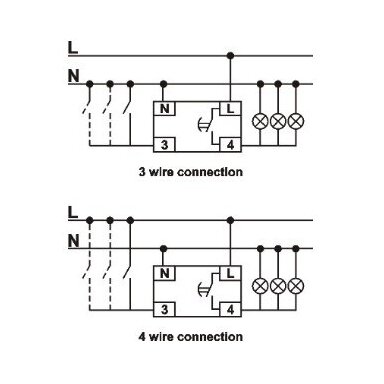
Several momentary push buttons → staircase relay → lighting circuitThe exact button connection, the permitted number of buttons and the wiring arrangement depend on the selected relay model.
Technical characteristics
Product group Modular staircase lighting relays Main purpose Temporary lighting switch-on and automatic switch-off Mounting type Modular, DIN rail mounting Supply voltage Depends on the specific model Control Momentary push buttons or according to the specific model wiring diagram Time range Adjustable or fixed depending on model Output Relay output or another output type depending on the specific model Contact load Must be checked according to the parameters of the specific model and load type Available modes Timed, permanent or other modes depending on model Installation location Electrical distribution boxes, panels and automation cabinets Where are staircase lighting relays used?
- Apartment building stairwells – for common lighting of floors and staircases.
- Corridors – to switch the lighting on only while passing through.
- Basements – for temporary lighting of common areas.
- Storage rooms – for short-term lighting.
- Technical rooms – where continuous lighting is not required.
- Passageways – for automatic switch-off after use.
- Dormitories and hotels – in shared stairwells and corridors.
- Office buildings – in auxiliary and common areas.
- Underground areas – for access areas and short passageways.
- Other common areas – where the lighting should switch off automatically after a preset period.
How to choose the right staircase relay?
- Check the supply voltage – it must match the specific electrical installation.
- Select the time range – it must be sufficient to pass through the required area.
- Check the load current – the relay contacts must be suitable for the total lighting load.
- Evaluate the luminaire type – LED, halogen or other light sources may have different inrush characteristics.
- Check the push button connection – determine whether phase, neutral or another type of control signal is used.
- Evaluate the number of push buttons – especially in apartment stairwells with many control locations.
- Check the restart function – whether a new button press extends the timing period.
- Evaluate the need for permanent mode – for example, for cleaning or maintenance.
- Check the module width – to ensure there is enough space in the panel.
- Follow the diagram of the specific model – wiring principles may differ between manufacturers.
Staircase relay and LED lighting
Modern stairwells most commonly use LED luminaires, so it is important to consider the characteristics of their electronic power supplies.
Although the continuous operating current of an LED luminaire may be low, its power supply may briefly draw a much higher current at switch-on. This can place additional stress on the relay contacts.
For LED loads:
When connecting a larger number of LED luminaires, do not rely solely on their total rated power. Check the permissible LED, capacitive or electronic load specified by the manufacturer of the specific relay.When should a contactor be used?
If the total load of the staircase lighting circuit is too high for the internal contacts of the relay, the staircase relay can be used as the control device while the final lighting load is switched by a contactor.
Typical circuit for a larger load:
Push buttons → staircase relay → contactor coil → contactor → lighting circuitThis solution may be suitable for a larger number of luminaires or loads whose inrush current exceeds the permissible switching characteristics of the staircase relay contacts.
Staircase relay and motion sensor
A staircase relay is usually controlled by push buttons, but in some systems motion or presence sensors may be used to automate the lighting. In this case, the output type of the specific sensor and the control input circuit of the relay must be evaluated.
A motion sensor may be more practical where completely automatic lighting without a button press is required. A staircase relay is more suitable for systems in which the user deliberately activates the lighting from one or more locations.
Selection principle:
If you want the user to activate the lighting manually, a staircase relay with push buttons is more commonly used. If you want the lighting to switch on automatically when someone enters the area, a motion or presence sensor is more commonly selected.General installation instructions
- Check the supply voltage. It must match the parameters of the specific relay model.
- Determine the control circuit. Check how the push buttons must be connected.
- Check the lighting load. Evaluate the total power, current and type of luminaires.
- Install the relay. Mount it on a DIN rail in an electrical distribution box or panel.
- Connect the power supply. Follow the manufacturer's terminal diagram.
- Connect the control buttons. Check that the correct type of momentary contacts is used.
- Connect the lighting circuit. If the load is too high, use a contactor.
- Set the operating time. Select a suitable interval for the specific area.
- Energise the circuit. Check the operation of the relay.
- Test all push buttons. Each control point must switch the lighting on.
- Check the automatic switch-off. Make sure the light switches off after the preset time.
- Test repeated button presses. Check how the specific model behaves while the timing period is active.
Electrical safety:
Connection of the electrical distribution box, panel and lighting circuits must be carried out by a qualified specialist in accordance with the documentation of the specific product and applicable electrical installation requirements. Before installation work is carried out, the circuit must be safely disconnected from the power supply.Common selection and installation mistakes
- The relay supply voltage is not checked.
- Incorrect latching switches are used instead of momentary push buttons.
- The push button control circuit is wired incorrectly.
- The lighting time is set too short.
- An unnecessarily long operating time is set, reducing the energy-saving benefit.
- Only the total LED power is evaluated without taking the inrush current into account.
- More luminaires are connected than the relay contacts can handle.
- A high load is controlled directly even though a contactor should be used.
- The repeated button press function is interpreted incorrectly.
- The permitted number of buttons for the specific model is not checked.
- Not all control points are tested after installation.
- The wiring diagram of the specific manufacturer is not followed.
Advantages
- ✅ Automatically switches the lighting off after the preset time.
- ✅ Helps reduce unnecessary electricity consumption.
- ✅ Can be controlled from multiple locations.
- ✅ Convenient for apartment building stairwells and corridors.
- ✅ Adjustable operating time on many models.
- ✅ Modular housing suitable for DIN rail mounting.
- ✅ Can be used with a contactor for larger loads.
- ✅ Easy to integrate into an electrical distribution panel.
- ✅ Some models offer a permanent lighting mode.
- ✅ Can replace manual switching-off of lighting in common areas.
Limitations
- ❌ Contact load is limited according to the specific model.
- ❌ Not all relays are suitable for a large number of LED luminaires.
- ❌ Separate momentary push buttons are usually required for control.
- ❌ Push button wiring diagrams may differ between models.
- ❌ A time setting that is too short may be inconvenient or unsafe.
- ❌ A time setting that is too long reduces the energy-saving effect.
- ❌ Larger loads may require an additional contactor.
- ❌ Not all models have a permanent ON mode.
- ❌ Not all models allow the time to be extended by pressing the button again.
- ❌ Incorrect selection of the LED load may shorten the service life of the relay contacts.
Quick guide to choosing a staircase lighting relay
Choose a modular staircase lighting relay when you need to switch the lighting on from one or more push buttons and automatically switch it off after a preset time. Before ordering, the most important parameters to check are the supply voltage, time range, control circuit and lighting load.
Many push buttons
Check the permitted control circuitFor LED lighting
Check the inrush currentFor a long corridor
Choose a suitable time rangeFor a larger load
Use a contactorSuitable when you need to:- automatically switch off staircase lighting;
- control the lighting from several floors;
- reduce unnecessary lighting operating time;
- install time control for a corridor or passageway;
- control lighting in common areas;
- use momentary control buttons;
- control a contactor coil if required;
- install the control device in a DIN rail electrical panel.
Check before ordering:- relay supply voltage;
- adjustable time range;
- total lighting circuit power;
- type of luminaires used;
- LED load inrush current;
- relay output contact ratings;
- push button wiring diagram;
- permitted number of control buttons;
- whether a repeated press extends the time;
- whether a permanent ON mode is required;
- whether a contactor is required for a larger load;
- electrical diagram of the specific model.
Important reminder:
Staircase relays can differ not only in their adjustable time range, but also in their control input circuit, restart logic, output contact load and additional operating modes. Therefore, before installation, always follow the wiring diagram and technical parameters of the specific selected model.FAQ – frequently asked questions
What is a staircase lighting relay used for?
It is designed to switch the lighting on temporarily after a button is pressed and automatically switch it off after a preset time.Can the lighting time be adjusted?
Yes, on many models. The exact adjustment range depends on the specific relay.Can several push buttons be connected?
Usually yes, so the lighting can be activated from several floors or different points in a corridor. The permitted circuit depends on the model.What type of buttons are used?
Momentary, spring-return push buttons are most commonly used. A standard latching switch may not be suitable.Does the timing restart if the button is pressed again?
It depends on the specific model. Some relays restart the timing period, while others may operate according to different logic.Can the lighting remain permanently switched on?
Some models have a permanent ON or service mode, but this function is not universal.Is the relay suitable for LED luminaires?
Yes, if the characteristics of the specific LED load do not exceed the permissible relay ratings. The inrush current of the power supplies must be taken into account.Why is inrush current important for LED loads?
An LED power supply may briefly draw a much higher current at switch-on than during normal operation, so the relay contacts may be subjected to greater stress.Can a large number of luminaires be connected?
Only when their total load and inrush characteristics comply with the contact ratings of the specific relay. A contactor is used if necessary.Can a staircase relay control a contactor?
Yes, provided that its output contact and the contactor coil ratings are compatible.When is a contactor required?
When the total lighting load or its inrush current exceeds the switching capability of the staircase relay contacts.Is a staircase relay the same as an impulse relay?
No. A staircase relay automatically switches the lighting off after a preset time, while an impulse relay normally changes its state after each control pulse and can retain that state until the next press.Is a staircase relay the same as a time relay?
A staircase relay is a specialised timing device designed primarily for lighting circuits. A universal time relay may offer a wider range of timing functions and operating modes.Can it be used with a motion sensor?
This depends on the output of the specific sensor and the control circuit of the staircase relay. Not every combination can be connected directly.How long should staircase lighting be set for?
The time should be selected according to the length of the staircase or corridor and user requirements. It must be long enough to safely pass through the entire area.Is the relay installed next to the luminaire?
A modular relay is usually installed on a DIN rail in an electrical distribution box or panel, not directly next to the luminaire.Can it be used in a private house?
Yes. It can be used in a house stairwell, corridor, basement, garage passageway or other areas where the lighting should switch off automatically.Can it be used for outdoor lighting?
The modular relay itself is normally installed in a suitable protected electrical box or panel. Outdoor luminaires can be controlled only after evaluating the electrical and environmental requirements of the entire system.What is most important to check before buying?
The supply voltage, time adjustment range, push button wiring diagram, relay contact load, type of luminaires used, LED inrush current and the need for additional operating modes.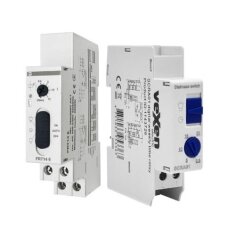 1 - 1 of 1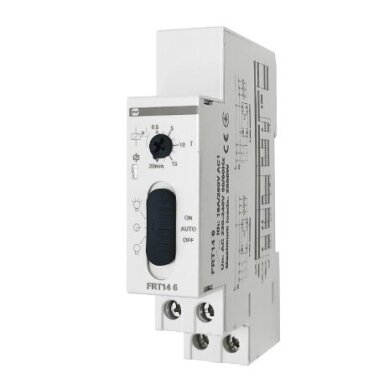
 Staircase lighting timer | 16A | 220-240V | 2000W | FRT14 6Code: PF-FRT146Price 18.15 € VAT incl.( 15.00 € VAT excl. )


