


Copper power supply wires H07V-K
-
Copper power supply wires H07V-K / LGY – for flexible fixed installation
Copper H07V-K wires, also known as LGY wires, are flexible single-core electrical wires with PVC insulation, intended for fixed installation, control cabinets, electrical panels, equipment connection, automation circuits and electrical power supply systems.
Main idea:
H07V-K wire is chosen when a flexible, reliable and easy-to-install copper wire is needed for electrical installation in conduits, cable ducts, distribution boards, control cabinets or enclosed systems. When choosing, it is most important to evaluate the wire cross-section, load current, installation method, ambient temperature, voltage class and colour marking.Conductor
Flexible annealed copper strandVoltage
450/750VInsulation
PVCPurpose
Fixed installation, panels, controlWhat is H07V-K wire?
H07V-K is a flexible single-core copper wire with PVC insulation. The conductor is made of fine annealed copper strands, which makes the wire more flexible than solid-core wires and convenient to install in electrical panels, conduits, cable ducts and internal equipment connections.
Important to know:
H07V-K wire is generally not intended for direct burial in the ground or for open mechanical exposure without additional protection. It is most commonly installed in insulating conduits, cable ducts, panels or enclosed installation systems.Technical data
Product type Copper single-core flexible wire H07V-K / LGY Conductor Stranded annealed copper wires Rated voltage 450/750V Insulation PVC Construction Single-core flexible wire Operating temperature Usually from -15 °C to +70 °C, depending on manufacturer data Installation In conduits, cable ducts, electrical panels, internal equipment circuits How to choose the correct H07V-K wire cross-section?
A correctly selected wire cross-section is one of the most important parameters of an electrical installation. It affects electrical system safety, wire heating, voltage drop, energy losses and the service life of the entire installation.
A wire with too small a cross-section may overheat, cause a higher voltage drop, increase energy losses, accelerate insulation ageing and increase the risk of fire. Meanwhile, a wire with an excessively large cross-section will usually work correctly from a technical point of view, but it will be more expensive, harder to install and will take up more space in electrical panels or installation ducts.
When choosing the H07V-K wire cross-section, it is recommended to evaluate:- ✔ The power of the connected device (W or kW).
- ✔ The operating current of the circuit (A).
- ✔ The electrical network voltage (230V or 400V).
- ✔ The cable length to the load.
- ✔ The permissible voltage drop.
- ✔ The installation method (in conduit, cable duct, electrical panel or in air).
- ✔ The ambient temperature.
- ✔ The number of wires installed in one route.
- ✔ The rated current of the circuit breaker or fuse.
- ✔ Possible future load increase.
When designing a new electrical installation, it is often worth choosing one size larger cross-section. This reduces voltage drop, allows a larger load to be connected in the future and extends the service life of the installation.
Wire cross-section Most common use Approximate operating current* 0.5-0.75 mm² Automation, signal and control circuits up to ~6 A 1 mm² Control cabinets, automation equipment approx. 10 A 1.5 mm² Lighting circuits approx. 16 A 2.5 mm² Socket outlet circuits approx. 20-25 A 4 mm² More powerful household appliances 25-32 A 6 mm² Electric cookers, three-phase equipment 32-40 A 10 mm² and more Distribution panels, incoming supply wires According to project *The stated currents are approximate. The actual permissible load depends on the installation method, ambient temperature, cable length, number of wires laid in one route and other factors.
Recommendation:
If you are choosing between two cross-sections, the safer and longer-lasting solution is usually to choose one size larger wire. This reduces voltage drop, reduces conductor heating and allows a larger load to be connected in the future without replacing the installation.What effect does cable length have?
Load power alone is not a sufficient criterion when choosing a wire. The longer the wire between the power source and the connected device, the greater the voltage drop. As a result, the device may operate at a lower voltage, its efficiency may decrease, and the wire itself may heat up more.
For short lines, a smaller cross-section is usually sufficient, but for longer runs it is often recommended to choose a larger cross-section wire. This reduces energy losses and helps ensure more stable operation of electrical equipment.
In brief:- ✔ Shorter wire → lower voltage drop.
- ✔ Longer wire → a larger cross-section is often required.
- ✔ Larger cross-section → lower energy losses.
When to choose H07V-K and when H07V-U?
Both wire types are intended for fixed electrical installation, but their construction differs, therefore their areas of use also differ.
H07V-K Flexible multi-strand copper conductor. Easy to bend, convenient for installation in electrical panels, automation cabinets, cable ducts and tight spaces. H07V-U Rigid solid copper conductor. Most often used in simpler building electrical installations where high flexibility is not required. Practical recommendation:
If the wire will be installed in an electrical panel, automation cabinet, control equipment or will require many bends – it is recommended to choose H07V-K. If the installation is simple and the wire will be laid straight in a building installation – H07V-U is often sufficient.Colour marking
Colour Purpose Black / brown / grey Phase conductor Blue Neutral conductor Green-yellow Protective earth conductor PE Most common selection mistakes
- Too small a wire cross-section is selected.
- Wire length and voltage drop are not evaluated.
- The installation method is not considered: in conduit, duct, panel or enclosed cavity.
- An incorrect colour is used for phase, neutral or earth.
- A flexible wire is connected without ferrules where they are required.
- The wire is used in an environment for which its PVC insulation is not suitable.
Advantages
- ✅ Very flexible and easy to install.
- ✅ Good electrical conductivity due to the copper conductor.
- ✅ Suitable for electrical panels, control cabinets and installation in conduits.
- ✅ PVC insulation protects against many common external influences.
- ✅ Wide choice of cross-sections and colours.
- ✅ Suitable for residential, commercial and industrial projects.
Disadvantages
- ❌ Not suitable for direct burial in the ground without additional protection.
- ❌ The cross-section must be correctly selected according to the load.
- ❌ Wire ferrules may be required when connecting to terminals.
- ❌ PVC insulation has temperature and environmental exposure limits.
- ❌ Incorrect installation may cause heating or voltage drop.
Frequently asked questions (FAQ)
Where is H07V-K wire used?
It is used for fixed installation in conduits, cable ducts, electrical distribution boards, control cabinets and equipment connection circuits.How does H07V-K differ from a solid-core wire?
H07V-K is flexible because its conductor consists of fine copper strands. Therefore, it is more convenient for installation in panels, conduits and more complex locations.How to choose the correct cross-section?
The cross-section is selected according to load current, circuit length, installation method, protective circuit breaker and permissible voltage drop.Can H07V-K be installed outdoors?
Only if the wire is properly protected from UV rays, moisture and mechanical damage and is used according to the manufacturer’s and installation requirements.Are ferrules needed when connecting H07V-K?
For a flexible conductor, wire ferrules are often recommended, especially when connecting to terminals, so that the contact is reliable and the strands do not spread apart. 1 - 8 of 8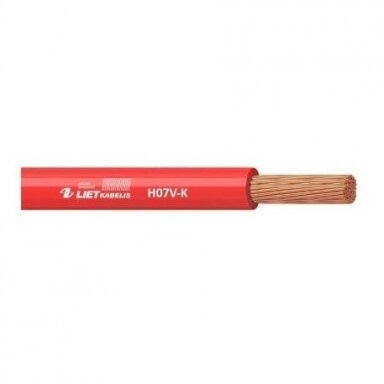
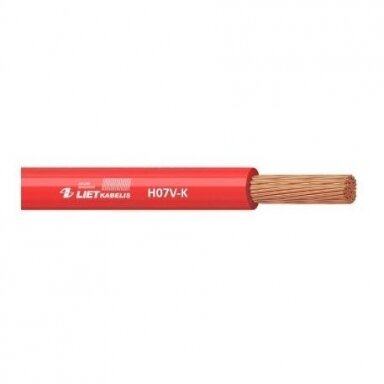
 Single-core flexible copper wire | 35 mm² | 450/750 V | red | PVC insulation | Lietkabelis H07V-K 35Code: 91335003Price 6.54 € VAT incl.( 5.41 € VAT excl. )
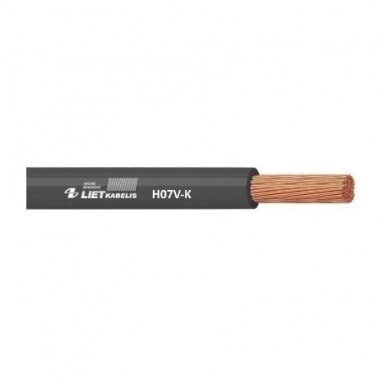 Price 1.06 € VAT incl.( 0.88 € VAT excl. )
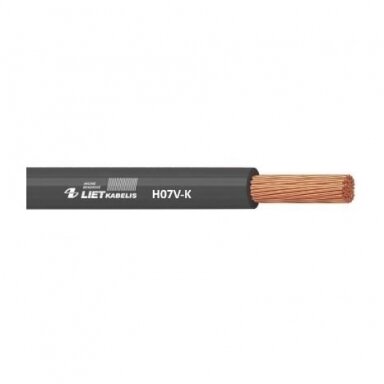
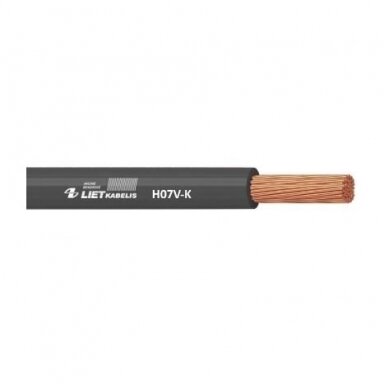
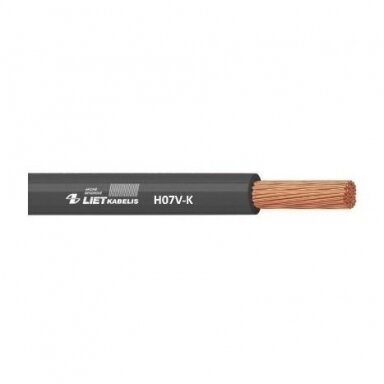 Wire 35mm² | copper | flexible | single-core | multi-stranded | H07V-K 35 | 1m | blackCode: 91335002Price 6.55 € VAT incl.( 5.41 € VAT excl. )
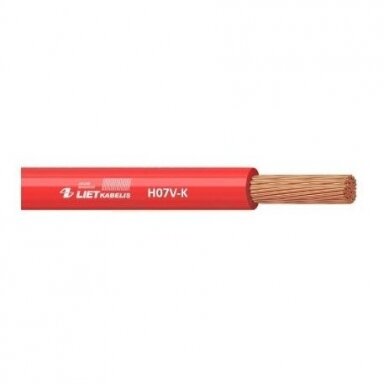 Price 12.78 € VAT incl.( 10.56 € VAT excl. )
 Price 12.78 € VAT incl.( 10.56 € VAT excl. )
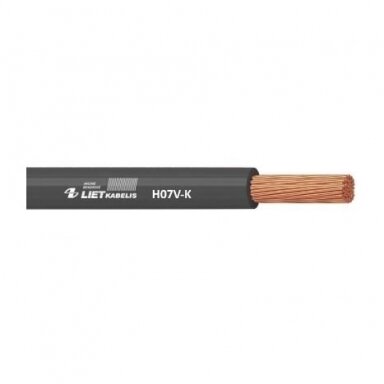 Wire 50mm² | copper | flexible | single-core | multi-stranded | H07V-K 50 | 1m | blackCode: 91350002Price 9.04 € VAT incl.( 7.47 € VAT excl. )
 Price 0.71 € VAT incl.( 0.59 € VAT excl. )
 Price 0.71 € VAT incl.( 0.59 € VAT excl. )


