
HVAC control solutions for heating and ventilation
-
HVAC guide: fresh air at home, in the office and on site
Here you will find a quick choice by situation, what really determines air quality, how to read sensor values, how much air different rooms need, the most common mistakes with diagrams, and answers to the key questions. More detailed selection advice is given in each subcategory description.
Colour key: ■ information · ■ benefit, solution · ■ ⚠ check · ■ ⚡ safety, mistakes
Contents: What do you need? · Sensors and automation · What we breathe · Insulated house · Sensor readings · How much air is needed · What to check · Mistakes · Diagrams · FAQWhat do you need? Quick selection
Situation Solution Where to look You have insulated the house or replaced the windows – the air is stuffy, windows mist up Decentralised heat recovery units (installed in pairs through the wall, no ducting) or a central MVHR system Insulated house, Fans Condensation on windows, mould in the bathroom or kitchen Extract fan (with timer or humidity sensor) + air supply through a trickle vent Fans, Trickle vents Damp basement, storeroom, construction site Dehumidifier sized for the floor area and humidity level Dehumidifiers Stuffy office, server room or flat in summer Portable air conditioner – no fixed installation Air conditioners Dust, allergens, odours Air purifier with HEPA / carbon filter; in a ventilation system – an in-line duct filter Air purifiers, Filters Supplementary or backup heating needed Electric heater with thermostat Electric heating Ventilation of a production or storage area In-line or centrifugal fan, duct run, dampers, filter, speed controller Ducts, Dampers Noisy existing system Duct silencer + fan speed control Silencers After renovation: dust, paint and adhesive odours Air quality sensor measuring PM2.5 / PM10 and TVOC / HCHO + air purifier with HEPA and activated carbon filter + more intensive ventilation Sensors, Air purifiers Ventilating through windows facing the street, smoke from chimneys noticeable A PM2.5 sensor shows when it is better to close the window; as a long-term solution – mechanical air supply through an ePM1 (F7) filter Sensors, Filters You want automatic control based on CO2, humidity or temperature Sensor + controller / speed controller, damper actuators HVAC automation Want truly clean air? Let sensors control the climate
A manually switched fan usually runs at the wrong time. We offer fans with humidity control – they switch on by themselves after a shower and switch off when humidity drops – and CO2 sensors, which increase or reduce ventilation according to the actual air quality. After renovation or when ventilating through windows facing the street, use combined air quality sensors – in addition to CO2 they also measure particulate matter PM2.5 / PM10. The result: fresh air at all times, less moisture and mould, and the fan does not run unnecessarily or waste heat.
- Bathroom, utility room: fan with humidity sensor and timer.
- Office, classroom, bedroom: CO2 sensor + speed controller or EC fan (0–10 V).
- Insulated house, new windows: decentralised heat recovery units – fresh air with heat recovery, no ducting.
- After renovation, near a busy street: CO2 + PM2.5 / PM10 (and TVOC) sensor together with an air purifier or filtered air supply.
- Smart home: CO2, temperature and humidity sensors with smartphone control and automation scenes.
Fans · CO2 sensors and HVAC automation · Smart CO2 / humidity sensors · How to read sensor values · How it works – diagram 3
What do we actually breathe?
Every day a person breathes in about 11,000 litres of air, and we spend most of our time indoors – at home, at the office, at school. That is why indoor air quality affects how we feel more than it may seem.
Clean outdoor air – what it consists of
The remaining ~1 % – argon, CO2 (~0.04 %, about 420 ppm), water vapour. The air we exhale contains about 4 % CO2 – a hundred times more than outdoors, which is why CO2 rises quickly in an unventilated room.
✗ What we breathe in a poorly ventilated room
- CO2 1500–2500 ppm – stuffy, drowsy, poor concentration
- Mould spores – can cause allergies and aggravate asthma
- House dust mite allergens – mites multiply in a damp environment
- TVOC and formaldehyde – from paints, adhesives, furniture
- Particulate matter PM2.5 – from cooking, candles, outdoor smog
- Excess moisture – above 65 % RH, condensation on windows
✓ What we can breathe with proper ventilation
- CO2 up to ~800–1000 ppm – a clear head, better sleep
- Humidity 40–60 % – no condensation or mould
- Filtered air – less dust, pollen and smog
- Vapours and odours removed after cooking or renovation
- Heat stays in the home – with heat recovery
- Everything is measured – sensors show when to ventilate
Mould is not just a stain on the wall. It is a sign that the room has too much moisture and too little air exchange. Remove the cause – the diagrams show how.
Insulated your house? Don't forget ventilation
When a house is insulated and the windows are replaced, the building becomes airtight – heat stays inside, but so do moisture and CO2. In the past, leaky windows and gaps “exchanged” the air; now ventilation has to do this job.
Insulation, new windows→The house becomes airtight→Moisture and CO2 stay inside→Condensation on windows, mould, stuffy air→✓ Solution: heat recoveryDecentralised heat recovery units – ventilation without ducting
A decentralised (single-room) heat recovery unit is installed through an external wall. Inside it there is a ceramic heat accumulator and a reversible fan that changes the airflow direction roughly every minute: the warm extract air heats the ceramic, and the incoming outdoor air is warmed by it. The units are installed in pairs – while one supplies, the other extracts.
- Suitable for renovated flats and houses, where there is no room for ducting.
- Fresh air with heat recovery – ventilation without open windows or draughts.
- Simple installation – a hole in the wall and a 230 V supply.
How it works – diagrams 4 and 5. Look for decentralised heat recovery units in the fans category or ask us – we will size them for your rooms.
How to read air quality sensor values
A sensor shows numbers, but it is not always clear whether they are good or bad. The table gives a simple “traffic light” scale: find your reading and see what to do.
Reading ● Good ● Acceptable ● Ventilate ● Poor CO2
ppm – is ventilation sufficientup to 800 800–1000 1000–1400 above 1400 PM2.5
µg/m³ – fine dust, smoke, smogup to 15 15–25 25–50 above 50 PM10
µg/m³ – coarser dust, pollenup to 45 45–75 75–100 above 100 TVOC
mg/m³ – vapours from paints, adhesives, furnitureup to 0.3 0,3–1 1–3 above 3 HCHO
mg/m³ – formaldehydeup to 0.05 0,05–0,1 — above 0.1 Humidity RH
% – relative humidity40–60 30–40 / 60–65 above 65 above 70 – risk of mould What to do? Nothing – the air is good Monitor; ventilation in normal mode Increase ventilation or air the room Ventilate intensively; if PM is high – close the windows and switch on the purifier The limits are indicative and intended for household assessment. The green zone limits for PM2.5 and PM10 correspond to the WHO 24-hour guideline values (15 and 45 µg/m³), HCHO – to the WHO 0.1 mg/m³ guideline, TVOC – to the levels of the German Environment Agency (UBA). Some sensors show TVOC in other units (ppb or as an index) – in that case follow the sensor's own scale.
⚠ How to avoid misreading the values:- Look at the trend, not a single number. A short spike while cooking or cleaning is normal. What matters is whether the reading stays high for a long time.
- A CO2 sensor does not detect dust or vapours, and a PM sensor does not detect CO2. After renovation and near busy streets, choose a combined sensor.
- True CO2 is measured by an NDIR sensor. Cheap “eCO2” readings are only calculated from TVOC and do not show the CO2 level accurately.
- Position the sensor correctly: at a height of ~1–1.5 m, not next to a window, door, cooker or radiator, and not directly in people's breathing zone.
How much air is needed: children's room, kitchen, office, assembly hall
Room Indicative airflow Example Children's room, bedroom 25–30 m³/h per person 2 children → 50–60 m³/h Living room by number of people, ~25 m³/h per person 4 people → ~100 m³/h Kitchen (extract) 50–75 m³/h; when cooking – cooker hood ~75 m³/h Bathroom / shower 25–50 m³/h ~50 m³/h WC 20–25 m³/h ~25 m³/h Office 25–36 m³/h per person 6 employees → 150–220 m³/h Classroom, training room 25–30 m³/h per person 25 pupils → 625–750 m³/h Assembly or conference hall 20–30 m³/h per person 150 seats → 3000–4500 m³/h The bars show the example values on a compressed scale so that both small and large rooms remain visible.
How to calculate: number of people × airflow per person. E.g. an assembly hall with 150 seats × 25 m³/h = 3750 m³/h. An airflow like this calls for an engineered system with a heat recovery unit – a single domestic fan will not do the job. A children's room for 2 children needs ~50–60 m³/h – a pair of decentralised heat recovery units or a trickle vent with extract can provide this.
⚠ What to check before buying
 KibirkštisBefore buying, I always check these points – it saves both money and a second trip to site.
What to check Why it matters Airflow and pressure Whether the fan will deliver the required m³/h against the real resistance of the duct run – not just the catalogue maximum. Diameter Whether the fan, ducts, dampers and silencer share the same nominal diameter (Ø100, Ø125, Ø160…). Power supply and control 230 V or 24 V; ON/OFF, 3-point or 0–10 V; whether this is compatible with your controller or distribution board. Installation location For damp rooms – a suitable IP rating (in a bathroom usually IPX4 or higher); outdoors – protection against rain and snow. Sensors True NDIR CO2, not “eCO2”; whether it measures PM2.5 / PM10; output – relay, 0–10 V or Wi-Fi / Zigbee. Boiler, fireplace, gas cooker If fuel is burned in the room – provide a make-up air opening and a CO detector. Heat loss For continuous ventilation in an insulated house, heat recovery is worth choosing – the heat is returned. ✗ Most common mistakes
Mistake Consequence The fan is chosen by its catalogue maximum In a real duct run the airflow is much lower – the room remains unventilated. No air supply (trickle vent, gap under the door) The extract fan “pulls against nothing” – moisture stays, mould appears. The house is insulated, but ventilation is forgotten Stuffy air, condensation on windows, mould in the corners. Duct diameter reduced More noise, less air. No backdraft damper When the fan is off, cold air and odours flow back. Uninsulated duct in a cold loft Condensate drips onto the ceiling and into the fan. Mismatched control (24 V actuator on 230 V, 0–10 V signal to an ON/OFF input) Damaged actuator or control does not work. Filters not replaced Airflow drops, the fan motor overheats. Powerful extract in a house with a boiler or fireplace and no make-up air ⚡ The chimney draught may reverse – risk of CO poisoning. What the key mistakes look like in practice – see the diagrams.

⚡ Safe installation – advice from Fazė
- Fans, electric heaters and actuators are connected via suitably rated protective devices in accordance with the manufacturer's instructions.
- Circuits in bathrooms and other damp rooms – with 30 mA residual current protection (RCD); the IP rating of the device must match the installation zone.
- In rooms with a boiler, fireplace or gas cooker – a make-up air opening and a CO detector.
- Connection to the 230 V / 400 V mains must be carried out by a qualified electrician.
☝ Elsprendimai.eu recommends: to control and protect the ventilation system, add contactors and relays, motor protection devices, CO2, temperature and humidity sensors, SONOFF controllers and enclosure heaters for distribution boards installed in unheated rooms.Diagrams: how it often is and how it should be
In each diagram, the most common mistake is on the left and the correct solution on the right. The numbers in the diagram correspond to the explanations below it.
Diagram 1. Air supply and mould. An extract fan without an air supply does not remove moisture. The trickle vent, the gap under the door and the bathroom extract must work as one chain.
KibirkštisThe bathroom fan is running, but the windows still mist up. Why?
FazėBecause the air has nowhere to come from. Let it in through a trickle vent, leave a gap under the door – then the extract will really work.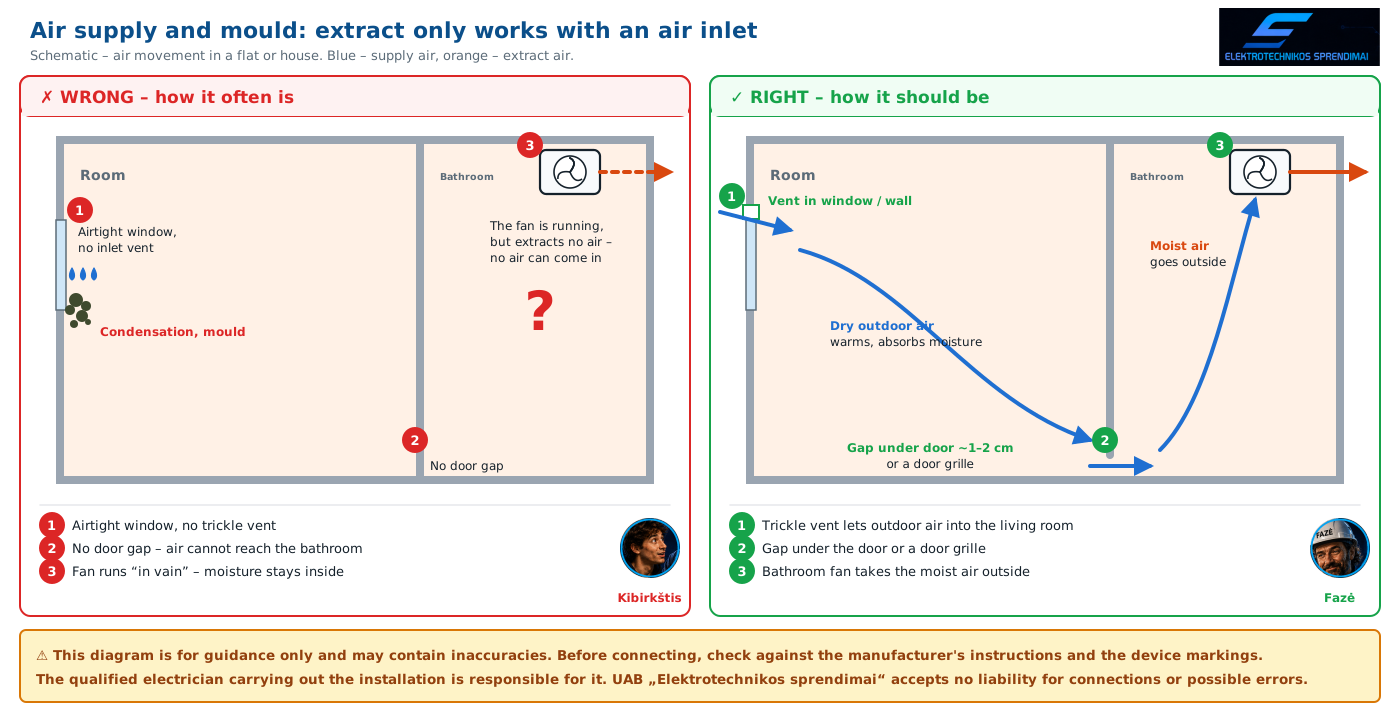 ☝ Click the diagram to open an enlarged version.⚠ This diagram is for guidance only and may contain inaccuracies. Before connecting, check against the manufacturer's instructions and the device markings.
The qualified electrician carrying out the installation is responsible for it. UAB „Elektrotechnikos sprendimai“ accepts no liability for connections or possible errors.Diagram 2. Backdraught from a boiler or fireplace. In an airtight house, a powerful extract can reverse the chimney draught. This is dangerous – carbon monoxide (CO) can enter the room.
KibirkštisWe installed a powerful cooker hood – why has the fireplace started smoking into the room?
FazėThe cooker hood is drawing air down the chimney. You need a make-up air opening and a CO detector – this is no longer about comfort, it is about safety.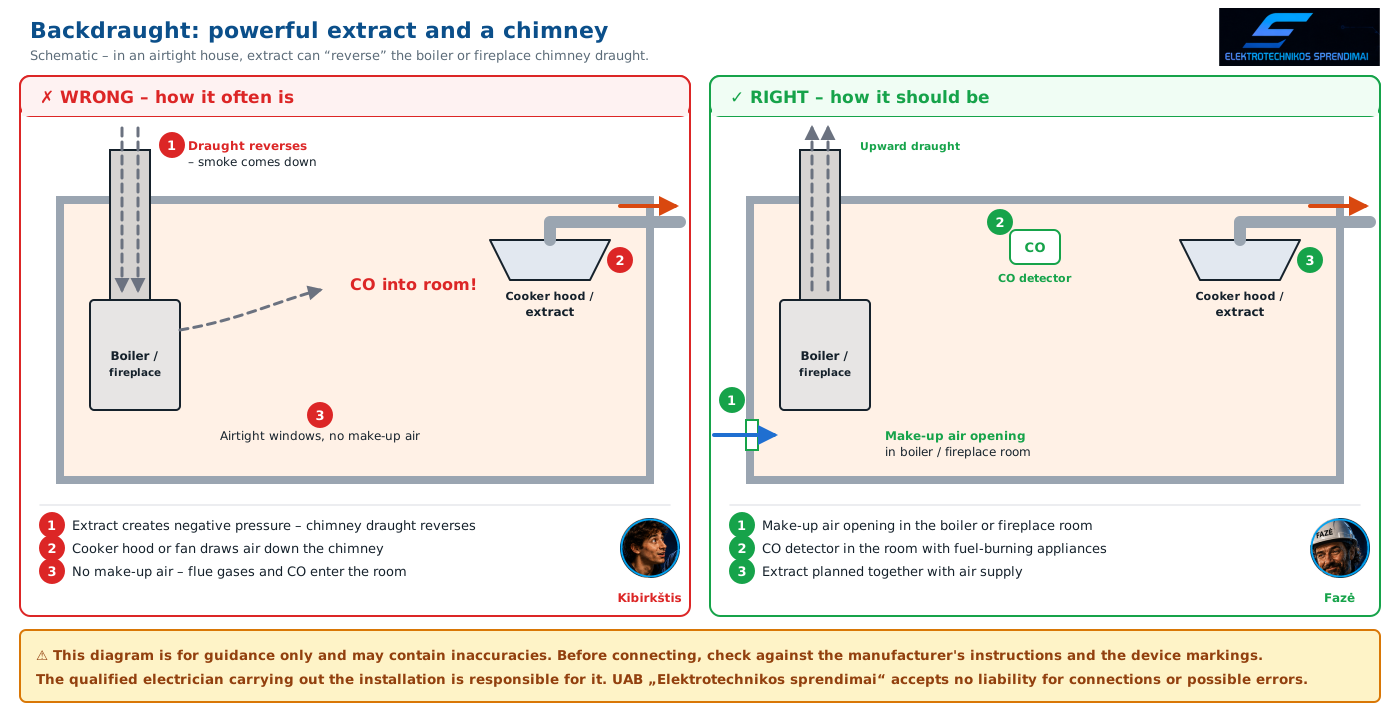 ☝ Click the diagram to open an enlarged version.⚠ This diagram is for guidance only and may contain inaccuracies. Before connecting, check against the manufacturer's instructions and the device markings.
The qualified electrician carrying out the installation is responsible for it. UAB „Elektrotechnikos sprendimai“ accepts no liability for connections or possible errors.Diagram 3. Automatic climate control. A CO2 sensor and a fan with humidity control ventilate when needed and as much as needed – without manual switching.
KibirkštisDo I have to switch the fan on by hand every time?
FazėNo need. The CO2 sensor and humidity sensor will tell the fan when to run and how hard.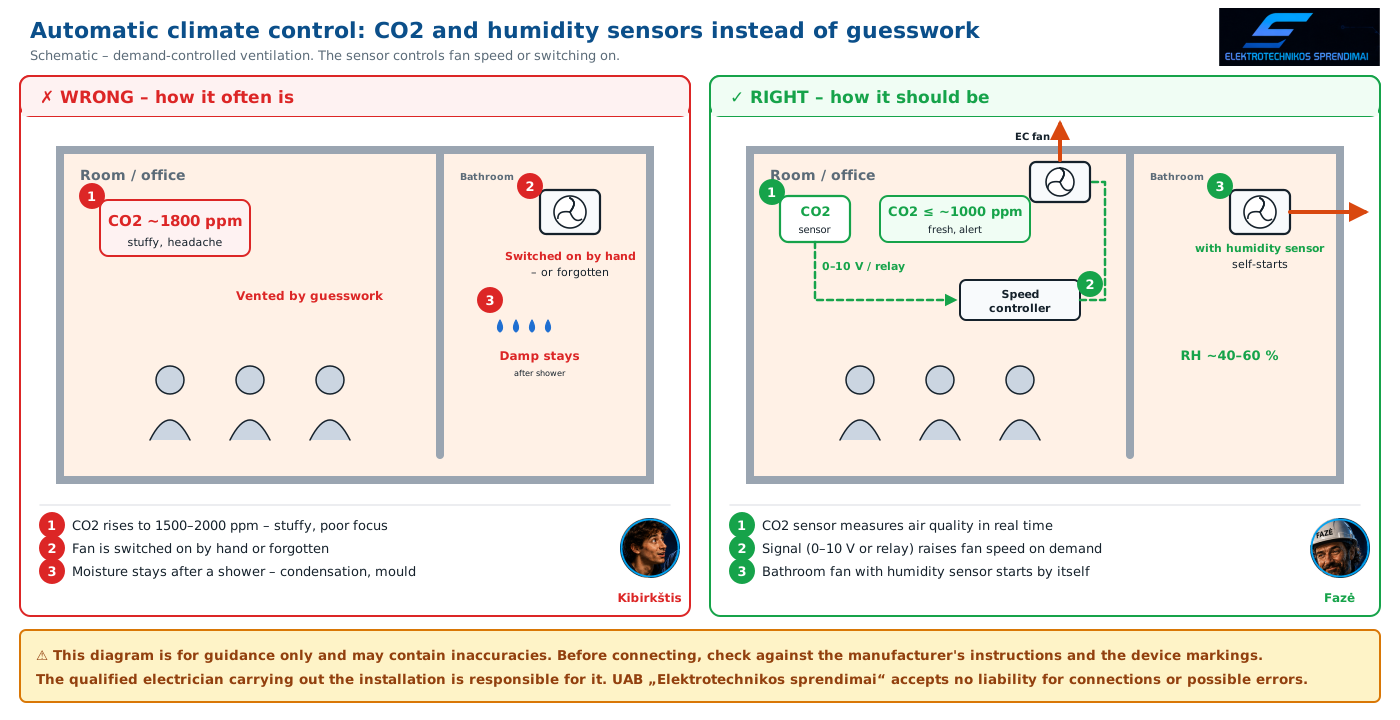 ☝ Click the diagram to open an enlarged version.⚠ This diagram is for guidance only and may contain inaccuracies. Before connecting, check against the manufacturer's instructions and the device markings.
The qualified electrician carrying out the installation is responsible for it. UAB „Elektrotechnikos sprendimai“ accepts no liability for connections or possible errors.Diagram 4. Insulated house and ventilation. An airtight insulated house without ventilation accumulates moisture and CO2. Decentralised heat recovery units supply fresh air and recover the heat.
KibirkštisWe insulated the house and replaced the windows – and now it is stuffy and the windows mist up. What did we do wrong?
FazėYou sealed the house but did not plan the ventilation. Decentralised heat recovery units will bring back fresh air and keep the heat.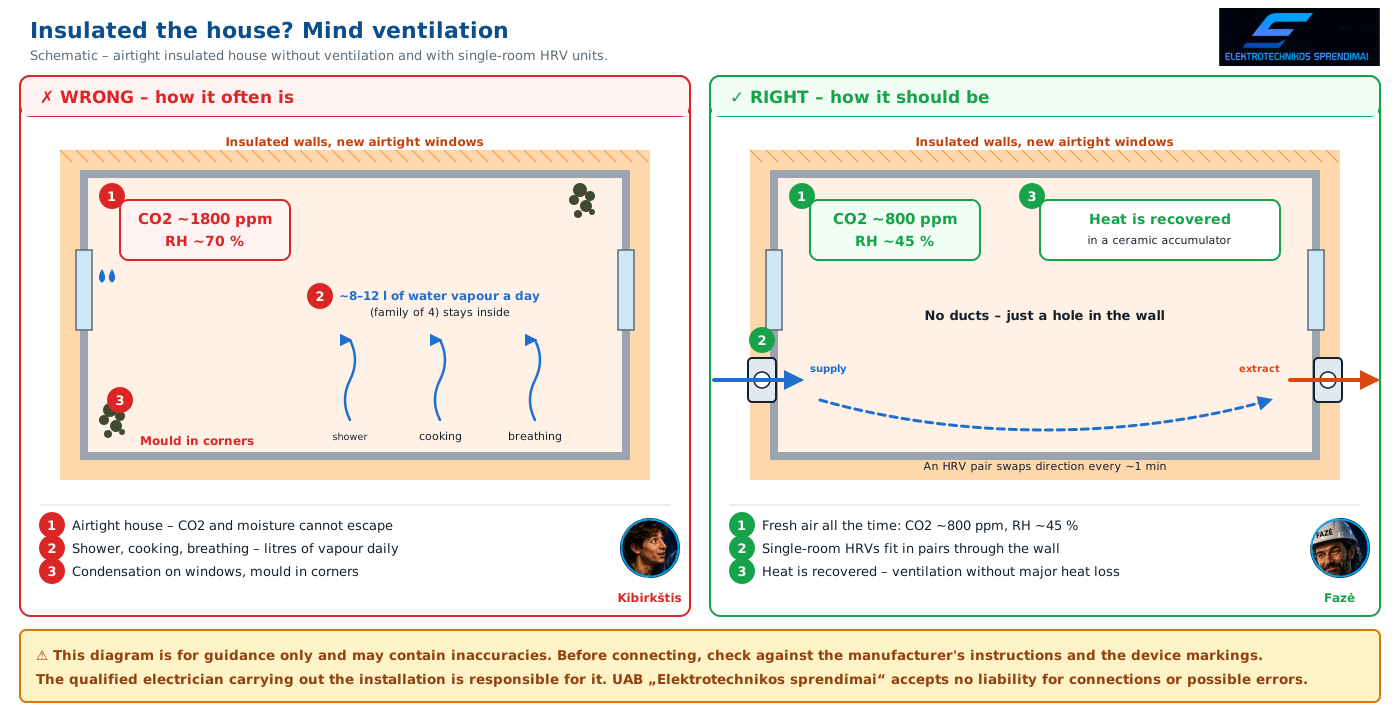 ☝ Click the diagram to open an enlarged version.⚠ This diagram is for guidance only and may contain inaccuracies. Before connecting, check against the manufacturer's instructions and the device markings.
The qualified electrician carrying out the installation is responsible for it. UAB „Elektrotechnikos sprendimai“ accepts no liability for connections or possible errors.Diagram 5. How a decentralised heat recovery unit works. Two phases: the extract air heats the ceramic accumulator, and the supply air is warmed by it.
KibirkštisHow does it supply fresh air without blowing the heat out?
FazėThe ceramic first stores heat from the extract air, and a minute later releases it to the incoming outdoor air.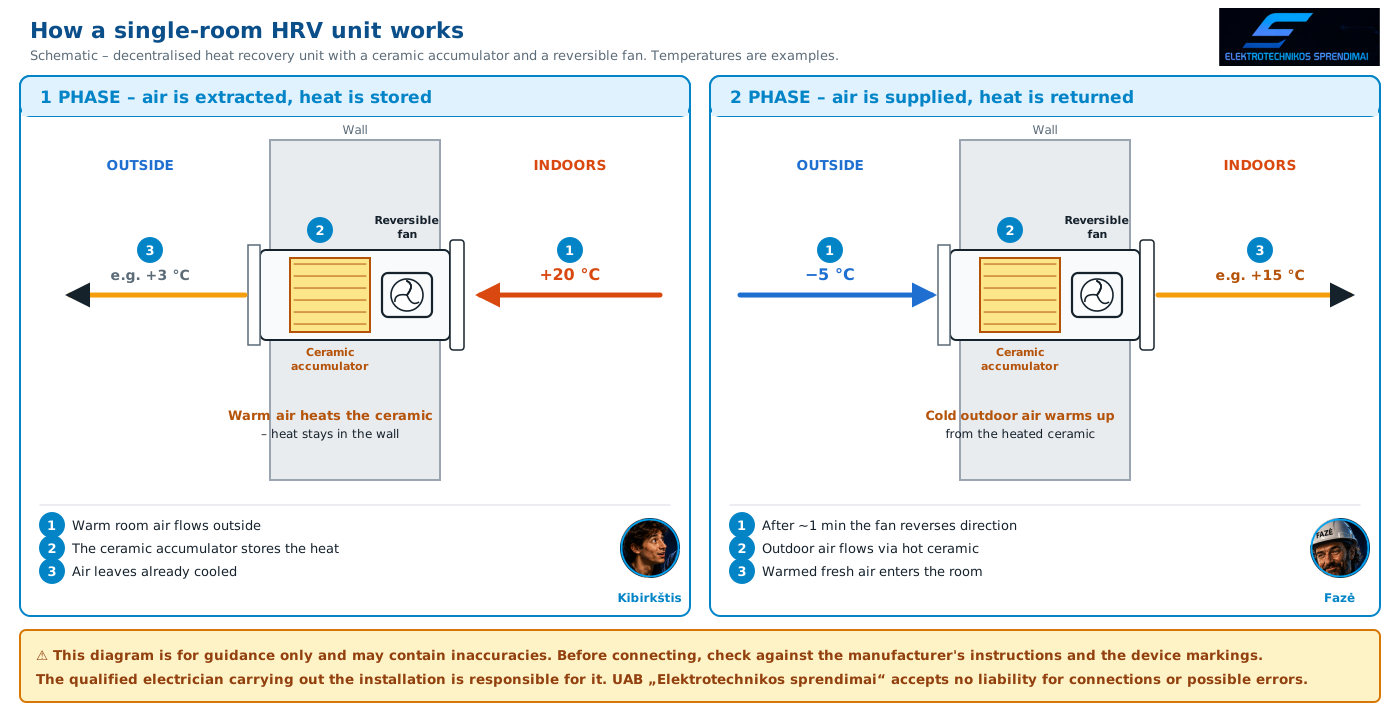 ☝ Click the diagram to open an enlarged version.⚠ This diagram is for guidance only and may contain inaccuracies. Before connecting, check against the manufacturer's instructions and the device markings.
The qualified electrician carrying out the installation is responsible for it. UAB „Elektrotechnikos sprendimai“ accepts no liability for connections or possible errors.Frequently asked questions
Asking: Kibirkštis – a young, curious electrician who dares to ask what others won't. Answering: Fazė – an experienced engineer.
KibirkštisDo trickle vents help prevent mould?
FazėThey do, but only together with extract ventilation. A trickle vent lets in dry outdoor air, which warms up in the room and absorbs moisture, and the extract in the kitchen, bathroom or WC carries it outside. Without extract, a trickle vent will not remove moisture, and without a trickle vent in an airtight house the extract has nowhere to draw air from (diagram 1). If the mould is caused by a thermal bridge or a damp structure, that has to be dealt with first.
KibirkštisHow is a heat recovery unit different from simple extract?
FazėSimple extract just throws the warm air out, and the fresh air comes in cold. A heat recovery unit uses the heat of the extract air to warm the supply air – ventilation runs continuously, but heat loss is much lower.
KibirkštisDecentralised heat recovery unit or a central system?
FazėA central ducted system suits new builds and major renovations. Decentralised heat recovery units are the choice when there is no room for ducting or it is too expensive: in a renovated flat, a house or a single room. They are installed in pairs through an external wall.
KibirkštisWhich sensor do I need after renovation?
FazėA combined one: PM2.5 / PM10 will show construction dust, TVOC / HCHO – vapours from paints, adhesives and new flooring, CO2 – whether ventilation is sufficient. Dust and vapours decrease gradually, so in the first weeks it is worth ventilating more intensively and using an air purifier with HEPA and activated carbon filters.
KibirkštisIs a powerful cooker hood dangerous in a house with a boiler or fireplace?
FazėIt can be. In an airtight house, extract creates negative pressure and can reverse the chimney draught – flue gases and CO enter the room. Provide a make-up air opening and a CO detector (diagram 2).
KibirkštisDo you help select components for a project?
FazėYes. Send us a room list, airflow figures or the project specification – we will select compatible components and send you a quotation. Contact us.We always have a solution for fresh air
Fans with humidity control, CO2 and air quality sensors, decentralised heat recovery units, ducting, filters and automation – all in one place. Send us a room list or floor plan: we will select compatible components and send you a quotation. Can't find the model or diameter you need in the catalogue? Some components are supplied to order.
Get a quotation


