Access panels with a transparent window
Access panels with a window are designed for convenient access to technical cavities, utilities, engineering systems, control units, equipment, or hidden structures, while also allowing you to visually inspect the space inside without opening the panel.
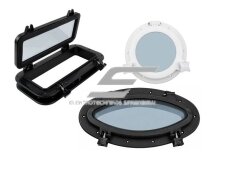
This product category may include panels of various dimensions, colors, and designs featuring a plastic frame and a transparent acrylic or other clear section. They can be installed in walls, partitions, technical cabinets, niches, equipment enclosures, storage systems, and other indoor or protected technical areas.
Important regarding application:
Panels in this category are intended for technical and inspection access. They are not inherently considered fire-rated, airtight, pressure-resistant, or suitable for aggressive outdoor environments unless explicitly stated in the specific product's technical data.
Important regarding dimensions:
Overall panel dimensions, the installation opening, and the internal usable access opening may differ. Before preparing the installation site, you must check the specific model's drawing and dimensions.
Key takeaway:
Choose an access panel with a window when you need quick access to a hidden technical space combined with the ability to visually inspect the interior without opening the cover. The appropriate model is selected based on overall and internal dimensions, frame material, window type, opening direction, locking mechanism, and installation environment.
Application
Inspection access
Window
Clear / transparent
Frame
Plastic or per model
Installation
In walls and technical cavities
Opening
Hinged / flip-open
Usage
For maintenance
What is an access panel with a window?
An access panel with a window is an openable access opening with a transparent section installed into a wall, partition, technical cabinet, or other structure. It not only allows access to the space behind the panel but also enables visual inspection of the components inside.
Such a solution is convenient in places where it is important to periodically check equipment status, indicators, valves, piping, metering devices, controllers, or other assemblies without opening the entire technical cabinet or finish.
Two functions in one:
An access panel with a window provides mechanical access alongside visual control through the transparent section.
Where are access panels with a window used?
-
In technical cabinets – for accessing equipment and control elements.
-
In utility shafts – for checking piping, valves, and communications.
-
In wall niches – for servicing hidden systems.
-
In electrical and automation areas – when indications or status need to be visible.
-
In HVAC systems – for access to dampers, regulators, or other assemblies.
-
In plumbing systems – for access to valves, meters, or connections.
-
In heating systems – for manifolds, control assemblies, or other equipment.
-
In technical boxes – for inspecting equipment and components.
-
In storage systems – when you need to see the internal space and access it if necessary.
-
In other service areas – where a small openable technical opening is required.
Purpose of the transparent window
The transparent window allows you to see the internal technical space without opening the panel. This is especially useful when the interior contains indicators, meters, mechanical position marks, or other information that needs to be checked periodically.
Depending on the model, the transparent part can be made of acrylic, polycarbonate, or another plastic material.
Practical advantage:
If you only need to check the equipment status, there is no need to open the panel every time. This can shorten inspection time and reduce unnecessary wear on latches and hinges.
Plastic frame
Some access panels are manufactured with a frame made of ABS or other technical plastic. This construction is lightweight, corrosion-resistant, and convenient for use in many indoor technical areas.
-
Low weight – does not overload the wall or technical structure.
-
Corrosion resistance – plastic does not rust like steel.
-
Easy maintenance – the surface is simple to clean.
-
Compact profile – suitable for small inspection openings.
-
Various colors – depending on the model, the frame can be white, black, or another color.
Operating environment:
The resistance of plastic to UV rays, high temperature, chemicals, and long-term outdoor exposure depends on the specific model. For outdoor use, check the manufacturer's technical data.
Hinged cover
The hinged cover remains connected to the frame by hinges, so when opened, it does not need to be completely removed and set aside separately.
This is convenient during maintenance when the internal equipment needs to be accessed briefly – to check, adjust, open a valve, or perform another service action.
Operating principle:
Latch released → cover hinged open → technical cavity accessed → cover closed → secured
Overall dimensions, installation opening, and internal opening
When choosing an access panel, it is important to distinguish between three different types of dimensions.
|
Dimension |
What does it mean? |
|
Overall dimensions |
The external dimensions of the entire product including the frame. |
|
Installation opening |
The opening in the wall, panel, or other structure required to install the panel. |
|
Internal usable opening |
The actual open space through which technical equipment is reached. |
Common mistake:
The size indicated in the product name does not necessarily represent the size of the internal access opening. Before cutting a wall or panel, you must check the dimensions of the specific model.
How to choose the right access panel?
-
Determine the installation location – wall, cabinet, niche, or technical structure.
-
Check overall dimensions – whether the panel fits in the intended space.
-
Check the installation opening – according to the specific model's drawing.
-
Evaluate the internal opening – whether it is sufficient to reach the equipment.
-
Check the window size – whether the required zone will be visible through it.
-
Choose the frame color – according to the environment and finish.
-
Evaluate the opening direction – so the cover does not interfere with surrounding elements.
-
Check the locking mechanism – simple, lockable, or other.
-
Evaluate environmental conditions – humidity, dust, temperature, and UV exposure.
-
Check technical data of the specific model – especially if a certain level of tightness is required.
General installation procedure
-
Choose the installation location. Make sure there are no interfering wires, pipes, or profiles behind the structure.
-
Check panel dimensions. Follow the specific product's technical drawing.
-
Mark the installation opening. Check its position and geometry.
-
Cut the opening. Do not damage adjacent structures.
-
Insert the panel. Check whether the frame fits evenly.
-
Secure the frame. Use fasteners appropriate for the specific base material.
-
Check cover movement. It must open and close freely.
-
Check the latch. The panel must lock securely.
-
Check visibility. The required technical zone must be visible through the window.
-
Perform a final inspection. Evaluate frame fit, mechanical firmness, and ease of use.
Before cutting the opening:
Check all dimensions at least twice. An access opening that is cut too large can later be difficult to adjust without additional finishing or structural work.
Maintenance
-
Periodically clean the frame and transparent window.
-
Do not clean the transparent part with rough abrasive agents.
-
Check hinge operation.
-
Check the latch or lock mechanism.
-
Inspect whether the plastic frame is cracked or deformed.
-
If a gasket is present, check its condition.
-
Avoid aggressive solvents that could damage acrylic or plastic.
-
If mechanical damage is noticed, evaluate whether it is safe to continue using the panel.
Common selection and installation mistakes
-
Overall dimensions are confused with the internal opening size.
-
The opening is cut without checking the technical drawing.
-
A panel that is too small for reaching the actual equipment is chosen.
-
The window is too small to see the desired indication or equipment.
-
The cover opening direction is not evaluated.
-
The plastic frame is screwed down too tightly and gets deformed.
-
Failure to assess whether the panel will be used in a humid or dusty environment.
-
A simple technical panel is assumed to be airtight without manufacturer confirmation.
-
Transparent acrylic is cleaned with aggressive solvents.
-
The thickness of the mounting surface is not evaluated.
-
The panel is installed in a location where the cover hits other equipment.
-
Failure to assess what size access will be needed for future maintenance.
Pros
-
✅ Convenient access to technical cavities.
-
✅ Ability to visually inspect the interior without opening the panel.
-
✅ Suitable for monitoring meters, indicators, and control elements.
-
✅ Compact design.
-
✅ Plastic models are lightweight and do not rust.
-
✅ Hinged cover does not need to be completely removed.
-
✅ Various dimensions and colors available.
-
✅ Can be installed in walls, partitions, and technical cabinets.
-
✅ Facilitates periodic maintenance.
-
✅ Transparent window helps determine equipment status faster.
Limitations
-
❌ Internal opening is smaller than overall product dimensions.
-
❌ Not all models feature sealing gaskets.
-
❌ Not all models are suitable for humid or dusty environments.
-
❌ Plastic can be sensitive to high temperatures and aggressive chemicals.
-
❌ Transparent window can get scratched.
-
❌ An incorrectly cut opening is difficult to make smaller.
-
❌ Over-tightening can deform the plastic frame.
-
❌ A simple access panel is not inherently fire-rated.
-
❌ A simple access panel is not inherently airtight.
-
❌ Outdoor installation requires separate evaluation of UV and environmental resistance.
Quick guide to choosing an access panel with a window
Choose an access panel with a window based on the installation location, required access size, and what you want to see through the transparent section. Before ordering, the most important things to check are overall dimensions, installation opening, internal opening size, and locking design.
For meters
Choose based on the visible zone
For valves
Choose a sufficient internal opening
For technical cabinets
Evaluate opening direction
For humid zones
Check tightness specifications
Suitable when you need to:
-
reach a technical cavity;
-
read meter values;
-
monitor equipment indication;
-
access valves or dampers;
-
service a plumbing assembly;
-
service heating system components;
-
install access in a technical cabinet;
-
install a neat inspection opening in a wall;
-
visually check the interior without opening the cover.
Check before ordering:
-
overall panel dimensions;
-
installation opening size;
-
internal usable opening size;
-
transparent window dimensions;
-
frame material;
-
window material;
-
frame color;
-
opening direction;
-
latch or lock type;
-
mounting surface thickness;
-
whether tightness is required;
-
whether the panel will be used in a humid environment;
-
whether UV resistance is required;
-
the specific product's technical drawing.
Important reminder:
An access panel with a window is primarily intended for technical access and visual control. If the project requires specific IP tightness, fire rating, mechanical resistance, or another certified property, it must be verified against the specific product documentation.
FAQ – frequently asked questions
What is an access panel with a window intended for?
It is designed for access to a technical cavity while also allowing visual monitoring of the equipment inside.
Where can it be installed?
In walls, partitions, technical cabinets, niches, equipment enclosures, and other service areas.
Is it suitable for a meter?
Yes, if the window size and panel design allow reading necessary values and accessing the meter for maintenance.
Is it suitable for water valves?
Yes. It is important to choose a sufficiently sized internal opening so that the valve is easy to reach and operate.
Is it suitable for a heating manifold?
It may be suitable for minor maintenance if the panel dimensions are sufficient. Larger manifolds may require a larger access solution.
What is the difference between overall dimensions and the internal opening?
Overall dimensions cover the entire product with the frame, while the internal opening indicates the real area through which the technical cavity can be reached.
Is the panel airtight?
Only if the manufacturer of the specific model specifies the corresponding tightness class or characteristics.
Can it be installed in a bathroom?
Only after evaluating the specific panel's resistance to moisture and the requirements applicable to the installation zone.
Can it be installed outdoors?
Only if the specific product's materials and design are suitable for outdoor conditions and UV, moisture, and temperature exposure.
Does a plastic panel rust?
No. Plastic does not rust like steel, but it can be affected by UV rays, temperature, and chemicals.
Can the transparent window get scratched?
Yes. Acrylic and similar materials are recommended to be cleaned with a soft cloth and non-abrasive products.
Can equipment indication be seen without opening?
Yes, this is one of the main functions of the transparent window.
What is most important to check before buying?
Overall dimensions, installation and internal opening size, window dimensions, frame and window materials, opening direction, latch, environmental conditions, and required tightness.


 1 - 8 of 8Access hatch with window | 130x323mm | plastic | whiteCode: ES-ALS993-01


