
-
Product Catalog
- Security and Surveillance Systems | accessories
- Lighting solutions for industrial | commercial | residential | outdoor environments | accessories
- Automation and Control Systems
- Smart Automated Products | Control | Transmission | Detection
-
Electrical distribution and installation
- Reactive Power Compensation Devices
- Electrical power | power cables | wires with copper conductors
- Electrical Distribution Panels, Boxes & Accessories
-
Modular equipment installed in electrical distribution boxes | panels
- Circuit breakers | installed in electrical distribution boxes | panels
- Power contactors | installed in electrical distribution boxes | panels
- Modular leakage relays | installed in electrical distribution boxes | panels
- Voltage relays modular | mounted in electrical distribution boxes | panels
- Current relays modular | installed in electrical distribution boxes | panels
- Power limiters modular | installed in electrical distribution boxes | panels
- Phase switch modular | mounted in electrical distribution boxes | panels
- Temperature controllers | modular thermostats | designed for mounting in electrical distribution boxes | panels
- Modular time relays | installed in electrical distribution boxes | panels
- Modular | panel | digital ammeters | voltmeters | for installation in electrical distribution boxes | cabinets
- Photo relays | twilight switches | mounted in electrical distribution boxes | panels
- Measurement monitoring electric energy monitoring equipment
- Modular control | signaling equipment | switches | indicator lamps | audible signals
- Automatic aerosol fire extinguishing systems for electrical cabinets and server rooms
- Modular liquid level control relays | for installation in electrical distribution boxes | switchboards
- Interface relays | modular for signal amplification and load control | for installation in electrical distribution boxes | panels
- Modular staircase lighting relays | for installation in electrical distribution boxes | panels
- Phase monitoring | sequence | protection relays, modular | for installation in electrical distribution boxes | panels
- Circuit breakers with residual current protection (RCBO) | for distribution boxes | panels
- Smart electrical network analyzers
- Reliable power management | stabilization | control | uninterrupted supply
- Fuse holder blocks
- Fuse disconnectors
- Fuses
- Electrical installation components
- Electric current transformers
- For domestic | professional use Extension cords | power supply extensions
- Industrial | domestic socket outlets | plugs | adapters for electricity supply
- High Voltage Equipment | Components 6kV | 10kV | 12kV | 20kV
- Underground Power Transmission | Overhead Power Lines
- Surge Protection and Lightning Protection
- Solar Energy Generation and Management Equipment
- HVAC control solutions for heating and ventilation
- Accessories for cars
- Workplace Safety | Electrical Safety Equipment | LOTO
- Technical maintenance | service equipment | fire protection solutions
- Emergency safety | hygiene | sanitary solutions
- Other products
- Quality used products
-
Manufacturer



































Temperature controllers | modular thermostats | designed for mounting in electrical distribution boxes | panels
-
Modular temperature controllers and thermostats are advanced devices designed to monitor and control temperature in various systems. They are essential for maintaining proper temperature in industrial, commercial, and residential environments, where temperature fluctuations can significantly impact equipment performance, energy consumption, and indoor comfort.
-
Read moreTEMPERATURE CONTROL · HEATING AND COOLING CONTROL · DIN MODULAR EQUIPMENT
Modular thermostats and temperature controllers | selection and installation guide
How to choose the right temperature controller by temperature range, sensor type, hysteresis, supply voltage, relay contacts and heating or cooling load.
DIN 35Mounting in a distribution boardNTC / PTCSensors according to controller typeHeatingAutomatic temperature maintenanceCoolingFan and cooling control
 Kibirkštis asks, Fazė answers – practical explanations of temperature automation.Key idea
A modular thermostat is a temperature-controlled switching device for an electrical circuit. It compares the temperature value received from the sensor with the set value and changes the output state according to the control algorithm. The thermostat itself does not heat or cool – it controls the heater, fan, contactor or other actuator connected to the system. Suitability is determined by the temperature range, sensor characteristic, hysteresis, output contacts and the electrical parameters of the load.
Quick thermostat selection by application
When choosing a temperature controller, first determine what function it will perform: maintain heat, switch on cooling, monitor the temperature of technical equipment or send a signal to the automation system.
Application Thermostat selection direction What must be checked? Electric heater control Heating-mode thermostat with a compatible relay output Supply voltage, load power, contact category Electric underfloor heating Thermostat with a suitable external floor temperature sensor NTC characteristic, floor temperature limitation, contactor Distribution board heating Heating thermostat suitable for the enclosure environment Sensor location, condensation, temperature range Distribution board fan Cooling-mode thermostat Does the contact close when the temperature rises? Industrial process monitoring Electronic or digital controller Measurement accuracy, sensor, control output Overheating alarm Temperature limit monitoring relay with a suitable alarm function Fault response, contacts, need for independent safety Important: not all thermostats can control heating and cooling equally. This requires an appropriate output contact configuration or a clearly defined operating mode. The purpose of the thermostat relay's NO / NC contacts must be assessed according to the specific wiring diagram.Technical parameters and controller designs
The technical characteristics of modular temperature controllers vary. The category may include both simpler thermostats with an adjustment knob and electronic temperature relays designed for external sensors, relay control and additional automation functions.
Parameter Value Selection note Mounting 35 mm DIN rail Check the module width and the board design Setting range Depends on the model, e.g. −5…+40 °C This is not always the same as the permissible ambient temperature Power supply AC, DC or universal AC/DC Check the voltage range and terminal diagram Sensors NTC, PTC or others depending on the product The sensor's electrical characteristic must match Output Relay NO / NC / C/O or other Check the output function and contact load Hysteresis Fixed or adjustable Affects switching frequency Indication LED, LCD or no display An LED does not necessarily mean a temperature readout Protection rating E.g. IP20 Does not mean the device is water-resistant Additional functions Programming, alarm, delay – depending on the model There is no universal function for all thermostats Example of a specific modular thermostat model – FRT11
“Promfactor Baltic” FRT11 – a DIN rail temperature controller with an NTC sensor, suitable for heating and underfloor heating control systems according to its wiring diagram.
FRT11 parameter Value Setting range −5…+40 °C Supply voltage 24–240 V AC/DC, 50/60 Hz for alternating current Temperature sensor NTC, external Sensor cable 2.5 m Adjustment Temperature and hysteresis Output contact 1 changeover C/O Contact rating Product page states 16 A; check the load against the contact characteristics Indication Power and relay status LED Module width 2 modules Protection rating IP20 View the FRT11 thermostat at elsprendimai.eu →
What is thermostat hysteresis and why does it matter?
Hysteresis – the temperature interval between the switch-on and switch-off thresholds. It protects the control system from excessively frequent switching when the measured temperature fluctuates very close to the set threshold.
Heating mode exampleThe desired set temperature is 22 °C, and the control differential is 2 °C. In one of the possible control schemes, the heater switches on when the temperature drops to 20 °C and switches off when it reaches 22 °C.
This is an illustrative operating principle. Some controllers apply hysteresis symmetrically around the set temperature, while others use a different algorithm.
Small hysteresisSmaller temperature fluctuations, but potentially more frequent switching of the relay or contactor.
Large hysteresisThe load is switched less often, but the temperature may deviate more from the set value.
The hysteresis setting depends on system inertia, sensor location, load power and process requirements. Underfloor heating and systems with high thermal inertia may require a different control strategy than a fast-heating electric heater.
Temperature sensors: NTC, PTC, PT100 and PT1000
Temperature measurement depends on the sensor design. Different sensor types use different principles of electrical resistance change with temperature and are not universal substitutes.
Sensor type Operating principle Important when choosing NTC Resistance decreases as temperature rises. Check the nominal resistance and B coefficient / characteristic. PTC Resistance increases as temperature rises. Different PTC designs have different characteristics. PT100 Platinum resistance sensor, nominally 100 Ω at 0 °C. Requires a measuring input that supports PT100. PT1000 Platinum resistance sensor, nominally 1000 Ω at 0 °C. Cannot directly replace a PT100 without input compatibility. Rule of thumb: two NTC sensors can have different characteristics even if they have the same number of wires. An incorrectly selected sensor can show an incorrect temperature and control the heating incorrectly.Where to install the temperature sensor?
The sensor must measure the temperature that is relevant to the controlled system. If room temperature is measured, it must be protected from direct sunlight, local heat sources and intense airflow. If a pipe or surface is measured, proper thermal contact and mounting method are essential.
The sensor cable must be routed according to the instructions of the specific controller. It must not be arbitrarily extended, shortened or laid next to power cables that cause interference without considering the permissible length, insulation and electromagnetic compatibility.
Where are modular thermostats used?
Residential heatingFor automatic control of electric heaters, underfloor heating and auxiliary heating systems.
Distribution board heatingFor switching on heating elements when the risk of low temperature or condensation must be reduced.
Ventilation and coolingFor controlling fans and cooling equipment when a set temperature threshold is reached.
Industrial automationFor temperature monitoring, control or signalling of equipment and technological processes.
Modular thermostat, room thermostat or temperature protection relay?
Device Main function When to choose? Modular thermostat Temperature control by a controller mounted in the distribution board. When control automation is concentrated in a distribution or control panel. Room thermostat Room temperature measurement and user control. When convenient temperature setting is needed in the room. Temperature monitoring relay Response to set temperature limits. When a monitoring or alarm function is important. Independent temperature limiter Protective shutdown at a dangerous temperature. When such a protective function is required for specific equipment. Control and safety are not the same. A standard temperature-maintaining thermostat is not automatically certified for independent protection against dangerous overheating. If a heating appliance requires a safety thermostat or temperature limiter, it must be provided separately according to the system requirements.Installation in a distribution board – key principles
1. Choose the control functionHeating, cooling or temperature limit monitoring.
2. Check the power supplyThe controller's supply voltage must match the electrical circuit.
3. Mount on the DIN railFix the device according to its mechanical design and the board requirements.
4. Connect the sensorUse only a compatible sensor and the measuring terminals intended for the product.
5. Connect the loadDirectly via the relay or via a contactor, if required.
6. Set the temperatureSelect the temperature threshold and a suitable hysteresis.
7. Check operationMake sure the load switches on and off under the intended conditions.
8. Check safetyAssess wiring protection, contactor, disconnection and thermal risk.
Potential-free contact: a relay C/O output does not necessarily supply voltage. If the contact is potential-free, the load supply circuit must be connected according to the control diagram. Applying voltage to the sensor terminals by mistake may damage the controller.Electrical safety: installation and connection work is carried out by qualified specialists after disconnecting the power supply and verifying the absence of voltage. A temperature controller does not replace a circuit breaker, residual current protection or other safety devices required in the system.Diagram: wrong and right – controlling a heating load with a thermostat
✗ WRONGThermostat with relay output↓Load too high or of an unsuitable typeRelay contact characteristics not considered↓Risk of contact overheating or failureThe rated contact current alone is not enough if the load does not match the contact utilisation category.
✓ RIGHTTemperature controller↓Properly selected relay contact or contactorControl voltage and load characteristics verified↓Reliable heating or cooling controlLoad switching is coordinated with the thermostat output and the requirements of the entire electrical system.
What heater power can a thermostat relay control?
Voltage and power are used to calculate the current of a simple resistive load. However, the resulting current must be compared with the characteristics of the specific thermostat's relay output, inrush current, switching frequency and electrical utilisation category.
Single-phase resistive load formulaI = P / UI – current in amperes, P – power in watts, U – supply voltage in volts.Heater power Current at 230 V Selection note 500 W 2.17 A Check the permissible contact load 1000 W 4.35 A Check the relay and protection 1500 W 6.52 A Check the heater type 2000 W 8.70 A Check the relay contact category 3000 W 13.04 A A contactor may be required 3500 W 15.22 A Do not automatically equate with a 16 A contact rating The table applies to a 230 V single-phase resistive load. It does not determine the permissible power of the thermostat and does not apply directly to motors, transformers or other types of load.
When to use a contactor?
A contactor is used when the thermostat's relay output is not suitable for directly switching a load of the intended power or type. In that case, the thermostat relay controls the coil of a contactor with a suitable voltage, and the contactor's power contacts switch the supply of the heater or other device.
Important: the contactor coil is also an electrical load. Its inrush and holding characteristics must be matched to the thermostat's relay output. Using a contactor does not eliminate the need for overcurrent protection and independent thermal safety.Most common temperature controller selection mistakes
✗ Wrong ✓ Right The thermostat is chosen based on price alone. Check the temperature range, sensor, output and control mode. An NTC sensor with an unsuitable characteristic is used. Use a compatible sensor. A 16 A relay is considered suitable for any 16 A load. Assess the nature of the load and the contact utilisation category. The sensor is mounted next to the heater. Measure the temperature relevant to the controlled system. Hysteresis is ignored. Choose a suitable temperature differential and switching frequency. A standard thermostat is used as the only overheating protection. Provide the mandatory independent safety functions. The enclosure IP and ambient temperature requirements are not considered. Install the thermostat in an enclosure that matches its operating conditions. Advantages and limitations of modular thermostats
Pros- Automatic temperature maintenance.
- Convenient DIN rail mounting.
- Less need to switch heating on manually.
- Ability to control the load via a contactor.
- Different control functions depending on the model.
- Ability to automate the microclimate of technical rooms and equipment.
Cons and limitations- A compatible sensor is required.
- An incorrect sensor location distorts control.
- Relay contacts have load limits.
- A separate contactor may be needed.
- Not all models have a display or programming.
- A standard thermostat does not replace emergency overheating protection.
Technical standards and safety requirements
- IEC / EN 60730-1 – general requirements for automatic electrical controls.
- IEC / EN 60730-2-9 – particular requirements for temperature sensing controls, where relevant to the specific product.
- IEC / EN 60715 – dimensions of standardised DIN mounting rails.
- IEC / EN 60529 – IP protection rating system.
- LST HD 60364 – requirements for low-voltage electrical installations.
- IEC / EN 60947 relevant parts – where applicable to contactors and other industrial control devices.
The application of standards depends on the intended use of the specific product and the declared conformity. The wiring diagram, relay contact loads, sensor compatibility and operating limits must comply with the technical documentation of the selected device.
FAQ – Kibirkštis asks, Fazė answers
10 practical questions about modular thermostats, temperature control, hysteresis, NTC sensors, relay contacts and control of heating and cooling systems.
Kibirkštis asks · 01 How does a modular thermostat differ from an ordinary room thermostat?
Fazė answers A modular thermostat is mounted on a DIN rail in an electrical distribution or automation panel. A room thermostat is usually mounted in the room so that the user can set the desired temperature. A modular model is convenient for centralised circuit control and for operation with external sensors.
Kibirkštis asks · 02 Can a modular thermostat control electric underfloor heating?
Fazė answers Yes, if the controller is designed for such a system and a compatible floor temperature sensor is used. The heating element power, contact load and maximum floor temperature limitation must be assessed. Higher loads may require a separate contactor and, in some cases, independent overheating protection.
Kibirkštis asks · 03 What does thermostat hysteresis mean?
Fazė answers It is the temperature difference between the switch-on and switch-off points. Hysteresis reduces excessively frequent relay switching when the temperature fluctuates close to the set point. A small hysteresis allows a narrower temperature band to be maintained, while a larger one usually reduces the number of switching operations. The specific operating algorithm depends on the thermostat.
Kibirkštis asks · 04 Can I connect any NTC sensor to a DIN thermostat?
Fazė answers No. NTC sensors can have different nominal resistances and different resistance-temperature characteristics. If the characteristic does not match the thermostat measuring input, the temperature will be displayed or evaluated incorrectly. The sensor specification, cable length and controller requirements must be checked.
Kibirkštis asks · 05 If the thermostat is rated 16 A, can it control a 3500 W heater?
Fazė answers A 3500 W resistive load at 230 V draws about 15.22 A, but this is not enough to confirm a direct connection. The permissible contact load, inrush current, switching frequency and operating conditions must be checked. If direct control is unsuitable, the thermostat controls the contactor coil and the contactor switches the heater supply.
Kibirkštis asks · 06 Can the same thermostat control a heater and a fan?
Fazė answers It depends on the output contacts and the control algorithm. A changeover C/O contact can be used for different control functions, but the state and load of each contact must be assessed according to the product diagram. If independent heating and cooling control with different temperature limits is required, two thermostats or a dedicated two-channel controller may be needed.
Kibirkštis asks · 07 Is the FRT11 temperature controller suitable for a 230 V mains network?
Fazė answers Yes. The FRT11 supply voltage range is 24–240 V AC/DC, so a 230 V AC supply falls within the specified limits. However, the controller supply terminals, sensor input and relay output contacts must be distinguished. All of them are connected according to the specific device diagram.
Kibirkštis asks · 08 Will the thermostat protect the heater against dangerous overheating?
Fazė answers An ordinary control thermostat maintains the set temperature but does not necessarily provide an independent safety cut-off. If the equipment requires protection against dangerous overheating, a separate safety temperature limiter or another approved safety system is usually required. A control thermostat alone cannot be regarded as universal protection against all faults.
Kibirkštis asks · 09 Why does the thermostat switch the heating on and off too often?
Fazė answers Possible causes – hysteresis too small, unsuitable sensor location, an oversized heater or temperature fluctuations around the sensor. It is also important to check whether a sensor with the correct characteristic is used. Before changing the settings, assess the thermal inertia of the heating system and the thermostat operating algorithm.
Kibirkštis asks · 10 What do you need to know before buying a modular temperature controller?
Fazė answers Specify what you will control – a heater, underfloor heating, a fan or other equipment. The supply voltage, load power, temperature range, sensor type, required hysteresis and whether a contactor will be used are also important. With this information, a thermostat matching the real requirements of the electrical system can be selected. Kibirkštis and Fazė remind youThe temperature controller and its sensor must work as a matched system. Check the temperature range, sensor characteristic, relay contact load, control mode and mandatory independent protective functions.
Modular thermostats for heating and cooling systems
Choose temperature controllers for electrical distribution and automation panels. Specify the required temperature range, controlled load, supply voltage and sensor type – we will help you choose the right solution.
View modular thermostats Contact usConnection of electrical equipment, temperature control and protective measures must comply with the installation and safety requirements of the specific device.
Functionality:
Temperature controllers and thermostats continuously measure the ambient temperature and automatically adjust heating, cooling, or air conditioning systems to maintain the set temperature. If the temperature falls below or rises above the established limits, the device responds and activates the corresponding system, ensuring temperature control.
Key Features:
Wide Temperature Measurement Range: Modular temperature controllers and thermostats can measure various temperature ranges, from very low to high temperatures, making them adaptable to various applications.
Sensitivity Adjustment: Users can set different temperature sensitivity levels, allowing the device to respond to temperature changes, optimizing system performance.
Multiple Functions: These devices may include additional features such as timers, programming, digital readings, and even remote control options, enabling users to manage systems more effectively.
LED Indicators: Most modular temperature controllers and thermostats have LED indicators that inform about the operational status of the device, as well as the set and actual temperature.
Compact Design: These devices are typically mounted on DIN rails, allowing for easy integration into existing electrical systems and saving space.
Testing Function: Many models include test buttons, enabling users to periodically check the device’s operation and ensure it functions efficiently.
Safety Features: Some models are designed with additional protective functions, such as automatic shutdown if the temperature exceeds set limits.
Applications: Modular temperature controllers and thermostats are widely used in various fields:Industry: Ensure that the temperature of industrial equipment is optimally maintained to prevent failures and improve manufacturing processes.
Climate Control Systems: Used in heating, cooling, and air conditioning systems to ensure comfort indoors.
Residential Systems: Maintain the desired temperature at home, helping to reduce energy costs and ensure comfort.
Advantages:Energy Efficiency: Effectively manages heating and cooling systems, helping to reduce energy costs.
Convenience: Automatic temperature regulation ensures comfort in residential and working environments.
Easy Installation: Compact design allows for easy integration of devices into existing systems, saving time and effort.
Disadvantages:Cost: Modular temperature controllers and thermostats may be more expensive than simpler models, but their functionality and safety levels often justify the investments.
Technical Knowledge Required: Although installation is not complicated, some technical knowledge may be needed to properly configure the device.
Incorrect Usage: Incorrectly configured devices may fail to respond adequately to temperature changes, leading to inconvenience.
Modular temperature controllers and thermostats are effective tools for ensuring temperature control in various systems. They help optimize energy consumption by ensuring that the temperature is consistently maintained and tailored to user needs. 1 - 1 of 1
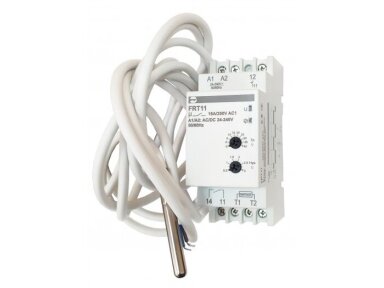
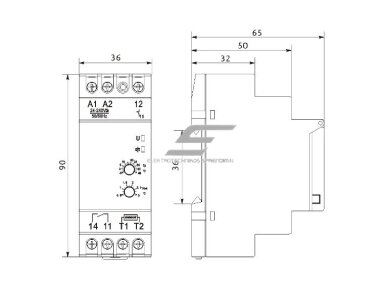

 Modular thermostat | temperature controller | relay | -5...+40°C | 16A | 24-240VAC/DC | DIN | IP20 | Promfactor Baltic | FRT11 | 4772151003099Code: PF-FRT11
Promfactor Baltic FRT11 – a modular electronic temperature controller (thermostat) with an external NTC sensor, designed to control heating equipment, underfloor heating and other temperature maintenance systems. The temperature can be adjusted within the −5...+40 °C range, power supply – 24–240 V AC/DC, relay contact – up to 16 A. The thermostat is mounted on a 35 mm DIN rail and features adjustable hysteresis, LED indication and a 2.5 m NTC sensor cable.
Price 22.40 € VAT incl.( 18.51 € VAT excl. )


Information