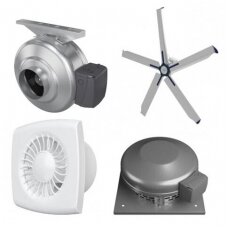
Fans for ventilation systems
-

Fans for ventilation systems are essential components that ensure the movement of air flows in buildings, supplying fresh air and removing contaminated air from various rooms. They are widely used in residential, commercial, and industrial buildings where good air quality and temperature control are important.
Main Types of Fans:
Centrifugal Fans: These fans operate on the principle of centrifugal force. They draw air into the center and expel it through the side, creating a strong airflow. These fans are commonly used in larger ventilation systems that require high pressure and strong airflow.
Usage: Industrial facilities, commercial buildings that require long-distance air supply or removal.Axial Fans: Axial fans rotate around their axis, pushing air straight forward. They are efficient in high-volume, low-pressure systems.
Usage: Indoor ventilation, such as bathrooms, kitchens, offices, and smaller buildings.Roof Fans: Installed on the roofs of buildings, they help remove warm air, smoke, or gases from the interior of the building. Most commonly used in industrial facilities or large commercial spaces.
Usage: Industrial facilities, large buildings where effective smoke or warm air removal systems are needed.Duct Fans: These fans are installed in duct systems, usually between pipes. They are used in larger ventilation systems where air flow through ducts needs to be ensured.
Usage: Residential spaces, offices, shopping malls.Ceiling Fans: These are specialized fans that are mounted directly on the ceiling. They are often used in smaller spaces.
Usage: Offices, bathrooms, small rooms.Key Parameters:
Air Flow (m³/h):
The power of the fan is usually measured by the volume of air it can move in cubic meters per hour (m³/h). This allows for determining how efficiently the fan can transport air. Depending on the type of fan, airflow can vary – smaller fans provide lower airflow, while larger industrial models can reach thousands of cubic meters per hour.Pressure (Pa):
Pressure indicates the air resistance that the fan can overcome. High-power fans (e.g., centrifugal) have a greater pressure capacity, making them suitable for longer duct systems.Noise Level (dB):
Fans produce some noise due to moving components. This is important in residential or work environments where noise levels need to be minimal. Smaller fans (e.g., axial) typically operate more quietly, while larger models may generate more noise.Power Consumption:
Fans can operate at different power levels, from a few watts (W) to several hundred watts for industrial models. Newer models are often energy-efficient, using minimal electricity.Protection Class (IP rating):
The IP rating indicates the fan's resistance to dust and moisture. For example, fans with an IP44 or IP65 classification are suitable for use in damp environments, such as bathrooms or outdoor ventilation systems.Additional Features:
Backdraft Damper:
Prevents air from returning to the space when the fan is off. This is especially important in residential areas where unwanted air return needs to be avoided.Timer:
Used to set the fan to operate for a certain time after being turned on.Humidity Sensor:
Such fans automatically turn on when the humidity level in the room increases, for example, in bathrooms or basements.Advantages:
Ensuring Air Quality: Fans remove contaminated air and ensure a supply of fresh air, helping to maintain a healthy environment.
Energy Savings: Many modern fans use energy-efficient motors that reduce electricity costs.
Temperature Control: An effective fan helps prevent heat buildup and maintains optimal room temperature.
Disadvantages:Noise: Depending on the type of fan, the noise level can be an issue in certain spaces.
Initial Investment: Larger and more powerful fans may require a higher initial investment.
Fans are an essential part of ventilation systems, ensuring good airflow and a comfortable microclimate in rooms.Fans are divided into domestic exhaust fans and industrial fans. Domestic exhaust fans are most commonly used in bathrooms, kitchens, or toilets for the removal of dirty or humid air. Domestic mixed airflow fans are also available in two-speed options, where the speed can be changed using a switch or toggle. Industrial fans include roof fans, duct fans, and kitchen fans. Duct centrifugal fans can be round or rectangular. Depending on the fan's power and control principles, speed regulators or frequency converters are used for fan control.
How to select a fan: step by step
- Determine the required airflow (m³/h) for each room – based on its use, number of occupants or volume (indicative values are in the HVAC guide table “How much air is needed”).
- Select the duct diameter based on the airflow and the permissible air velocity. Too small a diameter means noise and high resistance.
- Estimate the duct run resistance (Pa): duct length, bends, filter, dampers, silencer, diffusers, grilles.
- Select the fan by its duty point – on its performance curve, the required airflow must be achieved at the calculated pressure, ideally in the middle part of the curve.
- Complete the duct run: backdraft damper (to prevent air flowing back), filter (to protect the fan and the room), silencer (for living spaces and offices).
- Plan the control: switch, timer, speed controller, sensor or controller. Check the supply voltage and control signal (ON/OFF, 3-point, 0–10 V).
- Match the electrical side: protective devices, cables and, if required, a contactor and motor protection.
Most common questions
 KibirkštisHow do I calculate which fan I need?
 FazėAdd up the airflows of all rooms (m³/h), estimate the duct run resistance and choose a fan whose curve reaches the required airflow at the real pressure. It is convenient to have a ~20–30 % reserve and turn the speed down.
KibirkštisWhat is the difference between in-line, centrifugal and domestic fans?
FazėA domestic fan is mounted in a wall or ceiling and serves a single room with a short duct. An in-line fan is installed directly in the duct run and can handle a longer run; depending on the impeller type it can be axial, mixed-flow or centrifugal. Centrifugal (radial) fans generate the highest pressure – they are intended for long runs with filters and silencers and for industrial systems.
KibirkštisCan the fan speed be controlled?
FazėYes, if the motor is designed for it: AC fans – with a thyristor or transformer speed controller, EC fans – with a 0–10 V signal. Before buying, check the control method specified by the manufacturer.
KibirkštisIs an EC fan worth the higher price?
FazėIn a continuously running system – usually yes: EC motors use less energy, especially at part load, and are precisely controlled with a 0–10 V signal.
KibirkštisHow many decentralised heat recovery units do I need?
FazėIt depends on the required airflow (HVAC guide table “How much air is needed”) and the capacity in heat recovery mode stated by the manufacturer. Usually one pair covers one or two rooms. Send us your floor plan – we will do the calculation.
FazėAdd up the airflows of all rooms (m³/h), estimate the duct run resistance and choose a fan whose curve reaches the required airflow at the real pressure. It is convenient to have a ~20–30 % reserve and turn the speed down.
KibirkštisWhat is the difference between in-line, centrifugal and domestic fans?
FazėA domestic fan is mounted in a wall or ceiling and serves a single room with a short duct. An in-line fan is installed directly in the duct run and can handle a longer run; depending on the impeller type it can be axial, mixed-flow or centrifugal. Centrifugal (radial) fans generate the highest pressure – they are intended for long runs with filters and silencers and for industrial systems.
KibirkštisCan the fan speed be controlled?
FazėYes, if the motor is designed for it: AC fans – with a thyristor or transformer speed controller, EC fans – with a 0–10 V signal. Before buying, check the control method specified by the manufacturer.
KibirkštisIs an EC fan worth the higher price?
FazėIn a continuously running system – usually yes: EC motors use less energy, especially at part load, and are precisely controlled with a 0–10 V signal.
KibirkštisHow many decentralised heat recovery units do I need?
FazėIt depends on the required airflow (HVAC guide table “How much air is needed”) and the capacity in heat recovery mode stated by the manufacturer. Usually one pair covers one or two rooms. Send us your floor plan – we will do the calculation.Wiring diagram
Diagram 1. Bathroom fan with timer. For the timer to work, the fan must receive a permanent live, and the switch must only trigger it via the LT terminal.
KibirkštisI switch off the light – and the fan stops immediately. Is the timer faulty?
FazėMost likely not. The fan must receive a permanent live on L, and the switch only triggers it via LT.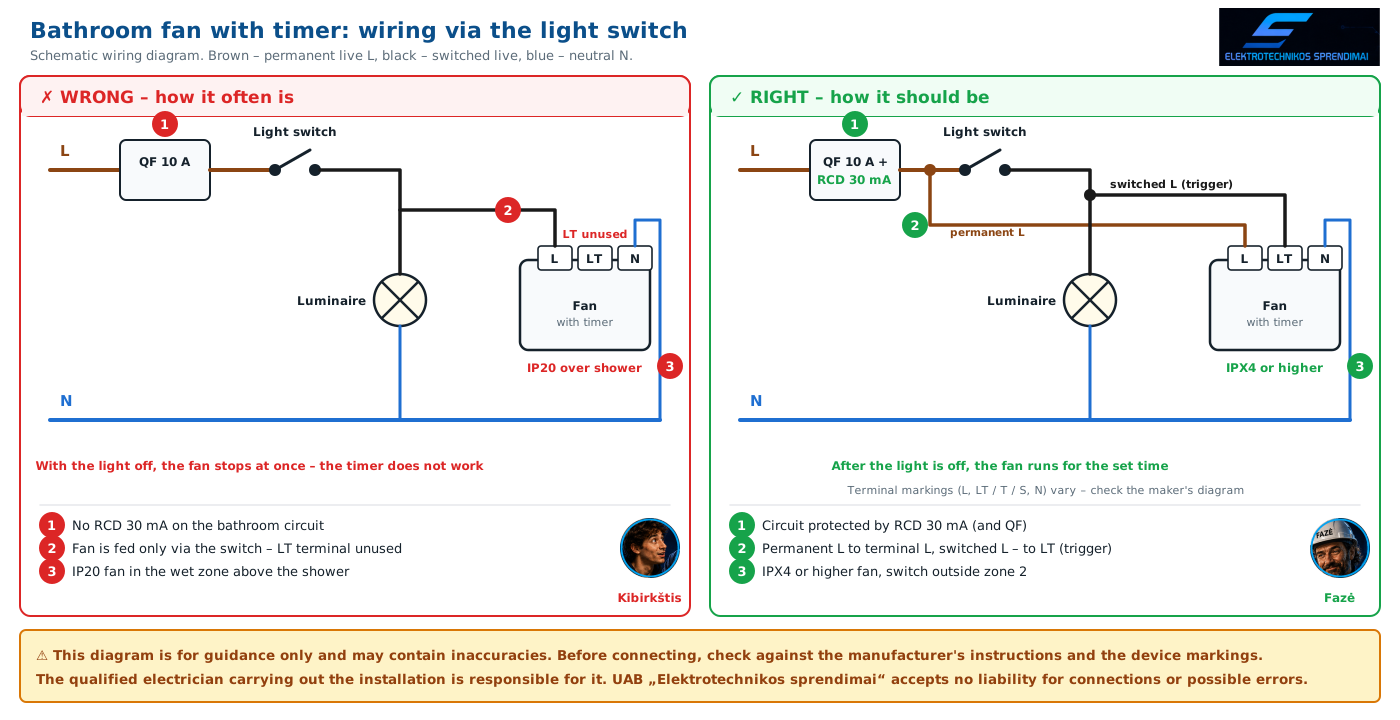 ☝ Click the diagram to open an enlarged version.⚠ This diagram is for guidance only and may contain inaccuracies. Before connecting, check against the manufacturer's instructions and the device markings.
The qualified electrician carrying out the installation is responsible for it. UAB „Elektrotechnikos sprendimai“ accepts no liability for connections or possible errors.← Back to the HVAC guide · Get a quotation