


Preformed helical anchor clamps for overhead lines
-
Preformed Spiral Anchor Clamps for Overhead Lines
Preformed spiral anchor clamps are mechanical fastening elements designed to secure, tension or anchor overhead-line conductors, cables or other compatible linear elements at a support point. The clamp consists of several metal wires preformed into a spiral shape, which are wrapped around the conductor during installation to create a stable mechanical fastening assembly.
This product group includes spiral anchor clamps with different lengths, wire diameters and numbers of spiral wires. The specific model must be selected according to the construction, outside diameter and mechanical load of the conductor or cable, as well as the installation conditions.
Important compatibility information:
The spiral anchor clamp must be selected according to the specific diameter and construction of the conductor or cable. A visually similar clamp may not be suitable for a conductor with a different diameter or construction. A clamp that is too large or too small may not provide the required mechanical grip.Important mechanical load information:
Before using the clamp, check the allowable mechanical load of the specific model, the compatible conductor diameter and the intended application specified by the manufacturer. The clamp wire diameter or number of spiral wires alone does not determine the load-bearing capacity of the complete fastening system.Main principle:
Choose a spiral anchor clamp when it is necessary to mechanically secure or anchor an overhead-line conductor or cable without a complex bolted clamping assembly. The correct model is selected primarily according to the conductor outside diameter, construction, required load-bearing capacity and type of fastening point.Type
Preformed spiral clampApplication
Anchoring conductors and cablesMaterial
Aluminum alloy or according to modelInstallation
Spiral wrappingUse
Overhead-line fastening assembliesSelection
By conductor diameter and loadWhat is a preformed spiral anchor clamp?
A preformed spiral anchor clamp is a set of several metal wires that are given a permanent spiral shape during manufacturing. These wires are selected so that, during installation, they wrap around a conductor or cable of a specific diameter and form a mechanical grip over a certain length of the conductor.
Unlike a traditional bolted clamp, the force is not concentrated at a single small clamping point. The spiral contacts the conductor over a longer section, allowing the mechanical load to be distributed over a larger surface area.
The geometry, length, number of spiral wires, wire diameter and material of the spiral clamp depend on the specific model and the conductor for which it is intended.
Important:
The shape of a spiral clamp is not universal. The internal diameter of the spiral section and its mechanical properties must be matched to the specific conductor or cable.How does a spiral anchor clamp work?
- Spiral wrapping – the preformed wires are wrapped around the conductor or cable.
- Mechanical grip – the spiral geometry creates contact between the clamp and the conductor surface.
- Load distribution – tensile force is transferred over a longer contact area.
- Anchoring – the loop or bend section of the clamp is connected to the appropriate support fitting or other line hardware.
- Maintaining conductor position – a correctly selected clamp helps keep the conductor in its intended position under tensile forces.
Main parameters of spiral anchor clamps
Parameter What does it mean? Clamp length Indicates the overall length of the preformed spiral. The length depends on the clamp design and intended application. Number of wires Indicates how many individual spiral wires make up the specific clamp. Wire diameter Diameter of one spiral element, e.g. Ø2.2 mm, Ø2.8 mm, Ø3.0 mm or Ø3.5 mm. Material Depends on the model; this group may use aluminum alloy or another material selected for the specific conductor. Do not compare models only by wire diameter:
A larger wire diameter or a greater number of spiral wires does not necessarily mean that the clamp is suitable for a higher load on a specific conductor. The complete clamp-and-conductor combination must be evaluated.Where are spiral anchor clamps used?
- Overhead power lines – for mechanical anchoring of conductors at supports.
- At line ends – where the conductor must be mechanically secured at an end support.
- At angle supports – when the construction and specific clamp model are suitable for such use.
- Tension assemblies – for transferring mechanical tensile force to the support hardware.
- Cable or strand fastening – if the specific clamp is technically compatible with the cable or strand used.
- Other overhead-line systems – according to the manufacturer's specified application and compatibility.
How to select the correct spiral anchor clamp?
- Determine the conductor type – check the construction and material of the conductor or cable.
- Check the outside diameter – this is one of the most important clamp selection parameters.
- Evaluate the tensile load – the clamp must meet the mechanical requirements of the specific fastening assembly.
- Check the clamp length – it must correspond to the design of the specific model.
- Evaluate the fastening point – the loop must be compatible with the line hardware used.
- Check material compatibility – especially where conductors and fittings made of different metals are used.
- Follow the data for the specific model – mechanical load-bearing capacity and exact conductor range cannot be determined from appearance alone.
Main selection principle:
If only the conductor cross-section in mm² is known, this may not always be sufficient. For a spiral clamp, the actual outside diameter, construction and mechanical properties of the conductor are important.Clamp length and number of spiral wires
Products of this type may have different lengths and consist of different numbers of spiral wires. These parameters depend on the designed mechanical construction, conductor diameter and load.
A longer clamp has a larger contact area with the conductor, but length alone is not a sufficient criterion for determining load-bearing capacity. Wire diameter, material, spiral geometry and the surface of the specific conductor are also important.
Important:
Do not use a clamp simply because its length or number of wires appears similar to a previously used model. Always check the compatible conductor diameter.Installation principle
Conductor preparation
- check the conductor type and diameter;
- inspect the conductor surface;
- remove contamination that could interfere with contact;
- make sure the conductor is not damaged;
- check the selected clamp model.
Installing the spiral clamp
- begin installing the clamp at the intended location on the conductor;
- follow the factory-formed shape of the spiral wires;
- wrap the clamp evenly;
- do not deform the spiral wires arbitrarily;
- all elements must be installed in the intended direction.
Final inspection
- check the position of the spiral;
- check that all spiral wires are seated correctly;
- check the fastening loop;
- make sure the conductor has not been damaged;
- inspect the complete mechanical assembly.
General installation instructions
- Check clamp and conductor compatibility. Make sure the selected model is intended for the specific conductor diameter and type.
- Inspect the conductor. The installation area must be free from significant mechanical damage or deformation.
- Inspect the clamp. The spiral wires must not be bent, stretched or otherwise deformed.
- Mark the installation position. The clamp must be installed in the intended anchoring zone.
- Start wrapping. Position the spiral wires according to their factory-formed shape.
- Wrap evenly. The spiral wires must follow their natural helix and sit against the conductor.
- Do not use excessive force. The spiral wires must not be stretched, straightened or twisted against their natural shape.
- Check the loop area. It must be correctly connected to the intended fastening hardware.
- Check all spiral wires. There must be no incorrectly bent or detached elements.
- Check the complete assembly before loading. Mechanical load may only be applied to a correctly installed and inspected clamp.
Do not modify the spiral clamp:
It is not recommended to shorten, straighten, additionally bend, weld or otherwise alter the factory-formed spiral geometry. Such modifications may change the mechanical grip and load distribution.What should be checked after installation?
- whether all spiral wires sit evenly against the conductor;
- whether there are any overlapping or incorrectly bent spiral wires;
- whether the clamp loop is correctly positioned in the fastening fitting;
- whether the conductor surface was damaged during installation;
- whether the clamp has shifted from its intended installation position;
- whether the complete support and line hardware assembly has been correctly installed.
Common selection and installation mistakes
- Selecting the clamp only by approximate conductor size.
- Considering conductor cross-section in mm² but not the actual outside diameter.
- Using the same clamp for conductors with different constructions.
- Failing to evaluate the mechanical tensile load.
- Straightening the spiral wires before installation.
- Stretching or forcibly twisting the spiral wires excessively.
- Using a deformed clamp or one damaged during transport.
- Installing only part of the spiral or leaving some wires improperly seated.
- Failing to evaluate compatibility between the loop and support hardware.
- Selecting a model only by wire diameter or number of spiral wires.
Advantages
- ✅ Simple preformed construction.
- ✅ No complex bolted clamping mechanism required.
- ✅ Mechanical force is distributed over a longer section of the conductor.
- ✅ Variants are available for different conductor diameters.
- ✅ Models with different lengths and numbers of spiral wires are available.
- ✅ Convenient visual inspection of installation.
- ✅ Suitable for various mechanical fastening assemblies in overhead lines.
- ✅ When correctly selected, a compact anchoring assembly can be formed.
Disadvantages
- ❌ The clamp is not universal for all conductor diameters.
- ❌ The conductor construction and actual outside diameter must be known accurately.
- ❌ Mechanical load-bearing capacity depends on the specific model.
- ❌ A deformed clamp cannot be considered equivalent to a new product.
- ❌ The spiral geometry must not be modified arbitrarily.
- ❌ An unsuitable model may not grip the conductor sufficiently.
- ❌ A model that is too small may damage or excessively compress the conductor.
- ❌ Nominal conductor cross-section alone is not sufficient for selecting the clamp.
Quick guide to selecting a spiral anchor clamp
Select a preformed spiral anchor clamp according to the specific overhead-line conductor or cable. It is important to check not only the nominal conductor size, but also its actual outside diameter, construction and required mechanical load-bearing capacity.
By conductor
First determine the conductor type and outside diameterBy load
Check the required mechanical load-bearing capacityBy fastening point
Check compatibility between the loop and line hardwareBy model
Check the conductor range specified by the manufacturerSuitable when you need to:- anchor an overhead-line conductor;
- form a mechanical tension assembly;
- secure a conductor at an end support;
- use a preformed fastening element;
- distribute mechanical contact over a longer section of the conductor;
- select variants for different conductor diameters;
- use clamps with different lengths or numbers of spiral wires;
- create a compact overhead-line anchoring assembly.
Check before ordering:- the exact conductor or cable type;
- the actual outside diameter of the conductor;
- the conductor construction and material;
- the required mechanical tensile load;
- the allowable clamp load;
- the clamp length;
- the number of spiral wires;
- the spiral wire diameter;
- the compatibility of the fastening loop;
- the intended application of the specific model specified by the manufacturer.
Important reminder:
A spiral anchor clamp is part of the mechanical overhead-line system. Final suitability must be evaluated together with the conductor used, support structure, fastening hardware and intended mechanical loads.FAQ – Frequently Asked Questions
What is a spiral anchor clamp used for?
It is used to mechanically secure or anchor overhead-line conductors or cables, or to transfer their tensile force to the support fastening assembly.What does “preformed” mean?
It means that the metal wires are given their precise spiral shape during manufacturing. During installation, they are wrapped around the conductor according to this factory-formed geometry.How do I select the correct clamp size?
First determine the outside diameter, construction and required mechanical load of the conductor or cable. A compatible clamp model is selected according to these parameters.Is knowing the conductor cross-section in mm² sufficient?
Not always. Conductors with the same cross-section may have different outside diameters and constructions, so the actual conductor diameter is important when selecting a spiral clamp.Can one clamp fit several conductor diameters?
This depends on the specific model. Some models may have a specified compatible diameter range, but this must be clearly stated in the manufacturer's specification.What does a marking such as 4×Ø3 mm mean?
Typically, such a marking means that the clamp consists of four spiral wires, each approximately 3 mm in diameter. The exact marking principle must be checked against the data for the specific product.Does a larger wire diameter mean a higher load-bearing capacity?
Not necessarily. Load-bearing capacity depends on the complete clamp construction, material, spiral geometry, length and the conductor on which the clamp is installed.Can the clamp be shortened?
It is not recommended. The factory-selected length and spiral geometry are part of the clamp design.Are special tools required for installation?
In many cases, the main installation step is performed by manually wrapping the spiral around the conductor. However, the complete line assembly may require special tensioning, lifting, safety or installation tools.Can a deformed clamp be used?
If the spiral is significantly deformed, stretched or its original shape has otherwise been altered, suitability must be evaluated according to the manufacturer's requirements. Use of a damaged fastening element is not recommended.Can the clamp damage the conductor?
A correctly selected and installed clamp is designed to transfer load through contact with the conductor. However, a clamp of the wrong size, unsuitable construction or incorrect installation may cause excessive localized mechanical stress.Is a spiral clamp an electrical contact connection?
The primary function of this product group is mechanical fastening. If an electrical connection is also required in a specific system, it must be addressed according to the technical requirements of the line and the specific components used.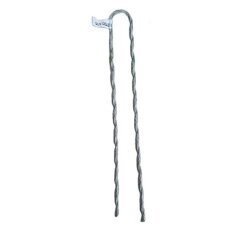 1 - 5 of 5Price 8.57 € VAT incl.( 7.08 € VAT excl. )Price 8.57 € VAT incl.( 7.08 € VAT excl. )Price 8.57 € VAT incl.( 7.08 € VAT excl. )Price 8.57 € VAT incl.( 7.08 € VAT excl. )Price 8.57 € VAT incl.( 7.08 € VAT excl. )


