
-
Product Catalog
- Security and Surveillance Systems | accessories
- Lighting solutions for industrial | commercial | residential | outdoor environments | accessories
-
Automation and Control Systems
- Automation control accessories
- Control components for automation and control systems
- Signal converters | controllers for automation control | for control systems
- Touchscreens | panels for automation control | control systems
- Automatic Circuit Breakers for Direct Current (DC) Circuits with Integrated Overload, Short-Circuit, and Voltage Stabilization Protection Functions
-
Automation and Electrical Control Components | Contactors | Relays | SSR | Accessories
- Mini contactors for electric motor control
- Contactors | Electrical starters | For equipment control
- Electronic solid-state (SSR) contactors
- Contactors with enclosure and control buttons | for electrical equipment control
- Electromechanical thermal relays | electrical equipment protection
- Control coils for contactors | starters | electrical equipment control
- Adapters-converters for relays and contactors
- Additional contacts | Accessories for contactors
- Modular impulse relays | lighting | electrical circuit control
- Industrial solid state relays | electrical load control
- Intermediate relays for automation | for PLC and electrical control panels
- Automation control | Data transmission | Low current
- Industrial measurement | counting | detection systems for conveyors
- Panel heaters | protection for electrical equipment against moisture and cold
- Converters-transformers from single-phase to three-phase voltage
- Silicone strip heaters | electric heating solutions for industry
- Heating elements for liquids | water | oils | food heating
- Heating elements | igniters | for stoves | boilers | heaters
- Insulation Monitoring & Power Supply Equipment for Medical IT Systems
- Smart Automated Products | Control | Transmission | Detection
- Electrical distribution and installation
- Solar Energy Generation and Management Equipment
- HVAC control solutions for heating and ventilation
- Accessories for cars
- Workplace Safety | Electrical Safety Equipment | LOTO
- Technical maintenance | service equipment | fire protection solutions
- Emergency safety | hygiene | sanitary solutions
- Other products
- Quality used products
Control relays | universal automation relays | for PLC and electrical panels
-
Read more
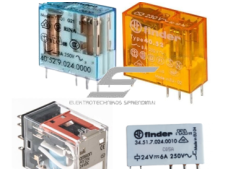
Control relays are among the most commonly used electrical components, ensuring circuit control, isolation, and signal transmission. They connect or disconnect electrical current according to a control signal, acting as an intermediary between the control system (e.g., PLC, automation controller) and the electrical load (e.g., motor, lighting, heater).
Universal devices suitable for industrial, commercial, and household systems where reliable circuit switching is required.Functions
Switching on/off the electrical circuit depending on the control coil voltage (DC or AC).
Isolation between control and load circuits.
Signal transmission between automation controllers, sensors, and actuators.
Interconnection of circuits with different voltages (e.g., 24 V control and 230 V load).
Indication – many models have LED or mechanical indicators showing relay status.
Applications
Industry: in production line automation, control panels, alarm circuits.
Commercial buildings: for lighting, ventilation, and air conditioning systems control.
Household devices: for controlling heaters, boilers, pumps, and household appliances.
For engineers – relays are used in design schemes as intermediaries between weak signals and stronger loads.
For electricians – in switchboard assembly, when a simple and reliable switching element is needed.
Advantages
Versatility – many options depending on voltage, contact number, and current load.
Reliability – durable, suitable for thousands of switching cycles.
Easy installation – usually mounted in sockets or on DIN rail.
Wide application – suitable for small to medium loads.
Clear indication – LED lights make it easy to check relay status.
Disadvantages
Mechanical wear – moving contacts wear out over time.
Noise – relays make a “click” sound when switching.
Limited current capacity – typically up to 3–12 A, not suitable for very large loads (contactors or SSR are used instead).
Control relays are essential elements of electrical automation, ensuring safe and reliable circuit switching. Despite their mechanical limitations, their versatility, wide application, and simple installation make them indispensable in both household and industrial projects. A properly selected relay guarantees long-term operation and system reliability.
 No items found.


