Selection guide · halogen-free cables for fixed installation
NHXMH-J cables: how to choose and why fire safety matters
NHXMH-J is a copper installation cable with a halogen-free sheath, intended for buildings where it is important to reduce the release of smoke and corrosive gases in a fire. In this guide we explain how to choose the number of cores, cross-section and length, how CPR classes differ and why a halogen-free cable is not the same as a fire-resistant cable.
300/500 V
Rated voltage U₀/U
Cca
CPR class of the listed products
+70 °C
Max. conductor temperature
Cu, class 1
Solid copper conductors

 Asked by Kibirkštis – a young electrician. Answered by Fazė – an experienced engineer.
Key point:
NHXMH-J is chosen for fixed indoor electrical installation where a reliable power supply and reduced release of smoke and acidic combustion products are required. The right choice is determined by the number of cores, cross-section, current, cable length, installation method and the mandatory reaction-to-fire class. A halogen-free cable is not in itself designed to maintain circuit operation during a fire.
Information and selection Suitable / benefit ⚠ Check ⚡ Safety and mistakes
What do you need? Quick selection of NHXMH-J
When choosing, first determine the purpose of the circuit, the required number of cores, the load and the fire safety requirements that apply to the specific part of the building.
|
Situation |
Indicative choice |
Where to look? |
|
Lighting circuit, 230 V |
3×1.5 mm², if it matches the design |
NHXMH-J 3×1.5 |
|
Socket-outlet circuit, 230 V |
3×2.5 mm², if it matches the design |
NHXMH-J 3×2.5 |
|
Three-phase 400 V supply with N and PE |
5×2.5 mm², if the current-carrying capacity is sufficient |
NHXMH-J 5×2.5 |
|
Escape routes, public building |
According to the mandatory CPR class |
Check the DoP and the design requirements. |
|
Operation required during a fire |
Not NHXMH-J alone |
A system with the appropriate fire resistance is required. |
|
Underground route, permanently outdoors |
Another cable type |
Choose a construction designed for such routes. |
Why the right choice matters: the right cross-section allows the intended current to be carried safely, and a CPR class suitable for the design helps meet the specified fire safety requirements of the building.
Range matrix – specific products
Click a cable size to open the corresponding product in the elsprendimai.eu shop. Combinations of cross-sections and number of cores are chosen according to the purpose of the circuit.
|
Parameter |
3×1.5 |
3×2.5 |
5×2.5 |
|
Number of cores |
3 |
3 |
5 |
|
Cross-section |
1.5 mm² |
2.5 mm² |
2.5 mm² |
|
Voltage |
300/500 V |
300/500 V |
300/500 V |
|
CPR class* |
Cca-s1a,d1,a1 |
Cca-s1a,d1,a1 |
Cca-s1a,d1,a1 |
|
Typical use |
Lighting |
Socket circuits |
Multi-core power supply |
|
Open product |
3×1.5 → |
3×2.5 → |
5×2.5 → |
* The CPR class must be checked against the Declaration of Performance (DoP) of the specific product. Product availability and minimum order quantity may change.
Why choose a halogen-free cable?
In a fire, the combustion products of conventional PVC cables may contain acidic and corrosive gases, and a large amount of smoke reduces visibility. The purpose of the halogen-free construction of NHXMH-J is to reduce the formation of such combustion products and dense smoke.
✓ Low smoke
Lower smoke emission helps preserve visibility during evacuation.
✓ Low acidity
The hazard from acidic and corrosive combustion products is reduced.
✓ Equipment protection
Lower risk of corrosion caused by combustion products for electrical and electronic equipment.
✓ Fire safety designs
Can be used where the design specifies halogen-free cables of the appropriate CPR class.
What is LSOH / LSZH?
Low Smoke Zero Halogen – a halogen-free construction with low smoke emission. It does not mean that the cable is completely non-combustible or that no harmful combustion products form in a fire.
CPR class Cca-s1a,d1,a1: what does each symbol mean?
CPR is the system for assessing the reaction to fire of construction products. The cable classification covers flame spread, heat release, smoke, flaming droplets and the acidity of combustion products.
|
Symbol |
Meaning |
Practical significance |
|
Cca |
Reaction-to-fire class of the cable |
Flame spread and heat release are assessed. |
|
s1a |
Low smoke subclass |
Important for visibility and the evacuation environment. |
|
d1 |
Flaming droplets and particles criterion |
The additional ignition hazard is assessed. |
|
a1 |
Low smoke acidity subclass |
Relevant to human safety and equipment corrosion. |
⚠ Important: not every halogen-free cable has class Cca. The classification of cables of the same type may differ by manufacturer and construction. Check the DoP of the specific product and the building design.
Does NHXMH-J maintain the power supply during a fire?
Reaction to fire
Describes how the cable itself reacts to fire and how much heat, smoke and combustion products it releases. This is defined by the CPR classification.
Circuit integrity
Describes whether the cable and its fixing system can maintain the function of the electrical circuit for a specified time when exposed to fire.
KibirkštisIf the cable is Cca and halogen-free, can it be used to supply a smoke extraction system that must operate during a fire?
FazėClass Cca alone is not enough. You need a cable, together with its entire installation system, that meets the fire resistance and circuit integrity requirements specified in the design.
⚡ Important: NHXMH-J must not automatically be regarded as a substitute for an E30, E60 or E90 circuit-integrity cable system. Such requirements are verified according to the relevant tests and the design.
Where is NHXMH-J suitable and where not?
✓ Residential buildings
Fixed lighting, socket and power distribution circuits.
✓ Offices and commercial premises
Buildings where halogen-free cables are preferred or required.
✓ Public buildings
Schools, healthcare and administrative institutions, if the design requirements are met.
✓ Fixed routes
For installation in walls, suitable trunking and other permitted indoor locations.
⚠ Damp rooms
The environment, connection protection and conditions of use of the specific cable must be assessed.
⚠ Concrete structures
The possibility of direct embedding in concrete and mechanical protection must be checked separately.
✗ Direct burial in the ground
This requires a cable designed for the respective environment.
✗ Constantly moving appliances
Solid copper conductors are not designed for frequent flexing.
How many cores are needed – 3 or 5?
In the designation NHXMH-J the letter J means that the cable contains a green-yellow protective PE core. The number of cores depends on the supply system and the circuit diagram.
3 cores: L, N and PE
A common choice for 230 V lighting or socket supply circuits.
View 3×2.5 →
5 cores: L1, L2, L3, N and PE
For three-phase 400 V circuits with neutral and protective conductors.
View 5×2.5 →
The blue core is usually used for the neutral conductor N, and the green-yellow core only for the protective conductor PE. The purpose of the cores must be coordinated with the specific circuit diagram.
Cross-section by load and power
The cable cross-section is selected according to the load current, installation method, cooling, temperature, protective device, grouping conditions and voltage drop. Cross-section or power alone is not enough.
Below is the current calculation for a single-phase 230 V resistive load (cos φ = 1). This is not a table of permissible currents for NHXMH-J cable.
|
Power |
Current |
What must be checked? |
|
500 W |
2.17 A |
Circuit purpose and protection |
|
1000 W |
4.35 A |
Cross-section and voltage drop |
|
2000 W |
8.70 A |
Continuous load and temperature |
|
3000 W |
13.04 A |
Installation method and protection |
|
3680 W |
16.00 A |
Cable, circuit breaker and the entire circuit |
Formula for a single-phase circuit:
I = P / (U × cos φ)
Example: 2300 W / 230 V = 10 A at cos φ = 1. For motors, starting modes and efficiency are also assessed.
Electrical resistance of solid copper conductors
Maximum DC resistance of class 1 solid plain copper conductors at +20 °C according to EN 60228:
|
Cross-section |
Ω/km |
Application |
|
1.5 mm² |
12.1 |
A common choice for lighting circuits |
|
2.5 mm² |
7.41 |
A common choice for socket circuits |
|
4 mm² |
4.61 |
Lower conductor resistance |
|
6 mm² |
3.08 |
Larger cross-section circuits |
⚠ The values are not permissible loads. The current-carrying capacity of a cable depends on the installation and cooling conditions. The circuit breaker is selected according to the parameters of the entire circuit and the applicable rules.
Length and voltage drop
A longer cable has a higher total electrical resistance. As a result, the voltage drop and the thermal losses in the conductors increase. The table shows calculated examples for a single-phase circuit at a current of 10 A and a conductor temperature of +20 °C.
|
Distance |
1.5 mm² |
2.5 mm² |
4 mm² |
|
10 m |
2.42 V |
1.48 V |
0.92 V |
|
20 m |
4.84 V |
2.96 V |
1.84 V |
|
30 m |
7.26 V |
4.45 V |
2.77 V |
|
50 m |
12.10 V |
7.41 V |
4.61 V |
Simplified formula:
ΔU ≈ 2 × L × I × R / 1000
L – length one way in metres; I – current in amperes; R – electrical resistance of one conductor in Ω/km.
The calculation does not take into account the conductor operating temperature, the reactive component or the resistance of connections. The total voltage drop is checked over the entire supply circuit.
Construction and technical data
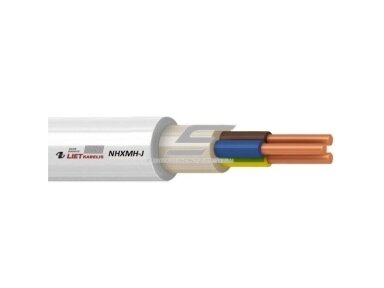
1. Copper conductor
Solid copper conductor suitable for fixed installation.
2. Core insulation
Cross-linked polymer that electrically separates the conductors.
3. Core assembly
Insulated cores and construction elements that form the inside of the cable.
4. LSOH sheath
Halogen-free outer sheath designed for lower emission of smoke and corrosive gases.
|
Parameter |
Data |
|
Cable type |
NHXMH-J, halogen-free, for fixed installation |
|
Conductor |
Annealed copper, class 1 – products in this category |
|
Rated voltage |
300/500 V |
|
Test voltage |
2000 V for the listed products |
|
Core insulation |
Cross-linked polymer |
|
Outer sheath |
LSOH halogen-free thermoplastic |
|
Max. operating temperature |
+70 °C for the conductor |
|
CPR class |
Cca-s1a,d1,a1 for the listed versions |
|
Colour |
White |
|
Protective core |
Yes, designation J |
|
Bending radius |
According to the specific cable diameter and data sheet |
|
Manufacturer |
AB „Lietkabelis“ – the listed range versions |
NHXMH-J, NYM-J, CYKY-L or BZ1Z1-P?
|
Cable |
Purpose |
How does it differ? |
Link |
|
NHXMH-J |
Indoor installation |
LSOH construction, low emission of smoke and corrosive gases. |
Group |
|
NYM-J |
Fixed installation |
Usually PVC insulation and sheath. |
NYM-J |
|
CYKY-L |
Fixed power supply lines |
PVC construction, installation conditions according to the product. |
CYKY-L |
|
BZ1Z1-P |
Halogen-free indoor installation |
A different halogen-free construction and a CPR class specific to the product. |
BZ1Z1-P |
Cables are not automatically interchangeable based on the same number of cores and cross-section. The rated voltage, construction, installation location, CPR class and design are checked.
Installation and operating conditions
1. Installation method
Determine whether the cable will run in a wall, trunking, conduit or another permitted route.
2. Mechanical protection
Protect against crushing, sharp edges, drilling and a bending radius that is too small.
3. Terminal compatibility
Use connections suitable for class 1 solid copper conductors.
4. Fire-stop penetrations
Seal penetrations through fire separations with suitable systems.
5. Cable grouping
Assess heat build-up in shared trunking and routes.
6. Electrical tests
Check the protective conductors, insulation resistance and operation of protection.
⚡ Do not use NHXMH-J as a frequently flexed appliance lead. A solid copper conductor is intended for fixed installation, and continuous movement can damage it.
Most common selection and installation mistakes
|
✗ Wrong |
✓ Correct |
|
Any halogen-free cable is assumed to be class Cca. |
Check the product DoP and the declared CPR class. |
|
Cca is taken as a guarantee of operation during a fire. |
Check circuit integrity against separate requirements. |
|
The circuit breaker is selected solely by conductor cross-section. |
Assess the permissible current of the cable and the entire circuit. |
|
The cable is installed as a moving power lead. |
Use a flexible cable according to the appliance requirements. |
|
The cable is laid directly in the ground. |
Choose a cable designed for underground routes. |
|
Grouping of several cables is not assessed. |
Apply thermal correction factors. |
⚡ Fazė’s advice: the entire installation matters
Fazė recommends
Even a cable with a good reaction-to-fire class will not deliver the expected result if the route is poorly installed, the insulation is damaged, the connections are wrongly selected or the penetrations through fire separations are not sealed. Assess the cable, protection and installation system as a single whole.
⚡ Safety requirement: carry out electrical installation work with the supply switched off and after verifying the absence of voltage. Design, installation and testing must be performed by appropriately qualified specialists.
☝ Elsprendimai.eu recommends
For a lighting circuit
Consider NHXMH-J 3×1.5, if it matches the load and the design.
For socket outlets
Consider NHXMH-J 3×2.5, after checking the current and protection.
For a three-phase circuit
NHXMH-J 5×2.5 – if the cross-section is sufficient and five cores are needed.
For a fire safety design
Start with the CPR requirements of the design, then check the cable DoP, construction and electrical parameters.
Diagram: wrong / right – cable selection
✗ WRONG
Building electrical installation
↓
Any “halogen-free” cable
CPR and DoP not checked
↓
Installed route
The CPR class of the design, cross-section and installation conditions were not assessed.
✓ RIGHT
Design and requirements
↓
NHXMH-J
CPR, DoP, load and installation checked
↓
Properly installed route
The cable matches the electrical circuit, safety requirements and conditions of use.
FAQ – Kibirkštis asks, Fazė answers
The most common questions about halogen-free NHXMH-J cables – from selection to installation and fire safety. Kibirkštis asks the way an electrician or buyer would. Fazė answers by explaining not only what to choose but also why.
Kibirkštis · Question 1What exactly is an NHXMH-J cable and what is it needed for?
FazėNHXMH-J is a cable for fixed indoor installation with copper conductors and a halogen-free construction. It is designed to supply electrical power in building lighting, socket-outlet and distribution circuits. The main difference from conventional PVC cables is the lower formation of smoke and corrosive combustion products in a fire. This is particularly relevant for buildings with stricter fire safety requirements.
Kibirkštis · Question 2If a cable is halogen-free, does that mean it does not burn at all?
FazėNo.
Halogen-free does not mean non-combustible. It means that the cable materials are designed to limit the release of halogen acid gases. An LSOH construction can also reduce the amount of smoke. However, the cable can still burn, and its reaction-to-fire characteristics are defined by the CPR class. More in the
CPR classification section.
Kibirkštis · Question 3What does Cca-s1a,d1,a1 mean? Why so many letters?
FazėThis designation describes four fire properties. Cca – reaction to fire, s1a – low smoke production, d1 – the flaming droplets and particles criterion, a1 – low acidity of combustion products. The higher the fire safety requirements of the building, the more important it is to check the full classification. The “LSOH” label alone is not enough – the DoP of the specific cable must be checked.
Kibirkštis · Question 4Will a Cca cable be able to supply power for 30, 60 or 90 minutes during a fire?
FazėNot because of class Cca alone.
Reaction to fire and maintaining circuit integrity are different properties. Cca assesses the cable’s contribution to a fire, whereas maintaining the power supply requires a cable and fixing system tested for the relevant time. For smoke extraction, emergency lighting or other systems that must operate during a fire, the cable must be selected according to the circuit-integrity requirements of the design. More in the
section on fire resistance.
Kibirkštis · Question 5Can I use NHXMH-J for a three-phase 400 V network?
FazėYes, a correctly selected
300/500 V class NHXMH-J can be used in a 230/400 V electrical system. The designation U₀/U = 300/500 V means 300 V between conductor and earth and 500 V between conductors. If you need L1, L2, L3, N and PE, you can consider
NHXMH-J 5×2.5 mm², but the cross-section must match the current and installation conditions.
Kibirkštis · Question 6For lighting – 3×1.5 or 3×2.5 mm²?
FazėFor standard lighting circuits,
3×1.5 mm² is often used. However, the circuit breaker rating cannot be decided from the cross-section alone. The cable installation, permissible current, voltage drop and circuit protection must be assessed. Longer routes or circuits with higher loads may require a larger cross-section.
Kibirkštis · Question 7Can a 16 A circuit breaker always be used for a 3×2.5 mm² cable?
FazėNot automatically. The cross-section is only one selection criterion. The permissible current of a cable depends on whether it is installed in thermal insulation, in a conduit or on a wall, whether it is grouped with other cables and on the ambient temperature. Protection must be selected so that the cable is protected and the circuit disconnection requirements are met. See the
cross-section and load section.
Kibirkštis · Question 8Can NHXMH-J be embedded in concrete or laid directly in the ground?
FazėNHXMH-J is primarily intended for fixed indoor installation. Installation in a wall or under plaster may be suitable according to the conditions of the specific product. Direct embedding in concrete must be checked, as different constructions may have different restrictions. For direct burial in the ground, choose a cable specifically designed for it, taking into account moisture, mechanical loads and soil conditions.
Kibirkštis · Question 9Is solid-conductor NHXMH-J suitable for connecting a moving electrical appliance?
FazėNo. The NHXMH-J cables in this range have class 1 solid copper conductors intended for fixed installation. Repeated flexing of a solid conductor can cause fatigue damage. For moving appliances, choose a suitable flexible cable, for example the
H03VV-F or H05VV-F group, if it meets the appliance and environmental requirements.
Kibirkštis · Question 10How does NHXMH-J differ from a standard NYM-J cable?
FazėBoth cables can be used in fixed installations, but their insulating materials and fire characteristics differ. NYM-J usually has a PVC construction, whereas NHXMH-J is halogen-free. If the design requires a specific low smoke and low acidity class, a standard NYM-J may not be sufficient. Compare the
cable types in the table.
Kibirkštis · Question 11What does the letter J mean, and can I use the green-yellow core for control?
FazėThe letter J in the cable designation indicates a green-yellow protective PE core. It must not be used for a phase, the neutral conductor or control signals. If the equipment needs additional control lines, choose a cable with a suitable number of cores and colour coding. The purpose of the protective conductor must be preserved throughout the circuit.
Kibirkštis · Question 12I need 120 metres of NHXMH-J for my project. How do I know whether the selected cross-section will be sufficient?
FazėFirst distinguish the total length purchased from the length of a single circuit. If the 120 metres are for several separate lines, each of them is assessed individually. For long circuits you must calculate the voltage drop and check the permissible current, short-circuit conditions and operation of protection. See the
voltage drop table. For a larger project it is worth providing a cable schedule – we will be able to offer the required quantities and options.
Technical sources, standards and important notes
-
EN 60228 – conductors of insulated cables and their classes.
-
DIN VDE 0250-214 – technical requirements for NHXMH-type cables.
-
EN 13501-6 – classification of cables by reaction to fire.
-
EN 50575 – reaction-to-fire requirements for cables used in construction works.
-
IEC 60754 – assessment of combustion product acidity and halogen acid gases.
-
IEC 61034 – smoke density tests of cables.
Important technical note
Manufacturers and constructions of NHXMH cables may differ in conductor class, outer diameter, temperature limits and CPR class. The 300/500 V, +70 °C and Cca-s1a,d1,a1 data given in this guide apply to the listed elsprendimai.eu products. Before use, check the DoP, technical documentation and installation requirements of the specific product.
Disclaimer: calculations, comparisons and selection examples are for information only. The final cross-section, protection and installation method are chosen by qualified specialists according to the design and applicable requirements. UAB „Elektrotechnikos sprendimai“ is not liable for the consequences of improper selection, installation or incorrect calculations to the extent permitted by law.
Need NHXMH-J cable for a project?
State the required number of cores, cross-section, length, installation method and the CPR class specified in the design. We will help you choose a suitable cable option and provide a quote for larger quantities.
Contact Elsprendimai.eu
Copper power supply cables NHXMH-J are specially designed solutions for safe and efficient energy supply using pure copper. These cables feature halogen-free insulation, ensuring greater safety and reduced environmental damage risk.
Conductor: The cables have one or multiple conductors made from pure copper, ensuring efficient electricity transfer.
Insulation: NHXMH-J cables are insulated with a special halogen-free material that does not produce toxic gases in the event of combustion. This increases safety and reduces fire risk.
Specifications:
Voltage range: These cables can be used at voltages up to 0.6/1 kV, making them suitable for various electrical installations.
Temperature range: Operating temperature ranges from -15 °C to +90 °C, allowing them to be used both indoors and outdoors.
Color code: Standard color code: black (phase), blue (neutral), green-yellow (earth).
Applications:
Industry: NHXMH-J cables are ideal for automation systems, electrical equipment, and other industrial applications where safe and durable energy supply is needed.
Domestic use: Suitable for home electrical systems, lighting installations, and other electrical applications where cable safety and eco-friendliness are important.
Construction sector: Used in electrical installations for new buildings and renovated facilities, ensuring safe and reliable energy supply.
Advantages:
Environmentally friendly: Due to halogen-free insulation, these cables do not produce toxic gases in the event of combustion, making them safer for the environment.
High electrical conductivity: The pure copper construction of the cables provides excellent conductivity, allowing efficient electricity transmission.
Durability: The special insulation ensures a longer service life for the cables, protecting them from external factors.
Safety: Fire-resistant insulation properties help reduce fire risk, making these cables suitable for use in both industrial and residential settings.
Copper power supply cables NHXMH-J are an excellent choice when a safe, efficient, and environmentally friendly energy supply solution is needed. Their design, exceptional properties, and versatility allow them to be used in various fields, ensuring long-term performance and safety. Due to their features, these cables are an ideal solution for both industrial and domestic projects.


 1 - 5 of 5
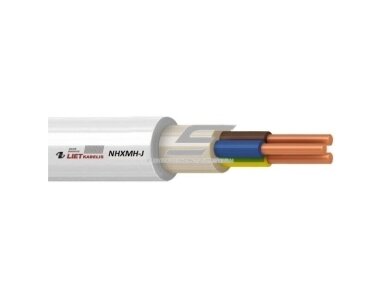
 Cable 5x2.5 mm² | copper | solid | halogen-free | NHXMH-J 5x2.5 | 1 m | whiteCode: 9205250113