LINEAR LIGHTING · FLUORESCENT TECHNOLOGY · T8 / G13
T8 fluorescent tubes – a complete guide to selection, compatibility and replacement
18 W, 36 W and 58 W tubes, G13 pins, nominal lengths, luminous flux, 4000 K and 6500 K, electromagnetic and electronic ballasts, T8 LED alternatives and safe disposal.
G13Two-pin ends
Ø26 mmT8 tube class
18 / 36 / 58 WMain versions
4000–6500 KColour options in the catalogue

 Kibirkštis asks, Fazė answers – how to choose and safely replace a T8 tube.
Key point
T8 is the tube size designation and G13 is the pin type. When replacing a fluorescent tube, it is important to match the exact length, tube wattage, ballast, starter use and desired luminous flux. An LED T8 tube may have the same G13 base but a different power supply circuit.
1. Quick selection of a T8 fluorescent tube
If you need to replace a burnt-out or worn tube in an existing luminaire, first check the marking on the old tube. It usually states the wattage, light colour code and tube type.
|
Existing luminaire |
Tube to look for |
Must be checked |
|
T8 18 W |
18 W, G13, approx. 60 cm |
Ballast and starter circuit |
|
T8 36 W |
36 W, G13, approx. 120 cm |
Pins and actual length |
|
T8 58 W |
58 W, G13, approx. 150 cm |
Rated ballast compatibility |
|
Unknown type |
According to the tube and luminaire marking |
Measuring the length alone is not enough |
2. Comparison of models and parameters in this category
Luminous flux, colour temperature and performance figures of different models are not the same, even at the same rated wattage.
|
Model |
Wattage |
Length |
Light |
Flux |
|
Bellight T8 G13 |
18 W |
60 cm |
6500 K |
1250 lm |
|
Bellight T8 G13 |
36 W |
120 cm |
6500 K |
3250 lm |
|
Bellight T8 G13 |
58 W |
150 cm |
6500 K |
1500 lm* |
|
Zext T8 |
18 W |
60 cm |
4000 K |
— |
|
Zext T8 |
36 W |
120 cm |
4000 K |
— |
3. What do T8, G13, 18 W, 36 W and 58 W mean?
T8 indicates the tube diameter class: one eighth of an inch multiplied by eight is approximately 25.4 mm. In commercial specifications T8 tubes are often rounded to 26 mm.
G13 is a two-pin base. The pin centre spacing is 13 mm, with a pair of pins at each end of the tube.
18 W, 36 W and 58 W indicates the rated power of the tube. This is not the total power consumption of the whole luminaire, as the ballast may also have energy losses.
60, 120 and 150 cm – nominal length designations. The exact tube and pin dimensions must match the luminaire lampholders.
4. How does a T8 fluorescent tube work?
A gas discharge takes place in the glass tube. The ultraviolet radiation produced by the discharge excites the inner phosphor coating, which converts it into visible light. A ballast is required to limit the tube current, and the ignition process depends on the control gear used.
Mains supply
↓
Ballast and starting circuit
↓
Gas discharge in the T8 tube
↓
Phosphor emits visible light
This operating principle must not be confused with LED technology, in which light is generated by semiconductor light-emitting diodes.
5. Electromagnetic ballast, starter and electronic ballast
|
System |
Operation |
Compatibility |
|
Electromagnetic ballast |
Current limiting by an inductive component |
A suitable starter is often required |
|
Electronic ballast |
Electronic starting and operating mode control |
Selected according to tube wattage, type and quantity |
|
Luminaire adapted for LED T8 |
LED module supply according to its design |
Do not equate with the fluorescent tube circuit |
Electrical safety: a T8 fluorescent tube is not a light source supplied directly from the 230 V mains, even though the packaging may state the rated mains voltage of the luminaire system. Removing the starter or bypassing the ballast must not be used as a universal way of connecting a fluorescent tube.
6. Light colour: 4000 K and 6500 K, luminous flux and efficacy
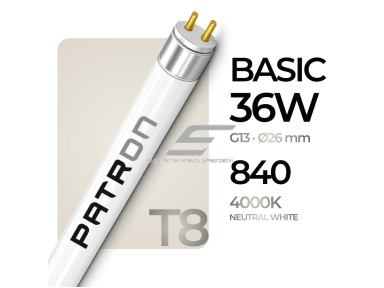
4000 K – neutral white
Often chosen for offices, workshops and general task lighting.
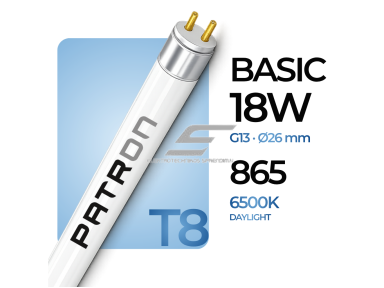
6500 K – cool white
Light with a cooler tint, used in technical and other suitable rooms.
Lumens (lm) indicate the amount of visible light emitted by the tube. Watts (W) – the electrical power consumed. Luminous efficacy is expressed in lm/W.
For example, the theoretical luminous efficacy of a 36 W, 3250 lm tube is about 90.3 lm/W. This value describes the tube itself, not the efficacy of the luminaire operating together with the ballast.
7. Where are T8 fluorescent tubes used?
Offices
Maintenance of existing linear ceiling luminaires.
Warehouses
Tubes for luminaires designed for T8 technology.
Workshops
Workplace and general lighting systems.
Schools
Servicing of existing T8 luminaires.
Garages and basements
Light sources for compatible luminaires.
Commercial premises
Repair of existing linear lighting systems.
8. Fluorescent T8 or LED T8 – what is the difference?
|
Property |
Fluorescent T8 |
LED T8 |
|
Light source |
Gas discharge and phosphor |
Light-emitting diodes |
|
Mercury |
Present |
Usually none |
|
Wiring circuit |
Compatible ballast required |
Depends on the LED model and supply type |
|
Energy consumption |
Tube plus ballast losses |
Usually lower for a similar light output |
|
Replacement compatibility |
According to the existing T8 ballast |
Ballast or rewiring scheme must be checked |
Look for LED T8 options in the T8 LED tubes category.
9. T8 tube replacement and compatibility check
1. Disconnect the power
Make sure the luminaire is safely disconnected.
2. Check the old tube
Write down the type, wattage, length and colour code.
3. Identify the ballast
Electromagnetic or electronic, and which tube it is intended for.
4. Check the lampholders
Condition of the G13 contacts and mechanical fixing.
5. Insert the tube
Follow the design of the luminaire lampholders.
6. Test it
Check ignition, stable light output and any unusual noises.
Important: when replacing a fluorescent T8 with an LED T8, it may be necessary to replace the starter, check electronic ballast compatibility or have the luminaire professionally rewired. This cannot be decided on the basis of the G13 base alone.
10. Power, luminous efficacy and energy consumption calculations
Electrical energy is calculated using the formula E = P × t / 1000, where P is the power in watts, t is the operating time in hours and E is kilowatt-hours (kWh).
|
Tube |
1000 h |
2000 h |
|
18 W |
18 kWh |
36 kWh |
|
36 W |
36 kWh |
72 kWh |
|
58 W |
58 kWh |
116 kWh |
This is the calculated consumption of the tubes alone, excluding ballast losses. For the actual energy consumption of the whole luminaire, use the total system power.
11. Diagram: wrong / right – tube and luminaire compatibility
✗ WRONG
Tube selected by length only
↓
Ballast and connection not considered
Improper ignition, flickering or an unsafe installation.
✓ RIGHT
T8, G13, wattage and length match
↓
Ballast and starting circuit checked
Tube selected for a compatible luminaire and installed correctly.
12. Most common T8 tube selection mistakes
|
✗ Wrong |
✓ Correct |
|
Any G13 tube is assumed to be compatible. |
Type, wattage, ballast and length are checked. |
|
An 18 W tube is fitted instead of a 36 W one. |
Rated wattages must match the luminaire. |
|
A fluorescent tube is connected without a ballast. |
The starting and current-limiting circuit intended for it is used. |
|
LED T8 is fitted without checking the circuit. |
The connection requirements of the specific LED tube are checked. |
|
Light colour code not checked. |
The required K and lm values are selected. |
|
A used tube is thrown away with household waste. |
It is handed over to separate collection for lamp waste containing hazardous components. |
13. Flickering, hard starting and luminaire maintenance
Flickering, slow ignition or weak light may be caused by a worn tube, an unsuitable starter, a ballast fault, contact problems or an unsuitable operating temperature. When troubleshooting, the whole circuit must be checked rather than automatically replacing just the tube.
If dark areas appear at the ends of the tube and ignition noticeably deteriorates, this may be a sign of ageing. If the equipment produces an unusual sound or smell, it must be switched off and inspected.
14. FAQ – Kibirkštis asks, Fazė answers
Frequently asked questions about T8 fluorescent tubes, G13 lampholders, ballasts, starters, light colour and safe use.
Kibirkštis asks · 01 What do the T8 and G13 markings mean?
Fazė answers T8 indicates the diameter class of the tube – approx. 26 mm. G13 denotes the pin type with two pins at each end, spaced 13 mm apart centre to centre. Both parameters are important for mechanical compatibility.
Kibirkštis asks · 02 Can an 18 W T8 tube replace a 36 W one?
Fazė answers Usually not. 18 W and 36 W T8 tubes differ in length and rated electrical parameters. Choose a tube with a wattage suitable for the luminaire design and ballast.
Kibirkštis asks · 03 Does a T8 tube always need a starter?
Fazė answers No. Luminaires with a conventional electromagnetic ballast often use a separate starter. An electronic ballast starts the tube differently, so it does not need a conventional starter.
Kibirkštis asks · 04 What is the difference between 4000 K and 6500 K?
Fazė answers 4000 K is neutral white light, while 6500 K is a cooler, more bluish white. Colour temperature does not indicate light intensity: the number of lumens must be assessed separately.
Kibirkštis asks · 05 Can a fluorescent T8 be replaced with an LED T8?
Fazė answers Yes, if an LED T8 tube compatible with the luminaire is selected. Some LED models work with certain ballasts, others are intended for direct supply after the luminaire has been properly rewired. The wiring diagram is checked before installation.
Kibirkštis asks · 06 Can a T8 tube be connected directly to 230 V?
Fazė answers A conventional fluorescent T8 tube must not be connected directly to 230 V without the necessary current-limiting gear. It requires a suitable ballast and a matching ignition circuit. Direct 230 V supply versions are typical only of LED T8 tubes designed for this.
Kibirkštis asks · 07 Why does the tube flicker or start with difficulty?
Fazė answers Possible causes: a worn tube, a faulty starter, a ballast fault, poor contact or an unsuitable ambient temperature. The exact cause is determined by checking the entire luminaire circuit.
Kibirkštis asks · 08 Do T8 tubes contain mercury?
Fazė answers Yes, conventional fluorescent tubes contain a small amount of mercury. Therefore, they must not be thrown away with household waste. A broken tube must be handled carefully, the room ventilated and the fragments collected in accordance with specific safety recommendations.
Kibirkštis asks · 09 What should be checked before ordering a T8 tube?
Fazė answers Check the T8 and G13 markings, rated wattage, tube length, light colour, required luminous flux and ballast type. If you are planning an LED alternative, also check its supply and luminaire rewiring requirements.
Kibirkštis and Fazė remind you
The G13 base and the correct tube length are only part of compatibility. The ballast, rated wattage and tube type must be checked. Burnt-out fluorescent tubes must be collected separately because of the mercury they contain.
15. Handling of used tubes
Used fluorescent tubes
Because of their mercury content, fluorescent tubes must not be disposed of with ordinary household waste. They must be taken to specialised collection points for waste electrical and electronic equipment or lamps. If a tube breaks, the room must be ventilated and the fragments collected in accordance with the safety recommendations for mercury-containing lamps.
Switching to LED technology
When upgrading lighting, an LED T8 alternative must be selected not only by wattage and lumens, but also by the luminaire's supply circuit. Any modification of the electrical installation must be carried out by a qualified specialist.
T8 fluorescent tubes | G13 | 18 W, 36 W, 58 W
Browse our range of T8 fluorescent tubes or compare LED T8 alternatives. When choosing, consider tube length, G13 pins, light colour and ballast compatibility.
T8 fluorescent tubes LED T8 alternatives
UAB „Elektrotechnikos sprendimai“ – lighting equipment and electrical installation solutions.


 1 - 7 of 7

 Fluorescent lamp T8 | G13 | 18W | 36W | 58W | 4000K | 6500K | 60, 120, 150 cmCode: SKU#158196878672811001


