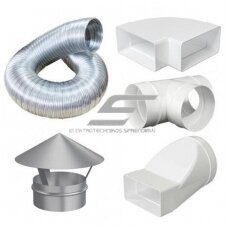
Ducts and connections for ventilation | air conditioning systems
-

Ducts and fittings are essential components designed for ventilation and air conditioning systems, ensuring the movement and distribution of air within spaces. Ducts help circulate air from the air source (e.g., heater, cooler) to required locations, while fittings allow for the installation and connection of duct systems. Duct and fitting systems can be used in both residential and commercial or industrial buildings.
Ducts
Ducts can be classified into several types based on materials, shapes, and functions:
Standard duct types:
Round ducts: Round duct pipes are the most commonly used in ventilation systems due to low air resistance and efficient airflow distribution. They are cost-effective as they require less material for production.
Square/rectangular ducts: These ducts are typically used when installation spaces are limited or require a compact duct. They fit conveniently against walls or ceilings.
Flexible ducts: Made from aluminum or plastic, flexible ducts are used in areas where easy installation and quick connections to systems are needed. They are particularly suitable for spaces where obstacles or complex angles need to be navigated.
Duct materials:Galvanized steel: Most commonly used due to its corrosion resistance and strength. Galvanized steel ensures durability and resistance to temperature fluctuations.
Aluminum: A lighter alternative to steel, often used in lightweight ventilation systems. Aluminum is corrosion-resistant but less durable.
Plastic (PVC): Plastic ducts are more commonly found in residential or lighter ventilation systems as they are cheaper and lightweight. They are moisture-resistant, making them suitable for areas with high humidity, such as bathrooms or kitchens.
Insulation:Ducts can be insulated to prevent heat loss or condensation. This is especially important for ducts carrying warm air in cold areas or cool air in warm areas. Insulating materials commonly include fiberglass or foam materials.
Duct FittingsFittings allow for the connection of various duct parts, ensuring tightness and efficient air movement. There are various types of fittings, depending on the shape and needs of the ducts being connected:
Connecting elements:
T-joints: Used when a branch is needed from the main duct to several directions. A T-joint allows the airflow to be distributed in two directions.
Y-joints: These fittings are used similarly to T-joints but allow for smoother airflow distribution, reducing air resistance and noise.
Angled elbows (90° and 45°): Used when changing the direction of the duct is needed. A gentler 45° elbow reduces airflow friction, while 90° elbows are more compact.
Adapters and transitions: Used when connecting ducts of different sizes, for example, when a smaller duct connects to a larger one.
Fasteners:Brackets: Used to connect flexible ducts to fittings or equipment.
Connection flanges: Flanges are often used with large rectangular ducts, allowing for a tight connection.
Rubber gaskets: Often used in fittings to ensure tightness and reduce noise and vibration.
Main functions and benefits:Efficiency: Properly designed and installed ducts ensure efficient airflow, reducing energy costs and increasing the effectiveness of heating or ventilation systems.
Flexibility: Flexible ducts and fittings allow for easier adaptation of the ventilation system in various spaces.
Durability: Using resistant materials such as galvanized steel or aluminum ensures that ducts serve for a long time, even under challenging environmental conditions.
Tightness: High-quality fittings ensure that there are no air leaks, thus increasing the efficiency of ventilation systems.
Well-chosen ducts and fittings not only improve air circulation but also ensure efficient energy use and the longevity of systems.Selecting the duct diameter
Circular duct capacity (at an air velocity of ~3 m/s – quiet operation for living spaces)
Diameter Airflow, ~m³/h Ø100 mm 85 Ø125 mm 130 Ø160 mm 215 Ø200 mm 340 Ø250 mm 530 Ø315 mm 840 In main duct runs and plant rooms a higher velocity (4–6 m/s) is permissible – capacity increases proportionally, but so does noise.
Frequent questions
 KibirkštisRigid or flexible duct?
 FazėFor the main run – rigid: lower resistance, easier to clean. Flexible duct is suitable for short connections to diffusers and where obstacles have to be bypassed. Long flexible sections significantly reduce the airflow.
Diagrams: how it often is and how it should be
Diagram 1. Duct run. The same fan can deliver half as much air if the run is reduced in diameter, has sharp bends or consists of a long flexible duct.
KibirkštisThe fan is powerful, but there is hardly any airflow. Why?
FazėLook at the duct run: reducers, bends and a long flexible duct eat up most of the performance.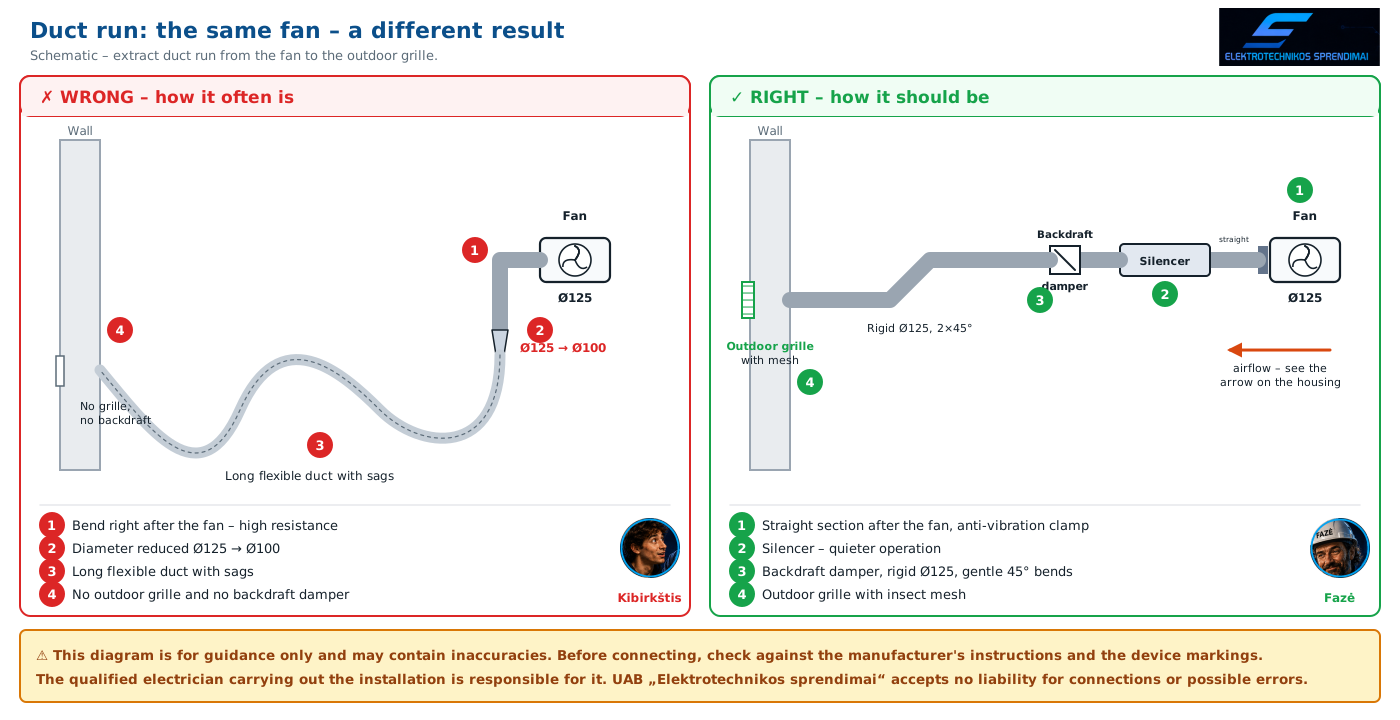 ☝ Click the diagram to open an enlarged version.⚠ This diagram is for guidance only and may contain inaccuracies. Before connecting, check against the manufacturer's instructions and the device markings.
The qualified electrician carrying out the installation is responsible for it. UAB „Elektrotechnikos sprendimai“ accepts no liability for connections or possible errors.Diagram 2. Duct through a cold loft. Warm, moist air condenses in an uninsulated duct in a cold loft – water drips back onto the ceiling and into the fan.
KibirkštisWater is dripping from the fan. Is it leaking?
FazėNo, it is condensation. A duct in a cold loft must be insulated along its entire length.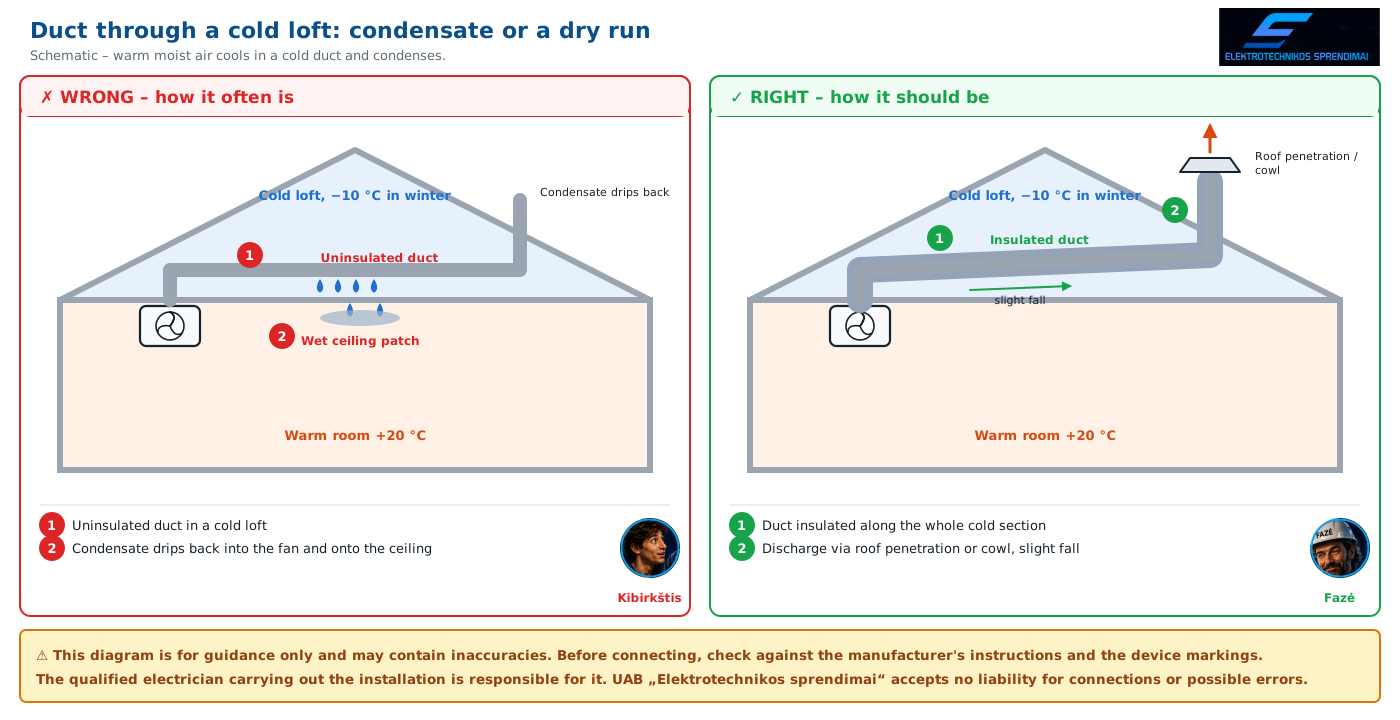 ☝ Click the diagram to open an enlarged version.⚠ This diagram is for guidance only and may contain inaccuracies. Before connecting, check against the manufacturer's instructions and the device markings.
The qualified electrician carrying out the installation is responsible for it. UAB „Elektrotechnikos sprendimai“ accepts no liability for connections or possible errors.← Back to the HVAC guide · Get a quotation