Circuit breaker guide: tripping curve, current rating, poles and breaking capacity
Here you will find quick selection by situation, a comparison of B / C / D / K curves, how to size the breaker current to the cable, breaking capacity, a matrix of manufacturers and series, smart WiFi breakers and industrial MCCBs, the most common mistakes with a diagram, and answers to practical questions. Exact specifications are given in each product description.
Colour key: ■ information · ■ benefit, solution · ■ ⚠ check · ■ ⚡ safety, mistakes
What do you need? Quick selection
|
Situation |
Solution |
Where to look |
|
Lighting and socket outlets in a flat or house |
1P, B curve, 6 kA: B10 for lighting on 1.5 mm² cable, B16 for sockets on 2.5 mm² cable |
Promfactor FB, Schneider iC60N |
|
Air conditioner, heat pump, fan, pump |
C curve – tolerates motor starting current; 3P for three-phase equipment |
Siemens 5SL6, Eaton PL6 |
|
Water heater, electric cooker, AC side of a solar PV system |
2P (single-phase) or 3P/4P (three-phase) – fully isolates the circuit for maintenance |
Promfactor FB, Vecas SGPS |
|
Compressor, welding machine, transformer |
D curve – high inrush currents (10–20×In); usually 3P |
Schneider iC60N, IEK |
|
Incomer close to a substation, commercial or industrial board |
Breaking capacity of 10 kA or more – based on the calculated short-circuit current |
Promfactor FB3 10–15 kA |
|
Remote control, energy metering, rental property |
Smart WiFi breaker with energy metering; if earth leakage protection is needed – a 30 mA model |
Smart WiFi breakers |
|
Current above 125 A, main incoming board |
Industrial MCCB with adjustable protection |
Promfactor FMC1–FMC6 |
|
You need a signal to a PLC/BMS or remote tripping |
Auxiliary or alarm contact, shunt trip – from the same series only |
Breaker accessories |
B, C, D and K curves: when the breaker trips instantly
The curve shows at what current (as a multiple of the rated current In) the breaker trips instantly via its electromagnetic release. Overload protection (the thermal part) is the same for all curves – the curve only determines how the breaker responds to a short circuit and to starting current.
■ B curve – 3–5 × In
-
Lighting, sockets, heating, underfloor heating.
-
Long runs, low short-circuit current.
-
Typical ratings: B6, B10, B16, B20.
■ C curve – 5–10 × In
-
Motors, air conditioners, pumps, LED luminaire groups.
-
Commercial premises, offices.
-
Typical ratings: C10, C16, C20, C25, C32.
■ D curve – 10–20 × In
-
Compressors, welding machines, transformers.
-
Direct-on-line motors with heavy starting.
-
⚠ Requires low loop impedance – verify in the design.
■ K curve – 8–14 × In
-
Motors and transformers where more sensitive overload protection is needed.
-
Industrial automation (to IEC 60947-2).
-
More often ordered to project specification.
Simple rule: B for resistive loads and domestic sockets, C for equipment with a motor or power supply, D for heavy starting. If the breaker trips when you switch an appliance on, check the curve first – don't just increase the current rating.
Poles: 1P, 1P+N, 2P, 3P or 4P?
|
Type |
What it disconnects |
Where to use |
Width |
|
1P |
Phase L only |
Lighting and socket circuits in a TN-S system |
1 module |
|
1P+N |
L and N; only the L pole is protected, N is switched only |
When N must be disconnected but space in the board is tight |
1–2 modules |
|
2P |
L and N simultaneously |
Water heater, flat incomer, AC side of a solar PV system, IT and TT systems |
2 modules |
|
3P |
L1, L2, L3 simultaneously |
Three-phase motors, heat pumps, EV chargers |
3 modules |
|
3P+N / 4P |
Three phases and N |
Main incoming breakers, boards with N loads, generator changeover |
4 modules |
One module = 18 mm of DIN rail. For a three-phase load, use a single 3P breaker, not three separate 1P units: if one pole trips, the other phases stay live and the motor runs on two phases.
Rated current: the breaker protects the cable, not the appliance
The basic rule: load current ≤ breaker In ≤ cable current-carrying capacity Iz. A cable's Iz depends on its cross-section, installation method, ambient temperature and how many cables are run together, so the table is for guidance only.
|
Copper cable |
Maximum breaker |
Typical application |
|
1.5 mm² |
10 A |
Lighting, control circuits |
|
2.5 mm² |
16 A |
Socket outlets, washing machine, water heater up to ~3 kW |
|
4 mm² |
25 A |
Induction hob, three-phase equipment |
|
6 mm² |
32 A |
EV charger, heat pump |
|
10 mm² |
40–50 A |
Flat incomer, sub-board supply |
|
16 mm² |
63 A |
House incomer, high-power sub-boards |
⚠ Important: if a breaker keeps tripping on overload, don't increase its rating without recalculating the cable. A larger breaker on the same cable means the cable will overheat while the protection does not operate. The final cable and breaker combination is determined by the design in accordance with HD 60364-5-52 and HD 60364-4-43.
Breaking capacity: 4.5, 6, 10 or 15 kA?
Breaking capacity (Icn to EN 60898-1 for modular MCBs, Icu/Ics to EN 60947-2 for industrial breakers) shows the highest short-circuit current the breaker can safely interrupt. It must be no lower than the prospective short-circuit current Ik at the point where the breaker is installed.
|
Breaking capacity |
Where it fits |
|
4.5 kA |
Final circuits far from the transformer, where Ik is known to be low |
|
6 kA |
Most flat and house boards – the most common choice |
|
10 kA |
Apartment block incomers, commercial premises, boards close to a substation |
|
15–25 kA |
Industrial boards next to the transformer, main distribution boards |
|
18–85 kA (MCCB) |
Incoming and power distribution boards – industrial MCCBs |
⚡ Safety: if the breaker's breaking capacity is lower than the prospective Ik, it may fail to interrupt the current during a short circuit and be destroyed. In commercial and industrial installations, Ik must be calculated in the design or obtained from the network operator.
Manufacturers and series: matrix of the whole range
The table shows what each subcategory contains. Ranges are compiled from product names; check exact specifications in the product description.
|
Manufacturer / series |
Type |
Current |
Poles |
Curves |
Breaking capacity |
|
Modular MCBs (DIN rail) |
|
Promfactor Baltic FB1, FB2, FB3 |
MCB |
1–125 A |
1P–3P |
B, C, D |
6 / 10 / 15 kA |
|
Schneider Electric iC60N, C120N |
MCB |
1–125 A |
1P–3P |
B, C, D |
6 / 10 kA |
|
Siemens 5SL6, 5SY4 |
MCB |
2–63 A |
1P, 3P |
B, C |
6–10 kA |
|
Eaton (Moeller) PL6 and others |
MCB |
2–125 A |
1P–3P |
B, C |
6–20 kA |
|
IEK |
MCB |
2–63 A |
1P–3P |
B, C, D |
4.5 / 6 / 10 kA |
|
Vecas SGPS |
MCB |
6–63 A |
1P–3P |
C |
6 kA |
|
Merlin Gerin C60 |
MCB |
1–25 A |
1P–3P |
C, D |
6 kA |
|
Legrand RX3 |
MCB |
6–32 A |
1P, 3P |
C |
6 kA |
|
Hager |
MCB |
13–100 A |
1P, 2P |
B, C |
6 / 10 kA |
|
Noark Ex9BN |
MCB |
16–32 A |
1P, 3P |
C |
6 kA |
|
ABB SH200, S200 |
MCB |
6–13 A |
1P |
C |
6 kA |
|
Other brands: Zext, Allen-Bradley, Netlux, Etimat, etc. |
MCB |
3–63 A |
1P–3P |
B, C, D |
6–10 kA |
|
Smart and industrial |
|
Smart WiFi (Tuya, GEYA, TOMZN) |
Smart MCB / RCBO |
1–100 A |
1P–4P |
model-dependent |
model-dependent |
|
Promfactor Baltic FMC1–FMC6 |
MCCB + accessories |
up to 800 A |
3P |
adjustable protection |
18–85 kA |
|
Circuit breaker accessories |
Contacts, releases, busbars |
– |
– |
– |
– |
Accessories (auxiliary and alarm contacts, releases, busbars) fit only their own series – check compatibility in the product description before buying.
Smart WiFi breakers: remote control and energy metering
A smart breaker combines protection, a controllable relay, an energy meter and WiFi connectivity (Tuya / Smart Life) in a single DIN module. You can switch the circuit on or off from your phone, monitor kWh, A and V, and set timers.
|
Model |
Functions |
Best suited for |
|
1P 50 A with energy metering |
Control, kWh / A / V, timers |
Water heater, underfloor heating |
|
2P 63 A with energy metering, TOMZN 2P 1–63 A |
Disconnects L and N, energy metering |
Incomer of a flat or rental property |
|
2P 63 A with earth leakage protection, GEYA 2P 40 A 30 mA |
MCB + earth leakage protection + metering in one module |
Outdoor sockets, country houses, summer cottages |
|
4P 32 / 63 / 100 A |
Three-phase remote control, 400 V |
Workshops, heat pumps, commercial premises |
⚠ What to check: a stable 2.4 GHz WiFi signal at the board (a metal enclosure weakens it), the breaking capacity and compliance with EN 60898-1 / EN 61009-1 in the datasheet. If the manufacturer does not state this data, keep a standard MCB upstream of the smart breaker and use the smart unit for control and metering. Only models stating 30 mA or RCBO provide earth leakage protection.
Modular MCB or industrial MCCB?
|
Parameter |
Modular MCB |
Industrial MCCB |
|
Current |
up to 125 A |
from ~16 A to 800 A and above |
|
Protection settings |
Fixed (B / C / D curve) |
Usually adjustable overload and short-circuit releases |
|
Breaking capacity |
4.5–15 kA (Icn) |
18–85 kA and above (Icu) |
|
Accessories |
Contacts, releases, busbars |
Contacts, coils, motor operator, extended terminals, handles |
|
Mounting |
DIN rail |
Mounting plate, some on DIN rail |
Selectivity: for only the nearest breaker to trip on a fault – not the incomer – the incoming breaker's current rating and curve must be sufficiently higher than those of the final circuit breakers. Exact selectivity is defined by the manufacturers' tables – especially when combining MCCBs and MCBs.
⚠ What to check before buying

KibirkštisBefore I take a breaker off the shelf, I always look at the cable and at what will be connected – not at the old breaker in the board.
|
What to check |
Why it matters |
|
Cable cross-section and installation method |
The breaker's In must not exceed the cable's Iz. 1.5 mm² – no more than 10 A. |
|
Type of load |
Resistive – B, with a motor or power supply – C, heavy starting – D. |
|
Short-circuit current Ik |
Breaking capacity ≥ Ik. Close to a substation – at least 10 kA. |
|
Poles and earthing system |
TN-S, TN-C-S, TT – determines whether N must be disconnected (2P, 4P). |
|
Space in the board |
Number of modules and busbar compatibility with the chosen series. |
|
Accessory compatibility |
Contacts and releases fit only breakers of the same series. |
|
Earth leakage protection |
A circuit breaker does not protect people against electric shock – that requires an RCD or an RCBO. |
✗ Most common mistakes
|
Mistake |
Consequence |
Correct approach |
|
Breaker rated higher than the cable's current-carrying capacity |
⚡ The cable overheats, the breaker doesn't trip – fire risk. |
In ≤ Iz |
|
B curve for a motor or air conditioner |
Trips every time the equipment starts. |
C curve |
|
“Fixing” nuisance tripping by increasing the rating |
⚡ The cable is left without overload protection. |
Find the cause, check the curve and the load |
|
A 6 kA breaker where Ik is higher |
⚡ During a short circuit the breaker may be destroyed and fail to interrupt the current. |
10 kA or more, based on Ik |
|
1P where N must be disconnected |
⚡ The neutral stays connected during maintenance. |
2P or 4P |
|
Three 1P instead of one 3P for a three-phase motor |
If one trips, the motor runs on two phases and overheats. |
3P breaker |
|
Accessories from another series |
They don't physically fit or the mechanism fails to operate. |
Accessories from the same series |
Diagram: choosing a circuit breaker – wrong and right
Diagram. The four most common situations in a distribution board. On the left – how it is often done; on the right – how it should be. The numbers in the diagram correspond to the explanations below it.
KibirkštisA customer complains the air conditioner keeps tripping the B16. If I swap it for a B25 – problem solved?

FazėNo. If the cable is 2.5 mm², a B25 no longer protects it. The problem isn't the current rating, it's the curve: the compressor's starting current exceeds the B curve's 3–5×In threshold. Fit a C16 – same cable protection, but it rides through the start-up.
☝ Click the diagram to open an enlarged version.
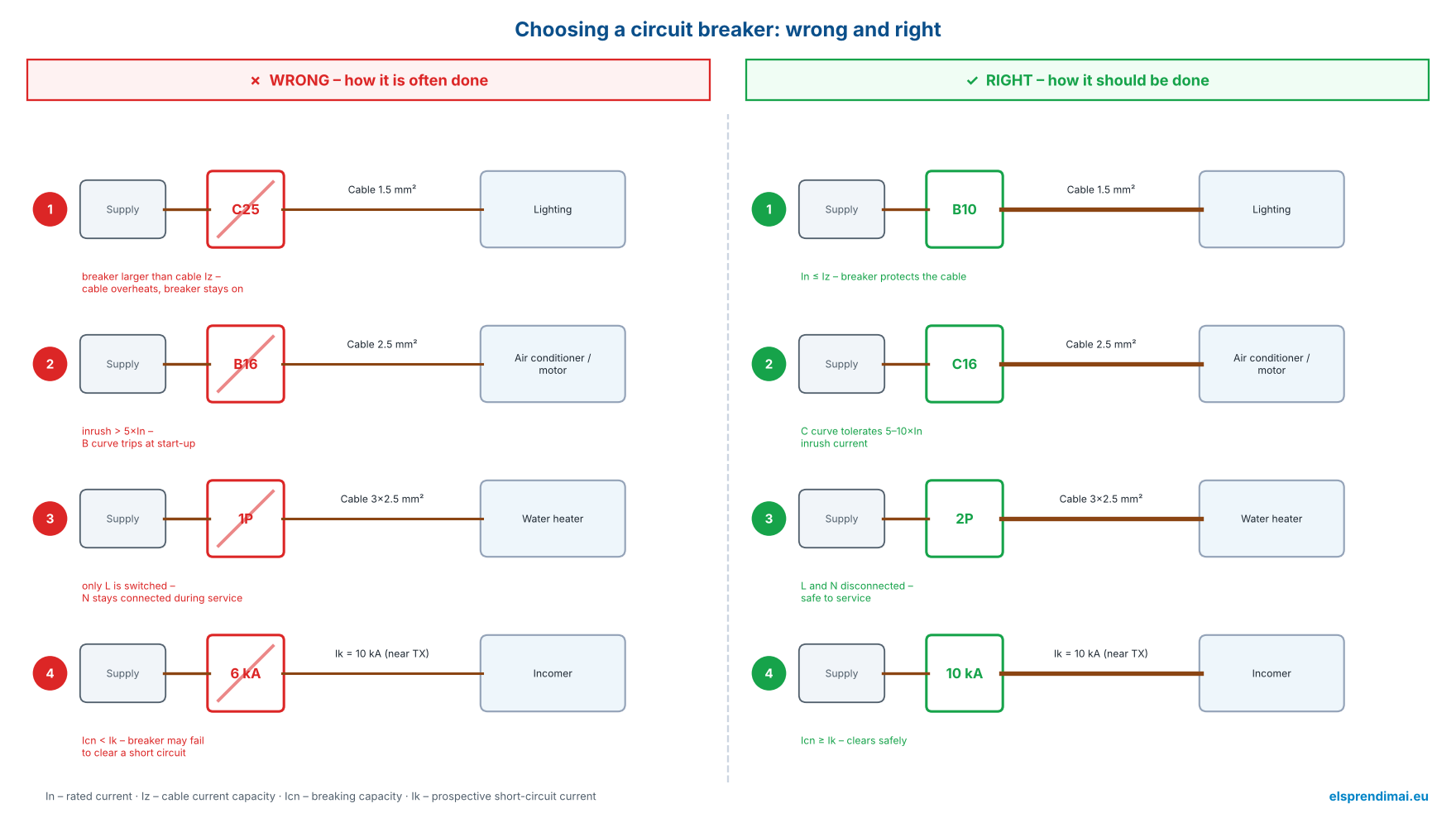
-
Current to suit the cable – B10 for a 1.5 mm² lighting circuit, not C25: the breaker must trip before the cable overheats.
-
Curve to suit the load – C16 instead of B16 for a motor or air conditioner: same cable protection, but the starting current doesn't trip it.
-
Poles to suit the circuit – 2P for a water heater: both L and N are disconnected during maintenance.
-
Breaking capacity to suit Ik – where Ik is 10 kA, the breaker must be rated at least 10 kA.
⚡ Important: the diagram is for information only. Circuit breakers must be selected and connected by a qualified electrician in accordance with the design, the applicable requirements for electrical installations and the manufacturer's instructions. UAB „Elektrotechnikos sprendimai“ accepts no liability for the accuracy and quality of the connection, or for faults or damage resulting from incorrect selection, installation or connection.
Frequently asked questions
Asking the questions is Kibirkštis – a young, curious electrician who dares to ask what others won't. Answering is Fazė – an experienced engineer.
KibirkštisDo a C16 and a B16 protect the cable equally?
FazėAgainst overload – yes, the thermal part is identical in both. The difference is the short-circuit response: a C needs a higher current to trip instantly, so on long runs with high loop impedance the B curve is more reliable.
KibirkštisWhat do C16 6 kA and C16 10 kA mean – is it the same breaker?
FazėThe curve and current are the same; the breaking capacity differs: the first safely interrupts short-circuit currents up to 6,000 A, the second up to 10,000 A. In a house far from the substation 6 kA is usually enough; close to it, go for 10 kA.
KibirkštisDoes a circuit breaker protect against electric shock?
FazėNo. It protects the cable against overload and short circuit. People are protected by a residual current device (RCD) or a combined RCBO, which merges both functions.
KibirkštisCan I mix breakers from different manufacturers in one board?
FazėElectrically – yes, if the ratings are right. But busbars and accessories often don't fit across series, and selectivity tables only apply to combinations from the same manufacturer. Within one board it's easier to stick to a single series.
KibirkštisWhich breaker do I need for underfloor heating?
FazėIt's a resistive load with no starting current, so a B curve is fine. Work out the current from the power: a 2 kW zone draws about 8.7 A, and with 2.5 mm² cable a B16 is suitable. Heating in damp rooms will also need 30 mA earth leakage protection.
KibirkštisCan a smart WiFi breaker replace a standard MCB?
FazėOnly if the datasheet states compliance with EN 60898-1 (or EN 61009-1 for an RCBO) and the breaking capacity matches Ik. If it doesn't – keep a standard MCB as the protection and use the smart unit for control and energy metering.
Sources
Standards and data this guide is based on. Checked on 2026-10-24.
-
EN 60898-1 – circuit breakers for overcurrent protection for household and similar installations (curves B, C, D, Icn)
-
EN 60947-2 – low-voltage switchgear and controlgear, circuit breakers (MCCB, Icu / Ics, K curve)
-
EN 61009-1 – residual current operated circuit breakers with integral overcurrent protection (RCBO)
-
HD 60364-4-43 – protection against overcurrent; HD 60364-5-52 – current-carrying capacities of cables
-
Manufacturers' data in product descriptions (Promfactor Baltic, Schneider Electric, Siemens, Eaton, IEK, Hager, Legrand, ABB and others)
The information and diagrams in this guide are recommendations only. The person carrying out the work is responsible for the accuracy and quality of the electrical connection and its compliance with requirements. UAB „Elektrotechnikos sprendimai“ accepts no liability for the accuracy and quality of the connection.
Breakers, RCDs and accessories – in a single order
Modular and industrial circuit breakers, smart WiFi models, RCDs, busbars and accessories – all in one place. Send us your board schematic or circuit list: we'll select compatible components and send you a quote. Can't find the series you need in the catalogue? Some products are supplied to order.
Get a quote


