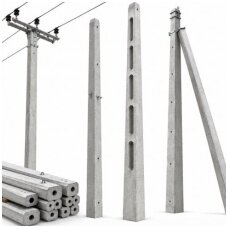
Reinforced concrete poles for overhead power lines and infrastructure networks
-
Reinforced Concrete Poles for Overhead Power Lines and Infrastructure Networks
Reinforced concrete poles are structural infrastructure elements made of concrete with internal steel reinforcement, designed to mechanically support overhead power lines, conductors, cables, insulators and other line hardware. Concrete provides compressive strength and resistance to environmental effects, while the internal steel reinforcement helps the structure withstand bending and tensile loads.
This product group includes reinforced concrete poles of different structural dimensions and types. The specific model must be selected according to the type of line being designed, the function of the pole, height, mechanical loads, conductor arrangement, soil conditions, wind and ice loads, and other project requirements.
Important structural selection information:
A reinforced concrete pole is a load-bearing structure. It must not be selected only by height or external dimensions. Conductor tension forces, wind and ice loads, the function of the pole in the line, soil properties, embedment depth and the structural requirements of the specific project must all be evaluated.Important installation information:
Transport, lifting and installation of the pole must be carried out using lifting points and equipment suitable for the specific structure. Incorrect lifting may damage the concrete, internal reinforcement or cause structural cracking.Main principle:
Choose a reinforced concrete pole when a strong, durable and outdoor-rated load-bearing structure for an overhead power line or infrastructure system is required. The final model must be selected according to the structural design and specific mechanical loads.Construction
Concrete + steel reinforcementApplication
Overhead-line structuresEnvironment
Outdoor infrastructureSelection
According to design loadsInstallation
In soil or a foundation assemblyVariants
Different sizes and constructionsWhat is a reinforced concrete pole?
A reinforced concrete pole is a vertical load-bearing infrastructure element in which concrete and internal steel reinforcement work together as one structural system. Concrete performs well under compressive loads, while steel reinforcement carries part of the tensile and bending forces.
This structural principle makes it possible to manufacture relatively rigid poles with good resistance to atmospheric exposure, which may be used in overhead power-line infrastructure and other projects when the specific product model is designed for such use.
Different poles may have different lengths, cross-sections, shapes, reinforcement arrangements, mounting holes, mechanical strength and installation requirements.
Reinforced concrete:
Concrete and steel reinforcement complement each other: concrete mainly carries compressive forces and protects the reinforcement from environmental exposure, while the reinforcement helps the structure withstand tensile and bending loads.What function does the pole perform in an overhead line?
- Supporting conductors – the pole keeps overhead-line conductors at the required height.
- Mounting line hardware – crossarms, insulators, clamps and other compatible equipment may be installed on the pole.
- Carrying vertical loads – the structure carries its own weight and the weight of the equipment installed on it.
- Carrying horizontal loads – depending on the design, the pole may be subjected to wind, conductor tension and other lateral forces.
- Maintaining line geometry – correctly selected poles help maintain the designed spans, conductor heights and line direction.
Main parameters for selecting reinforced concrete poles
Parameter What should be evaluated? Pole length Selected according to the required above-ground height of the structure and the planned embedment depth or mounting assembly. Cross-section Affects the geometry and mechanical properties of the structure and must be checked for the specific model. Mechanical load Bending, tension, wind, conductor and other design loads must be evaluated. Pole function Intermediate, angle, anchor, terminal or another type according to the specific system design. Soil conditions Soil bearing capacity and properties affect embedment depth, foundation design and overall pole stability. Line hardware Mounting points, crossarms, insulators, clamps and other components installed on the pole must be evaluated. Important:
A taller or more massive pole is not automatically more suitable for a particular line. The pole must be selected according to the designed load combination and the manufacturer's technical data.Main types of reinforced concrete poles by function
Pole function Typical application Intermediate pole Used on straight sections of the line to support conductors and hardware where horizontal tension forces in both directions are essentially balanced according to the design. Anchor pole Used at points where more significant longitudinal conductor tension forces must be resisted. Angle pole Used where the line changes direction; loads depend on the angle of deviation and conductor tension. Terminal pole Used at the end of a line, where conductor tension may act predominantly in one direction. Special-purpose pole Selected for transformer, branch-line or other special structures according to the specific project. The pole type cannot be determined by appearance alone:
Poles with the same or similar geometric shape may have different reinforcement arrangements and mechanical characteristics. The function of the pole must be verified from the technical documentation of the specific product.What loads act on a reinforced concrete pole?
- Self-weight of the structure – the weight of the pole itself and the equipment attached to it.
- Conductor weight – loads from conductors, cables, insulators and line hardware.
- Conductor tension forces – particularly important for anchor, terminal and angle poles.
- Wind load – acts on the pole, conductors and equipment mounted on the pole.
- Ice load – may increase the weight of the conductors and structure as well as the area exposed to wind.
- Additional design loads – depend on the specific line, region and structural solution.
Where are reinforced concrete poles used?
- Overhead power lines – for supporting conductors, insulators and line hardware.
- Electrical distribution networks – according to the design of the specific network and the technical characteristics of the pole.
- At line angles – where the specific pole is designed for angle loads.
- At line ends – using structures designed to withstand one-sided conductor tension.
- At line branches – according to the specific structural solution.
- Other infrastructure projects – where the specific pole model and manufacturer documentation permit such use.
How to select the correct reinforced concrete pole?
- Determine the line application – overhead power line or another infrastructure project.
- Determine the function of the pole – intermediate, angle, anchor, terminal or another type.
- Select the required height – take into account the part that will be embedded or fixed in the foundation.
- Calculate the mechanical loads – conductor tension, wind, ice and other effects.
- Evaluate soil conditions – these determine the foundation or embedment solution.
- Check mounting points – verify that the pole is suitable for the intended hardware and equipment.
- Check the product technical data – pole construction, mechanical characteristics and intended application.
- Follow the project design – final pole selection must comply with the structural requirements of the project.
Main selection principle:
First determine the function of the pole and the loads acting on it, then select the required height and structural model. Pole length is only one of several important selection parameters.Pole length, embedment and working height
The total length of a reinforced concrete pole is not the same as its height above ground. Part of the pole may be embedded in the soil or installed in a special foundation assembly.
Simple principle:
Pole height above ground ≠ total pole length
The embedment depth or foundation section is determined according to the structural design, pole type, soil properties and loads.It is not recommended to determine the installation depth independently as a fixed percentage of the pole length when a specific structural solution is defined by the project.
Importance of soil and foundation
The stability of the pole depends not only on the reinforced concrete structure itself. The soil or foundation assembly into which the loads acting on the pole are transferred is also very important.
- soil type and bearing capacity;
- groundwater conditions;
- frost depth;
- design embedment depth of the pole;
- backfilling and compaction method;
- need for an additional foundation or support structure;
- transfer of horizontal and vertical loads into the ground.
Transport and storage
- Poles must be transported and supported at the designated structural support points.
- During storage, uneven support that may create additional bending should be avoided.
- Poles must not be dropped or subjected to impact.
- Lifting equipment with suitable lifting capacity must be used.
- The pole must not be lifted by random holes or by hardware attached to the pole unless such a lifting method is specified by the manufacturer.
- Before installation, the concrete must be inspected for significant cracks, spalling or other transport damage.
Important when lifting:
Reinforced concrete poles are heavy and long structural elements. The lifting arrangement, sling points and equipment used must be selected according to the manufacturer's requirements for the specific product and the installation design.General installation principle
- Check the project. Determine the pole model, location, function and design loads.
- Check the soil and foundation solution. The installation location must comply with the geotechnical requirements of the project.
- Inspect the pole. Check whether significant cracks, spalling or other damage occurred during transport.
- Prepare the installation location. Construct the designed borehole, foundation or other specified fixing assembly.
- Prepare the lifting equipment. Use equipment suitable for the pole mass, length and the lifting arrangement specified by the manufacturer.
- Lift and position the pole. During lifting, protect the structure from impacts and uncontrolled bending.
- Set the vertical position. Pole geometry and inclination must comply with project requirements.
- Secure the pole. Backfilling, concreting or other fixing must be carried out according to the project.
- Install the line hardware. Crossarms, insulators and other components must be installed according to the project details.
- Perform a final inspection. Before loading the pole with conductors, check the pole position, fixing and condition of the structural assemblies.
The installation instructions are general:
The exact installation process, embedment depth, foundation dimensions, lifting points and allowable loads must be determined from the documentation of the specific model and the structural design.Pole condition inspection
- check for significant cracks in the concrete surface;
- evaluate spalled or mechanically damaged areas;
- check whether the internal steel reinforcement is exposed;
- evaluate the vertical alignment and any possible leaning of the pole;
- inspect the soil or foundation area;
- check the condition of hardware attached to the pole;
- after severe storms or other unusual loads, perform an additional visual inspection according to operating requirements.
Common selection and installation mistakes
- Selecting the pole only by its overall length.
- Failing to consider the function the pole will perform in the line.
- Failing to evaluate conductor tension forces.
- Failing to evaluate wind and ice loads.
- Ignoring soil properties and foundation design.
- Changing the designed embedment depth independently.
- Lifting the pole from structural points not intended for lifting.
- Installing a pole that was significantly damaged during transport.
- Installing additional equipment not included in the design without evaluating the additional loads.
- Applying the mechanical characteristics of one pole model to another model that merely looks similar.
Advantages
- ✅ Strong reinforced concrete load-bearing structure.
- ✅ Combined structural action of concrete and steel reinforcement.
- ✅ Suitable for long-term outdoor infrastructure.
- ✅ Resistant to normal atmospheric exposure according to the intended use of the specific product.
- ✅ Does not require the same type of surface corrosion maintenance as an unprotected steel structure.
- ✅ Models with different sizes and mechanical characteristics are available.
- ✅ Suitable for mounting overhead-line hardware and equipment according to the project.
- ✅ Durable structural solution when the pole is correctly selected and installed.
Disadvantages
- ❌ High structural weight makes transport and installation more difficult.
- ❌ Lifting equipment is usually required for installation.
- ❌ The pole cannot be selected by height alone.
- ❌ A suitable soil or foundation solution is required.
- ❌ Strong mechanical impacts may damage the concrete.
- ❌ Significant cracks or spalling may require structural assessment.
- ❌ The function of the pole must not be changed without evaluating the additional loads.
- ❌ Mechanical data for one specific model cannot automatically be applied to other poles.
Quick Reinforced Concrete Pole Selection Guide
Select a reinforced concrete pole according to its function in the designed line, the required height and the calculated mechanical loads. The same or similar pole length does not mean that the mechanical characteristics and intended use are identical.
By function
Determine the role of the pole in the lineBy load
Evaluate conductor, wind and ice effectsBy height
Evaluate the embedded and above-ground sectionsBy soil
Check installation and foundation conditionsSuitable when you need to:- install a support for an overhead power line;
- support conductors and line hardware;
- install a long-term outdoor infrastructure structure;
- form an intermediate, angle or other designed line assembly;
- mount insulators and compatible overhead-line hardware;
- use a reinforced concrete structure instead of another type of pole;
- select poles of different sizes according to a specific project;
- install a mechanically designed overhead-line structure.
Check before ordering:- the exact pole model;
- the total pole length;
- the required height above ground;
- the function of the pole in the line;
- the design mechanical loads;
- wind and ice effects;
- soil and foundation conditions;
- the type of line hardware to be installed;
- the pole mass and transport conditions;
- the manufacturer's installation and lifting requirements.
Important reminder:
A reinforced concrete pole is part of the complete structural system of the overhead line. Its suitability must be evaluated together with the conductors, insulators, crossarms, anchoring hardware, foundation, soil and other elements of the specific project.FAQ – Frequently Asked Questions
What is a reinforced concrete pole?
It is a load-bearing structure made of concrete and internal steel reinforcement, designed to mechanically support a line or other infrastructure elements.What are reinforced concrete poles used for?
They are most commonly used in overhead power lines to support conductors, insulators, crossarms and other line hardware, provided that the specific model is designed for such use.Can a pole be selected only by height?
No. The function of the pole, mechanical loads, construction, installation method and soil conditions must also be evaluated.Does the entire pole length remain above ground?
Not always. Part of the pole may be embedded in the soil or installed in a foundation assembly according to the specific project.How is the pole embedment depth determined?
It is determined according to the pole model, loads, soil conditions and structural design. There is no single universal embedment depth for all poles.Why are soil conditions important?
The loads acting on the pole are transferred into the ground through the soil or foundation. Unsuitable soil conditions or incorrect fixing may reduce the stability of the entire structure.Can an installed pole be subjected to additional loads?
If additional conductors, cables or other equipment are installed on the pole, it must be verified that the structure and foundation can withstand the additional loads.Does a small surface crack in the concrete mean the pole is unsuitable?
The significance of a crack depends on its width, depth, location and the structure itself. Uncertain or significant damage should be evaluated by a responsible specialist according to the requirements for the specific product.Can a pole with spalled concrete be used?
This depends on the extent and location of the damage. If the reinforcement is exposed, the damage is deep or structural cracks are present, the suitability of the pole must be assessed before installation.Does a reinforced concrete pole require corrosion protection?
The steel reinforcement is normally protected by the concrete cover. If the concrete is damaged and the reinforcement becomes exposed, there may be a risk of corrosion, so such damage must be evaluated.Can the pole be shortened?
Arbitrarily changing the length of a factory-made reinforced concrete pole is not recommended, as this may damage the reinforcement arrangement and alter the mechanical properties of the product.Can additional holes be drilled in the pole?
Drilling additional holes may damage the reinforcement and reduce structural strength. This should only be done when the solution has been approved in the structural design or by the manufacturer.How are reinforced concrete poles transported?
They are transported using vehicles and support points suitable for the pole length and mass so that the structure is not subjected to excessive bending or mechanical damage.