Special purpose cable guide: how to choose by temperature, movement, signal and environment
Here you will find a quick choice by situation, a comparison matrix of the cables in this group, an explanation of markings (H05RR-F, H07RN-F, SiHF, YSLY-JZ, LIYCY), the most common mistakes and answers to practical questions. Exact parameters are given in each product description.
Colour meaning: ■ information · ■ benefit, solution · ■ ⚠ check · ■ ⚡ safety, mistakes
What do you need? Quick selection
|
Situation |
Solution |
Where to look |
|
Sauna stove, electric heater, boiler, cooking equipment – cable next to a hot surface |
Silicone-insulated SiHF cable, resistant to high temperature |
SiHF 3×2.5, SiHF 3×1.0, SiHF-JB 3×2.5 |
|
Single-core connections in a hot zone: heating elements, inside ovens, panel wiring near heat sources |
Single-core SiHF wire + heat-resistant glass fibre sleeve for extra protection |
SIHF 1×2.5, SiHF 1×6.0, sleeve OSPU 6 |
|
Circuit must keep working during a fire (alarm, emergency lighting, smoke extraction) |
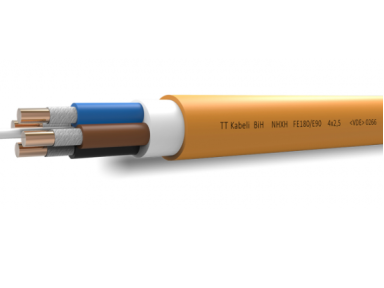
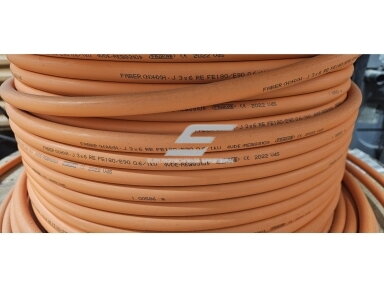
Cable with ceramifying silicone insulation – forms a ceramic layer when burning |
2×1.5, 3×1.5, 3×2.5 |
|
Extension cord, portable tool or appliance indoors, light mechanical stress |
Rubber H05RR-F (300/500 V) |
H05RR-F 3×1.5, 3×2.5, 5×2.5 |
|
Construction site, outdoor work, three-phase tool, welding machine, generator, moisture and oil |
Heavy-duty rubber H07RN-F (450/750 V) |
H07RN-F 3×2.5, 5×2.5, 5×50 |
|
Control circuits, push buttons, contactor coils, panel–machine connections without interference |
Control cable YSLY-JZ (OPVC-JZ) with numbered cores |
3×0.75, 18×0.75, 18×1.5 |
|
Sensors, 4–20 mA / 0–10 V signals, encoders, RS485 – near drives and motors |
Shielded LIYCY cable (copper braid shield) |
LIYCY 7×0.34 |
|
Cable chains, gantry robots, conveyors – continuous movement |
Highly flexible cable for moving equipment |
KAWEFLEX 5178 SC 1×240 |
|
Plastic water pipe, gas pipe or fibre optic route underground – must be found later with a locator |
Copper tracer (route marking) wire laid together with the pipe |
SL 1×1.5 blue, SL 1×1.5 orange |
Selection matrix: all cables in this group in one table
|
Type |
Insulation / sheath |
Voltage |
Strength |
Not suitable for |
|
SiHF |
Silicone rubber |
300/500 V |
High and low temperature, flexibility in the cold |
Mechanical damage, abrasion, continuous movement |
|
Ceramifying silicone |
Ceramifying silicone rubber |
see product description |
Circuit integrity during fire |
General use – unnecessarily expensive |
|
H05RR-F |
Natural / synthetic rubber |
300/500 V |
Flexible, convenient for portable equipment indoors |
Permanent outdoor use, oil, harsh conditions |
|
H07RN-F |
Rubber + polychloroprene sheath |
450/750 V |
Outdoor conditions, moisture, oil, construction |
High temperature near hot surfaces |
|
YSLY-JZ (OPVC-JZ) |
PVC |
300/500 V |
Many cores, numbering, PE core |
Environments with interference, direct burial |
|
LIYCY |
PVC + copper braid shield |
see product description |
Protection against electromagnetic interference |
Power circuits |
|
SL tracer wire |
PVC/PE insulation |
— |
Locating underground routes with a locator |
Power supply |
Heat and cold resistant cables
Silicone insulation stays flexible where PVC already softens or cracks: next to sauna stoves, boilers, electric heaters, cooking equipment, luminaires with hot housings, and in winter – in cold rooms and outdoor equipment. The exact operating temperature is given in each product description. All heat and cold resistant cables →
⚠ Check:
-
Silicone resists heat but is soft – unprotected it is easily cut and abraded. Use a sleeve or trunking over sharp edges.
-
Stranded core ends – only with ferrules, otherwise the strands spread in the terminal and overheat.
-
A ceramifying cable maintains the circuit in a fire only together with certified fixings – check the certification requirements of the system.
Flexible rubber cables: H05RR-F or H07RN-F?
H05RR-F – a lighter 300/500 V cable for indoor use: extension cords, household and workshop appliances. H07RN-F – a heavy-duty 450/750 V cable with a polychloroprene sheath, more resistant to moisture, oil and weather: for construction, generators, welding machines, industrial equipment and temporary outdoor connections. If in doubt and the cable will be outdoors – choose H07RN-F. All rubber cables →
✔ Benefit:
-
A rubber cable withstands bending and low temperatures well – it does not stiffen in winter like a PVC extension cord.
-
Large cross-section H07RN-F (e.g. 5×50) is suitable for temporary site supply from a generator or distribution box.
Control and shielded cables
YSLY-JZ (OPVC-JZ) – a flexible PVC control cable with black numbered cores and a green-yellow PE core (JZ). Convenient for panel and machine control circuits: each core is easy to identify by its number. LIYCY – a shielded signal cable with a copper braid for analogue signals, sensors and data lines where drives, motors or power cables are nearby. All control cables →
⚡ Safety and mistakes:
-
YSLY-JZ is not shielded – do not use it for motor supply from a frequency drive or for sensitive analogue signals.
-
The LIYCY shield only works when connected – earth the shield as instructed by the equipment manufacturer.
-
Do not lay signal and power cables in one bundle without spacing or a separator.
Tracer wires for underground routes
A metal detector will not find a plastic pipe underground. A copper tracer wire laid together with the pipe allows the route to be located precisely with a cable locator later – before excavation, repair or laying new utilities. Match the colour to the project or the route owner's requirements (often orange – telecom / fibre, blue – water routes). Tracer wires →
What do the markings mean?
|
Marking |
Meaning |
|
H (at the beginning) |
Harmonised European cable type |
|
05 / 07 |
Rated voltage: 05 – 300/500 V, 07 – 450/750 V |
|
RR / RN |
Insulation rubber (R) / sheath rubber (R) or polychloroprene (N) |
|
-F |
Flexible (stranded) cores |
|
Si |
Silicone insulation |
|
JZ / JB / J |
With green-yellow protective earth core |
|
OZ / X |
Without green-yellow core |
|
C / CY |
Shield (copper braid) |
|
3×2.5 |
Number of cores × cross-section mm² |
What to check before buying
⚠ Check:
-
The maximum ambient and surface temperature at the installation site.
-
Whether the cable will be fixed, occasionally flexed or in continuous motion.
-
Rated voltage (300/500 V or 450/750 V) and the required cross-section according to current, length and installation method.
-
Whether a PE (green-yellow) core is needed – marking J / JZ.
-
Whether there are sources of interference nearby – then a shielded cable is needed.
-
Cable price is per 1 m unless stated otherwise in the product description.
Most common mistakes
|
Mistake |
Consequence |
Correct solution |
|
PVC cable next to a sauna stove or heater |
Insulation softens, cracks, short circuit |
SiHF silicone cable, extra sleeve in the hot zone |
|
H05RR-F permanently outdoors or on a construction site |
Faster sheath ageing and damage |
H07RN-F |
|
Unshielded cable for sensors near a frequency drive |
Jumping readings, false signals |
LIYCY or another shielded cable, separate routing |
|
Stranded core without a ferrule |
Poor contact, overheating |
Ferrules matching the cross-section |
|
Plastic route without a tracer wire |
Route cannot be found, damage during excavation |
Tracer wire laid with the pipe |
FAQ
Which cable should I choose for an electric sauna stove?
Next to the stove and in the hot zone – silicone SiHF cable; cross-section and number of cores according to stove power and the manufacturer's instructions.
Can H05RR-F be used outdoors?
Briefly – yes, but for permanent outdoor use and construction sites choose H07RN-F.
What is the difference between JZ and OZ control cables?
JZ has a green-yellow protective earth core, OZ does not.
Does a shielded cable need to be earthed?
Yes, the shield only works when connected; the connection method is specified by the equipment manufacturer.
Is silicone cable suitable for laying in the ground?
No, silicone insulation is not intended for direct burial or mechanical loads.
Do you sell cable by the metre?
Yes, the price of most cables is per 1 m – state the required length when ordering.
This guide is for information only. Cable type and cross-section are selected according to the project, applicable installation requirements and the equipment manufacturer's instructions. UAB „Elektrotechnikos sprendimai“ is not responsible for product selection based solely on this guide. In doubt – ask us.