
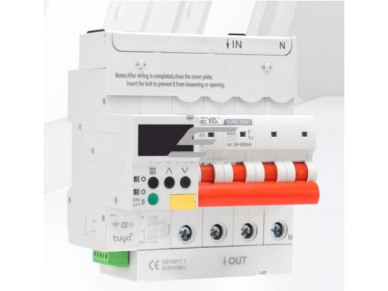

Smart circuit breaker | 4P | 32 A | C | 6 kA | 400 V AC | WiFi Tuya + RS485 | energy metering | residual current protection | GEYA GYRC-ZN01
Code: ESGYRC-ZN01Price 189.00 € VAT incl.( 156.20 € VAT excl. )Smart automatic circuit breaker (MCB) with Wi-Fi control, designed for remote switching on/off of electrical circuits and overload protection. Integration with the TUYA Smart Home platform allows convenient power management via a mobile app, enabling timers, scenarios, and real-time status monitoring. This circuit breaker is intended for three-phase (3F + N) electrical systems, making it suitable for residential buildings, commercial premises, workshops, automation solutions, and smart electrical panels.
-
Smart circuit breaker | 4P | 32 A | C | 6 kA | 400 V AC | WiFi Tuya + RS485 | energy metering | residual current protection | GEYA GYRC-ZN01
GEYA GYRC-ZN01 – a three-phase 4-pole smart circuit breaker with a 32 A rated current, C curve and 6 kA breaking capacity. In a single housing it combines overload and short-circuit protection, residual current, voltage and phase monitoring, energy metering and remote control via the Tuya Smart app (WiFi) and RS485.
Key idea:
This is not just a breaker but a “guardian” of a three-phase supply or a high-power circuit: you see voltage, current and consumption on your phone, can disconnect the site remotely, and in the event of a voltage surge, phase loss or overload the breaker trips by itself and, if you allow it, switches back on automatically. Especially relevant for sites that are not permanently occupied.Rated current
32 A, 4P, 400 V ACProtection
C curve, Icu = Ics = 6 kAResidual current protection
adjustable 30–500 mACommunication
WiFi (Tuya Smart) + RS485How it works
The breaker is mounted in a distribution board on a DIN rail or screwed to a mounting plate; three phases and neutral are connected to it. Once connected to a WiFi network, it is paired with the Tuya Smart / Smart Life app, while the RS485 interface allows integration into a building management or monitoring system.
During operation the breaker continuously measures voltage, current and power on each phase, residual current and internal temperature. When a set limit is exceeded – voltage, current, leakage, imbalance or temperature – the circuit is disconnected in less than 0.1 s. The threshold and delay (0–10 s) of each parameter are set in the app.
The result is a three-phase supply that can be monitored, controlled and protected from anywhere, and after a short-term grid disturbance power is restored automatically, without a trip to the site.
Why choose GYRC-ZN01?
Instead of a separate circuit breaker, RCD, voltage relay, energy meter and remote control module, you get one device with a single app. Fewer components in the board and fewer connections to maintain.Technical specifications
Product type Smart circuit breaker with residual current protection and energy metering Manufacturer / model GEYA GYRC-ZN01 Number of poles 4P (3 phases + N) Rated current 32 A Rated voltage / frequency 400 V AC (three-phase network), 50 Hz Tripping characteristic C Breaking capacity Icu = Ics = 6 kA Residual current threshold 30–500 mA (default 100 mA); sudden leakage change threshold 30–100 mA Overvoltage / undervoltage 250–350 V (default 280 V) / 110–200 V (default 165 V), delay 0–10 s Overload adjustable 0.6–1.0 × In, delay 0–10 s Other protections phase loss, voltage and current imbalance (5–30 %), overtemperature (60–100 °C), underpower / overpower Metering voltage, current, power, energy consumed; accuracy class 1.0 Communication WiFi 2.4 GHz (Tuya Smart / Smart Life) + RS485 (default baud rate 9600 bps) Control app, timers, manual operation, automatic reclosing Closing / opening time < 1.5 s / < 0.1 s Service life mechanical > 12 000 cycles, electrical > 6 000 cycles Mounting DIN rail or screw mounting, screw terminals Degree of protection IP20 (for installation in a distribution board) Standards declared by the manufacturer GB/T 16917, CQC1149 Key functions
- Remote switching on and off – disconnect the site from your phone, no need to travel to the board.
- Per-phase energy metering – see load and consumption, making it easier to find what is “eating” electricity.
- Voltage and phase-loss protection – protects motors, pumps and electronics against overvoltage, undervoltage and running on a missing phase.
- Adjustable residual current protection – set the threshold to suit the site, from 30 mA.
- Automatic reclosing – after a short grid disturbance power is restored by itself; the function can be disabled.
- Timers and scenes – switch the circuit on a schedule, e.g. during cheaper tariff hours.
- RS485 interface – the breaker can be connected to a building management or monitoring system.
Where is it used?
- Three-phase supply of a house, country house or summer cottage
- Rental apartments and commercial premises – remote disconnection and consumption control
- Heat pumps, electric boilers and water heaters
- Water pumping stations, boreholes and irrigation systems
- Workshops, small production halls and machine tools
- Agricultural buildings, warehouses, garages
- EV charging circuits (with the separately required protection)
- Mobile and temporary sites: construction sites, event power supply
Use by need
For country house or cottage owners.
On arrival there is no need to search for why there is no power – the app shows what happened, and power can be switched on in advance.For rental property managers.
You see consumption for each property separately and disconnect power remotely between tenants.For farm or workshop owners.
Pumps and motors are protected against phase loss and voltage surges, and you learn about a fault immediately.Practical use
If one phase is lost at a country house with a borehole pump and a heat pump, GYRC-ZN01 disconnects the entire supply within a few seconds, so the motors do not run on a missing phase and do not burn out. When normal voltage returns, the breaker switches back on automatically, and a record of when and why it tripped remains on your phone.Pros
- Many protections in one device: MCB, residual current, voltage, phases, temperature
- All thresholds and delays are adjustable
- Energy metering, accuracy class 1.0
- WiFi and RS485 at the same time
- Automatic reclosing without travelling to the site
- 6 kA breaking capacity, C curve
Cons / limitations
- The manufacturer declares Chinese standards (GB/T 16917, CQC); where an EN 61009 RCBO or a type A RCD is mandatory, use a separate certified RCD
- Default residual current threshold is 100 mA – for personal protection it must be set to 30 mA
- Remote control requires a stable 2.4 GHz WiFi
- Energy metering is not MID certified – for billing tenants, choose a MID meter
- Wider than a standard 4P MCB – leave space in the board
Safety and installation notes
- Installation and configuration by a qualified electrician only, with the power disconnected.
- The rated current of 32 A must match the current-carrying capacity of the protected cable (In ≤ Iz).
- Check that the short-circuit current at the installation point does not exceed 6 kA.
- After connection, set the residual current, voltage and overload thresholds in the app to suit the site – the factory settings are not suitable everywhere.
- Disable automatic reclosing in circuits where sudden switching on could be dangerous (machine tools, hoists).
- Connect the N conductor – without it, voltage metering and the protections will not work correctly.
Quick selection guide
4P | 32 AC | 6 kALeakage 30–500 mAWiFi Tuya | RS485Suitable when you need:- to control and monitor a three-phase supply or high-power circuit remotely;
- to protect equipment against voltage surges and phase loss;
- to restore power automatically at an unoccupied site.
Check before use:- that 32 A matches the cable cross-section and load;
- that there is enough space in the board and WiFi coverage there;
- that the site does not require a certified type A RCD.
Important reminder: the breaker does not replace a surge protective device (SPD) against lightning surges or a MID-certified meter for billing.FAQ
Does the breaker work without the internet?
Yes – the protections work independently; without WiFi, only remote control and app data are unavailable.Which app should I use?
Tuya Smart or Smart Life; through them the breaker can also be linked with Google Home or Alexa.Will it replace an RCD?
Functionally it has residual current protection from 30 mA, but where the project requires an EN 61009 / EN 61008 certified device, install a separate RCD.Is it suitable for a single-phase network?
This 4P model is designed for a three-phase 400 V network; for a single-phase circuit, choose the 2P version.Can automatic reclosing be disabled?
Yes, it is switched on and off in the app.What cable is needed for a 32 A breaker?
The cross-section is selected by the designer according to cable type, length and installation method – the cable's current-carrying capacity must be no less than 32 A.Smart circuit breaker | 4P | 32 A | C | 6 kA | 400 V AC | WiFi Tuya + RS485 | energy metering | residual current protection | GEYA GYRC-ZN01
GEYA GYRC-ZN01 32 A – a three-phase smart circuit breaker with C curve, 6 kA breaking capacity, adjustable residual current, voltage and phase protection, energy metering, WiFi Tuya and RS485 control. Suitable for the supplies of homes, country houses, rental and commercial properties that need to be monitored and controlled remotely.
Illustrative image may have been created using AI. The appearance of the product may differ slightly from the image shown. Please refer to the technical specification.Circuit breakers, also known as protective breakers or circuit interrupters, are essential components of electrical protection systems. They automatically disconnect the electrical circuit when it becomes overloaded or when a short circuit occurs. They are used in electrical installations to protect equipment and people from electrical faults. Circuit breakers come in various types and have different characteristics depending on the installation location, circuit load, and other specifications.
Circuit Breaker Characteristics:
B, C, and D Characteristics:
B characteristic: Used in residential areas or low-load systems. They operate when the current exceeds the nominal current by 3 to 5 times.
C characteristic: Commonly used in both residential and commercial or industrial spaces. Their operating threshold is 5 to 10 times the nominal current, making them suitable for loads with high inrush currents (e.g., motors, lighting systems).
D characteristic: Used in industrial installations where loads have very high inrush currents (e.g., compressors, transformers). They operate when the current exceeds the nominal by 10 to 20 times.
Advantages (Pros) of Circuit Breakers:Safety: Circuit breakers ensure that the circuit is automatically disconnected in case of overload or short circuit, preventing wire burning, equipment damage, or even fires.
Reliability: They are highly reliable and can operate for long periods without maintenance, reacting automatically when electrical faults occur.
Ease of use: There is no need to replace the breaker after it trips. After an overload or short circuit, the circuit breaker can simply be reset to its operational position, avoiding the need to replace fuses.
Precision: Circuit breakers operate accurately according to the nominal current and circuit characteristics, ensuring minimal unnecessary power interruption.
Protection against short circuits and overloads: Breakers not only protect against short circuits but also against prolonged overloads, which can be harmful to electrical systems.
Versatility: There are various types of circuit breakers suitable for different systems, from small household installations to large industrial systems.
Easy reset: After a trip, the breaker can simply be reset without the need to replace it (unlike fuses that need to be replaced after a trip).
Disadvantages (Cons) of Circuit Breakers:High cost: Circuit breakers, especially those with more complex functions (e.g., adjustable protection limits), are more expensive than simple fuses.
Limited operating range: While breakers provide protection against overloads and short circuits, they cannot protect against all types of electrical faults, such as overvoltage. Additional protection devices are required for that.
Larger size: Circuit breakers are generally larger than fuses, meaning their installation may require more space in the distribution panel.
Limited protection against frequent overloads: If the electrical system experiences frequent overloads, circuit breakers may not fully protect equipment from long-term damage caused by continuous overload exposure.
More complex repair: Some complex circuit breakers may require more maintenance or repairs if they malfunction or trip incorrectly.
Applications of Circuit Breakers:Household Installations:
B characteristic breakers are most commonly used in residential installations to protect circuits from short circuits and overloads. They are suitable for lighting circuits, plugs, and other low-load devices.
C characteristic breakers are also used in homes but are better suited for areas with higher inrush currents, such as electric motors or heaters.
Commercial and Industrial Installations:C characteristic breakers are often used in commercial and industrial buildings. They are suitable for electrical equipment with medium inrush currents.
D characteristic breakers are used in industrial equipment where large inrush currents occur, such as for heavy motors, transformers, or high-power equipment protection.
Large Mechanisms and Industrial Equipment:D characteristic breakers are used where the inrush currents are very high. This includes electrical network distribution sections, industrial machinery, and transformers.
Protection of Electronics Equipment:Certain types of circuit breakers are used to protect electronic equipment, such as in server rooms or other sensitive systems where fast and precise protection is required.
Conclusion:
Circuit breakers are essential in modern electrical systems to ensure safe power supply and protection from faults. They have many advantages, such as reliability, safety, and easy resetting, but they also have some drawbacks, such as higher cost and larger size. Their selection depends on the intended use and required protection parameters.K – Trips when the current is 8-12 times higher than the nominal current, designed to protect circuits powering motors, capacitors, and transformers.
S – Trips when the current is 13-17 times higher than the nominal current, designed for the protection of control transformers.
Z – Trips when the current is 2-3 times higher than the nominal current, designed for the protection of computer equipment and other electronic components and devices.
This product is marked with the CE label, which confirms that it complies with all applicable European Union directives and regulations. CE marking is not just a formality – it is an important indicator of quality and safety, ensuring that the product has been properly assessed, tested, and can be safely used throughout the EU market.
CE certification means that the product has been evaluated according to the main criteria:
Safety requirements – ensures that the product does not pose a risk to the user or the environment
Electromagnetic compatibility (EMC) – the device does not interfere with other equipment and is resistant to external disturbances
Environmental standards – complies with current ecological and material usage requirements
Operational reliability – the product is suitable for long-term use according to its intended purposeCE marking allows this product to:
be legally supplied and used in all European Union countries
ensure a high level of quality and safety
be used in residential, commercial, and industrial environmentsThe CE mark is a declaration of the manufacturer’s responsibility, confirming that the product complies with all applicable standards and has been assessed according to EU legislation.
What does this mean for you as a buyer?
Safe use in everyday activities
Reliable performance and reduced risk of failure
Compliance with EU standards and requirements
Suitability for professional solutions Love it? Share your thoughts in a review!Write Review
Related products
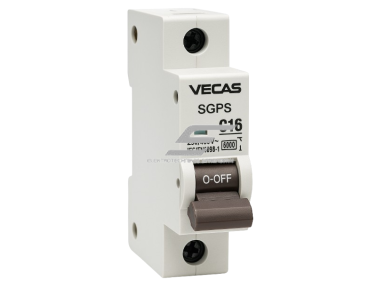 Modular circuit breaker 1P | 20A | C | 6kA | DIN | MCB VecasCode: SGPS120
A miniature circuit breaker (MCB) is a reliable protection device designed to safeguard low-voltage electrical circuits against overcurrents – including both overloads and short circuits. Developed for residential, commercial, and industrial installations, this breaker complies with the IEC60898 standard, ensuring a high level of safety and operational reliability. It offers a rated breaking capacity of up to 6000A, and the C-curve characteristic makes it suitable for circuits with moderate inrush currents, such as those powering lighting, household, or commercial loads.
Price 1.20 € VAT incl.( 0.99 € VAT excl. ) Modular circuit breaker 1P | 10A | C | 6kA | DIN | VecasCode: MCBC10
A miniature circuit breaker (MCB) is a reliable protection device designed to safeguard low-voltage electrical circuits against overcurrents – including both overloads and short circuits. Developed for residential, commercial, and industrial installations, this breaker complies with the IEC60898 standard, ensuring a high level of safety and operational reliability. It offers a rated breaking capacity of up to 6000A, and the C-curve characteristic makes it suitable for circuits with moderate inrush currents, such as those powering lighting, household, or commercial loads.
Price 2.53 € VAT incl.( 2.09 € VAT excl. ) Modular circuit breaker 2P | 25A | C | 6kA | DIN | MCB VecasCode: SGPS225
A miniature circuit breaker (MCB) is a reliable protection device for electrical installations, designed to protect two-phase circuits from short circuits and overloads. The device is intended for mounting on a standard 35 mm DIN rail, making it suitable for residential, commercial, and industrial distribution boards. Its type C tripping characteristic is ideal for mixed loads with moderate inrush currents, such as lighting and motor systems.
Price 2.40 € VAT incl.( 1.98 € VAT excl. ) Modular circuit breaker 3P | 63A | C | 6kA | DIN | MCB VecasCode: SGPS363
Vecas automatic modular circuit breaker (MCB) is a reliable and compact electrical protection device designed to protect three-phase circuits against short circuits and overloads. This module is mounted on a 35 mm DIN rail, making it ideal for use in electrical distribution boxes. The C-curve characteristic ensures proper resistance to medium inrush currents, while the 6000 A breaking capacity allows it to be used in both residential and industrial applications.
Price 4.76 € VAT incl.( 3.94 € VAT excl. )Alternative products
-
Product Catalog
-
Security and Surveillance Systems | accessories
- IP Surveillance Security Cameras
- Network accessories | equipment for reliable connection
- Video surveillance camera recording devices
- Data storage media | hard drives (HDD) | SD memory cards
- Low Voltage | Power Supply Accessories
- Motion | door | window contact | magnetic sensors | detectors security alarm components
- Keyboards | control panels for security system management
- Security alarm sirens
- Holders | mounting bases | brackets for surveillance cameras
- Solar panels and battery power supplies for surveillance cameras
- Manual camera control panels | video surveillance control
- Protection control system modules
-
Lighting solutions for industrial | commercial | residential | outdoor environments | accessories
- Commercial lighting
- Indoor Interior Lighting
- Lights for corridors | staircases | basement
- Outdoor luminaires | lighting solutions for home | yard | garden
- LED floodlights | street | park lights
- Lamps | for household | industrial lighting | accessories
- Inserts for ceiling light | LED modules with magnet
- LED flexible strips hermetic | non-hermetic | accessories
- Optical Fiber
- Emergency lighting
- Blue lamps | for drug prevention
- Motion | presence sensors | detectors
-
Automation and Control Systems
- Automation control accessories
- Control components for automation and control systems
- Signal converters | controllers for automation control | for control systems
- Touchscreens | panels for automation control | control systems
- Automatic Circuit Breakers for Direct Current (DC) Circuits with Integrated Overload, Short-Circuit, and Voltage Stabilization Protection Functions
- Automation and Electrical Control Components | Contactors | Relays | SSR | Accessories
- Automation control | Data transmission | Low current
- Industrial measurement | counting | detection systems for conveyors
- Panel heaters | protection for electrical equipment against moisture and cold
- Converters-transformers from single-phase to three-phase voltage
- Silicone strip heaters | electric heating solutions for industry
- Heating elements for liquids | water | oils | food heating
-
Smart Automated Products | Control | Transmission | Detection
- Smart Emergency Call System SOS
- Smart Office Management Solutions
- Mirror lighting – modern | smart | functional lighting and control solutions
- Automatic vacuum cleaner robots | smart solutions for daily home care
- NOUS smart | automated control
- WOOX Smart | Automated Control
- SONOFF Smart | Automated Control
- iNELS RF smart | automated control
- TUYA Smart | Automated Control
- IMOU smart | automated control
- Smart home hubs | accessories | for home automation
- Smart water valve controllers | water supply management
-
Electrical distribution and installation
- Reactive Power Compensation Devices
- Electrical power | power cables | wires with copper conductors
- Electrical Distribution Panels, Boxes & Accessories
- Modular equipment installed in electrical distribution boxes | panels
- Smart electrical network analyzers
- Reliable power management | stabilization | control | uninterrupted supply
- Fuse holder blocks
- Fuse disconnectors
- Fuses
- Electrical installation components
- Electric current transformers
- For domestic | professional use Extension cords | power supply extensions
-
Solar Energy Generation and Management Equipment
- Solar Modules | Electricity Generation Equipment
- Inverters for Solar Energy Systems
- Batteries | solar energy storage units
- Mounting systems for solar power plants – stable and secure installation of solar panels on roofs or ground
- Solar Power Plant Balancing | Automation Control | Analysis | Monitoring
- Protective DC automatic circuit breakers for solar modules
- Fuses | fuse holders | disconnectors for solar systems
- Wires | cables | connectors for solar power plants – reliable connection between solar modules | inverters | batteries
- Solar tracking system accessories, controllers, bearings and motors
- DC circuit breakers for batteries and low-voltage DC systems | 12–250 VDC
-
HVAC control solutions for heating and ventilation
- HVAC automation
- Fans for ventilation systems
- Ducts and connections for ventilation | air conditioning systems
- Deflectors | ventilation | ventilation systems
- Dampers for ducts | ventilation | air conditioning systems
- Duct Silencers | Ventilation | Ventilation Systems
- Air Filters for Ducts | Ventilation | Ventilation Systems
- Supply Air Ventilation Dampers
- Diffusers for Ventilation Systems
- Electric heating
- Mobile Air Conditioners | for Indoor Climate Control
- Domestic | industrial air purification systems
- Accessories for cars
-
Workplace Safety | Electrical Safety Equipment | LOTO
- Personal protective equipment for work
- Dielectric tools
- Safety tools
- Safe transport boxes
- Safety relays
- LOTO Lockout Devices | Safety Padlocks | Lockout Hasps
- Alarm warning sirens | audible-visual signals
- Work zone barriers and impact protection | barriers | corner guards
- Antistatic protection | static discharge grounding posts
-
Technical maintenance | service equipment | fire protection solutions
- Revision access doors
- Fire protection
- Passive lifting | unloading | transporting magnets
- Inflatable Liquid Storage Tanks | Reservoirs | Bladders
- Inflatable rubber plugs for sealing high-pressure plumbing pipes
- Rotary | rotating | moving high-pressure nozzles | for industrial cleaning | surfaces | coating treatment
- Ultrasonic micro mist spraying nozzles | dust suppression | humidification | cooling solutions for industry
- High-pressure washing hose reels
- Flood water barriers | protection systems for buildings and infrastructure
- Composite sewer manhole | technical access covers
- Industrial ozone generators for water treatment | disinfection
-
Emergency safety | hygiene | sanitary solutions
- Mobile sanitary containers | container toilets | showers | washbasins | WC
- Emergency safety showers | body | face | eye wash systems | stationary | mobile | combined solutions
- Air showers for cleanrooms | micro-particles | contaminant removal from clothing surface
- Laboratory mixers | sinks | laboratory accessories | for chemistry, medicine, industry
- Other showers | outdoor showers for pools | beaches | SPA
-
Other products
- Operational service products
- Tempered glass
- Pneumatic components
- Thermal Imaging
- Audio Systems
- Educational books
- Insulating anti-vibration sound-absorbing protective materials
- Rubber granule tiles - pavers
- Cutting | grinding discs for working with stone and metal
- Universal drills for concrete | masonry
- Motors and gearheads – precise | reliable | efficient motion control for various tasks
- Power line filters | protection against interference and voltage fluctuations
- Quality used products
-
Security and Surveillance Systems | accessories
- Current Affairs
-
Our services
-
- Automation panel assembly according to your request.
- Drone photography with thermal camera for tightness - thermographic inspections
- Tractor service, drilling, support dismantling... pile drilling for homes
- Rental of professional power network analyzers for accurate electrical parameter measurement and energy quality analysis
- Electrical panel configurator
-
- Contacts
Products catalog
-
Product Catalog
-
Security and Surveillance Systems | accessories
-
IP Surveillance Security Cameras
- BULLET Security Cameras
- EZVIZ Security | Surveillance Cameras
- DOME Security | Surveillance Cameras
- PTZ security | video surveillance cameras
- CUBE security | video surveillance cameras
- PT security | Surveillance cameras
- TURRET security | video surveillance cameras
- Other protection | video surveillance cameras
- Silicone caps for surveillance cameras
- Network accessories | equipment for reliable connection
- Video surveillance camera recording devices
- Data storage media | hard drives (HDD) | SD memory cards
- Low Voltage | Power Supply Accessories
- Motion | door | window contact | magnetic sensors | detectors security alarm components
- Keyboards | control panels for security system management
- Security alarm sirens
- Holders | mounting bases | brackets for surveillance cameras
- Solar panels and battery power supplies for surveillance cameras
- Manual camera control panels | video surveillance control
- Protection control system modules
-
IP Surveillance Security Cameras
-
Lighting solutions for industrial | commercial | residential | outdoor environments | accessories
- Commercial lighting
- Indoor Interior Lighting
- Lights for corridors | staircases | basement
- Outdoor luminaires | lighting solutions for home | yard | garden
- LED floodlights | street | park lights
-
Lamps | for household | industrial lighting | accessories
-
Energy-saving LED bulbs
- LED bulbs E27 base
- LED bulbs E14 base
- GU10 LED bulbs
- LED bulbs GU5.3 (MR16) base
- LED T8 lamps (tubes)
- LED T5 lamps (tubes)
- LED bulbs G4 base
- LED bulbs G9 base
- LED bulbs R7s base
- LED bulbs | analogues to fluorescent-compact bulbs
- LED lamps G53 base
- Decorative / vintage LED bulbs with E27 base
- Decorative / Vintage LED bulbs E14 base
-
Industrial LED lamps | HQL analogs | NAV lamps
- Industrial LED lamps | alternatives to mercury vapor lamps (HQL) E27 base
- Industrial LED lamps | analogs for mercury vapor lamps (HQL) E40 base
- Industrial LED bulbs | alternatives to sodium vapor lamps (NAV) E27 base
- Industrial LED bulbs | Alternatives to sodium vapor lamps (NAV) E40 base
- Industrial UFO type LED lamps | analogs for high-intensity discharge (HID) lamps E40 socket
- Holders for industrial LED lamps
- Fluorescent lamps
- Incandescent bulbs E27 | E14 base
- Household filament type bulbs E14 | E27 base
- Halogen Bulbs R7s | G9 | G6.35 | G4 | E27 Base
- Special purpose lamps
- Accessories for light fixtures | adapters | sockets | holders
- Ballasts for fluorescent lamps T8 | T5 base
- Starters for fluorescent lamps
- Electronic lamp starters | ignitors | initiators
-
Energy-saving LED bulbs
- Inserts for ceiling light | LED modules with magnet
-
LED flexible strips hermetic | non-hermetic | accessories
- Waterproof flexible LED strips
- Non-waterproof flexible LED strips
- Control of Flexible LED Strips
- Profiles | Channels | Corners for LED Flexible Strips
- LED flexible strip connectors | contacts | plugs
- 5V DC Switching Power Supplies for LED Strips
- 12V DC Power Supply for LED Strips
- 24V DC power supplies for LED strips
- Sensors for LED strip
- LED modules
- Optical Fiber
- Emergency lighting
- Blue lamps | for drug prevention
- Motion | presence sensors | detectors
-
Automation and Control Systems
-
Automation control accessories
-
Time voltage deviation current level network control visualization relay
- Controllers for automation systems
- Logical controllers for automation systems
- Servo Controllers for Automation Systems
- Network adapters | industrial automation | communication systems
- Digital | analog input modules for automation controllers
- Digital | analog output modules for automation controllers
- Signal towers | beacons | modules | accessories
- Power and time control relays for home automation with integrated SCHUKO sockets, designed for alternating and direct current protection and for household users.
- Boxes for signaling equipment | Signal lights
-
Cam switches | for devices on/off control
- Cam switches | changeover switches | for equipment control | 1-0-2
- Cam switches | changeover switches | for equipment control | 0-1
- Cam switches | changeover switches | for equipment control | 0-Y-Δ
- Cam switches | changeover switches | for equipment control | reversing | L-0-R
- Cam switches | changeover switches | for equipment control | 1-2
- Cam switches | changeover switches | for three-phase voltage measurement
- Cam switches | changeover switches | emergency | for equipment control
- Other cam switches | changeover switches | for equipment control | 1-2-3 | Uca -O-Uab-Ubc | Uc-O-Ua-Ud
- Plastic enclosures for cam switches
- Handles | levers for cam switches
- Electric motor control | protection management
- Soft starter devices for electric motors
-
Energy meters
- Single-phase electricity meters | energy metering devices
- Three-phase electricity meters | energy metering devices
- Single-phase electrical energy meters | metering devices with current transformers CT
- Three-phase electricity meters | energy metering devices with current transformers CT
- DC electrical energy meters | with shunt
- Hour meters | operating time recording
-
Time voltage deviation current level network control visualization relay
-
Control components for automation and control systems
-
Sensors | Detectors for automation | Control | Management systems
- Contactless bulk material level sensors
- End-position mechanical switches for automation control | control systems
- End-position micro switches for automation control | control systems
- Safety limit switches | industrial switches for equipment safety | for position control and automation
- Connection cables for sensors | detectors for control | automation systems
- Infrared safety barriers
- Contactless magnetic sensors for object detection in automation control | monitoring systems
- Non-contact inductive sensors for detecting metallic objects in automation control | monitoring systems
- Capacitive proximity sensors | for detection of metallic and non-metallic objects in automation control and monitoring systems
- Non-contact ultrasonic sensors for object detection in automation control | monitoring systems
- Non-contact photoelectric sensors for automation control | monitoring systems
- Optical sensors | detectors for automation devices
- Contactless color mark recognition sensors | color contrast detection in automation
- Camera sensors | detectors | brackets for control | automation systems
- Connectors | Sockets (female) | Plugs (male) for sensors | detectors for control | automation systems
- Mounting brackets for photoelectric sensors | control sensors | automation systems
- Rotary level sensors for bulk materials | rotating motion level switches | detectors for silos, hoppers, and tanks
- Vibrating level switches | sensors | detectors | for bulk materials and liquid level control
- Displacement | Linear Position Sensors for Automation
- Trolleys | Crane Control Panels | Hoist Control | Joystick
- Foot control pedals for industrial equipment management
- Audible signals 22/28mm for automation control | control systems
- Buttons for automation control | control systems
- Switches | Keys for automation devices control | control systems
- Additional accessories | components for buttons in automation control | control systems
- Latching push-button switches | ON-OFF | reversing
-
Sensors | Detectors for automation | Control | Management systems
- Signal converters | controllers for automation control | for control systems
- Touchscreens | panels for automation control | control systems
- Automatic Circuit Breakers for Direct Current (DC) Circuits with Integrated Overload, Short-Circuit, and Voltage Stabilization Protection Functions
-
Automation and Electrical Control Components | Contactors | Relays | SSR | Accessories
- Mini contactors for electric motor control
- Contactors | Electrical starters | For equipment control
- Electronic solid-state (SSR) contactors
- Contactors with enclosure and control buttons | for electrical equipment control
- Electromechanical thermal relays | electrical equipment protection
- Control coils for contactors | starters | electrical equipment control
- Adapters-converters for relays and contactors
- Additional contacts | Accessories for contactors
- Modular impulse relays | lighting | electrical circuit control
- Industrial solid state relays | electrical load control
- Intermediate relays for automation | for PLC and electrical control panels
- Automation control | Data transmission | Low current
- Industrial measurement | counting | detection systems for conveyors
- Panel heaters | protection for electrical equipment against moisture and cold
- Converters-transformers from single-phase to three-phase voltage
- Silicone strip heaters | electric heating solutions for industry
- Heating elements for liquids | water | oils | food heating
- Heating elements | igniters | for stoves | boilers | heaters
- Insulation Monitoring & Power Supply Equipment for Medical IT Systems
-
Automation control accessories
-
Smart Automated Products | Control | Transmission | Detection
- Smart Emergency Call System SOS
-
Smart Office Management Solutions
-
Office security and access control | management systems
- Electromagnetic door locks | latches for ensuring access control and security of premises | Accessories
- Electromagnetic door holders for various types of doors | ensuring convenience and safety in premises
- Hydraulic door closers | with impact damping | for smooth and silent door closing
- Exit door opening buttons | for controlling various types of indoor doors
- Face scanning and recognition systems | for secure and efficient access control
- Biometric fingerprint scanners | designed for security and access management
- Card | QR Code | Electronic Key Readers | For Premises Security and Access Control
- Electronic entry cards | key fobs | keys | stickers | for secure and convenient access management
- Door Code Locks | For Security and Access Management of Premises
- Turnstiles | Efficient People Flow Management | Access Control
- Intercoms
- Gate control access management systems
- Access control systems for electronic locks
- Door control and interface controller connection solutions
- Electronic door locks and access controllers
- Canopies for intercoms | protection of access control equipment
- Smart Door Locks | Security and Access Control Solutions
-
Universal mobile | network routers
- Communication converters | Data transmission interfaces and network integration solutions
- Data transmission solutions over a 230V power network | routers
- Mobile routers | 4G LTE | 5G | home and industrial
- Wireless communication | Long-range modems | Routers | Directional antennas | Network solutions
- Communication boosters for drones | wireless signal repeaters
- Wi-Fi routers | wireless network access points for home and office
- Wi-Fi Mesh systems | stable whole-home wireless coverage
-
Office security and access control | management systems
-
Mirror lighting – modern | smart | functional lighting and control solutions
- Magnifying mirrors with sandblasted edge for lighting
- Heating mats | defoggers heaters for mirrors
- Touch | contactless proximity switches mounted behind the mirror
- Digital information displays for mirrors
- Speakers | Resonance speakers for mirrors | furniture
- Smart mirror accessories and control solutions
- Automatic vacuum cleaner robots | smart solutions for daily home care
- NOUS smart | automated control
- WOOX Smart | Automated Control
-
SONOFF Smart | Automated Control
- SONOFF Smart Switches | Touch Switches
- SONOFF temperature | humidity sensors | controllers
- SONOFF smart home control panels
- SONOFF smart switches
- SONOFF smart motion sensors
- SONOFF smart energy meters
- SONOFF smart Schuko sockets
- SONOFF smart home hubs
- SONOFF smart lighting control
- SONOFF smart flexible LED strips
- SONOFF Smart Surveillance | Security Cameras
- SONOFF smart door and window sensors
- SONOFF smart roller shutter | blind | curtain control
- SONOFF other products | accessories
- iNELS RF smart | automated control
- TUYA Smart | Automated Control
- IMOU smart | automated control
- Smart home hubs | accessories | for home automation
- Smart water valve controllers | water supply management
- Smart electrical sockets | energy management
- Wireless automation modules | for smart system control
- Smart Automated Gate Control
- Farm automation | livestock equipment
-
Electrical distribution and installation
- Reactive Power Compensation Devices
-
Electrical power | power cables | wires with copper conductors
- Copper power cables CYKY-L (CYKY-J)
- Copper power supply cables KH05VV-U (NYM-J)
- Copper power supply cables BVV-LL
- Copper power supply cables H03VV-F, H05VV-F
- Copper power supply cables halogen-free NHXMH-J
- Copper power supply cables BVV-PLL
- Copper power supply cables BVV-P
- Copper power supply cables BVV-F, BVV-PL
- Copper power supply cables halogen-free BZ1Z1-P
- Copper power supply wires H05V2-K, H07V2-K
- Copper power supply wires H05V-K
- Copper power supply wires H07V-R, H07V2-R
- Copper power supply wires H07V-K
- Copper power supply wires H05V-U, H07V-U, H05V2-U, H07V2-U
- Halogen-free copper power supply cables H07Z1-K
- Aluminum power supply cables
- Computer power supply cables
- Special purpose power supply cables
- Copper | vintage | retro style braided cables
- Power transmission busbar
- Power supply cables / Leftovers
-
Accessories for power supply cables
- Wire trays | channels for power supply cables | wires
- Cable trays | channels for power supply cables | wires
- Lighting cable trays | channels for power supply cables | cable management
- Profiles for electrical supply cables | wire laying | metallic
- Cable ladders for power supply cables | wires
- Accessories for metal power supply cable | wire channels | trays
- Cable laying | fixing | installation structures
- Installation cable trays | channels for electrical cables | wires | plastic
- Electrical cable | wire identification markers | marking tools
- Surface-mounted sealed | unsealed installation distribution boxes for electrical cables | wires
- Cable lugs and connectors
- Thermally shrinking insulating gloves | hermetically seal electrical wires | cables
- Heat shrink tubing | insulating electrical wires | cables
- Electrical insulating tapes | for electrical wires | cables
- Spiral strips | for concealing electrical wires | cables
- Gel sleeves | for electrical wires | cables
- Gels | lubricants for wire | cable pulling
- Insulating gels for protecting electrical wires | cable connections | contacts from humidity
- Warning hazard | caution marking tapes
- Dielectric insulating sheaths for the protection of electrical cables | wires
- Connectors | plugs | sockets for electrical cables | wires | hermetic
- Electrical cable | wire mechanical protection devices
- Hermetic cable and corrugated conduit entries into electrical distribution boards and enclosures | sealed cable entry solutions
-
Electrical Distribution Panels, Boxes & Accessories
- Single-phase | three-phase electricity metering boxes
- Electrical energy distribution | metering boxes for apartments
-
Surface-mounted electrical power panels | boxes
- Metal | steel surface-mounted electrical distribution boxes | enclosures
- Plastic overhead electrical distribution panels | boxes
- Steel | stainless steel surface-mounted electrical panels | boxes
- Plastic surface-mounted electrical enclosures | boxes
- Metal overhead electrical distribution boxes | panels
- Aluminum surface-mounted | hermetic electrical distribution cabinets | boxes | IP67
- Flush-mounted electrical distribution panels | boxes
- Transparent protective covers for electrical distribution panels | boxes
-
Special electrical panels for garages | panels designed for commercial premises
- Industrial electrical distribution modular enclosures | panels | boxes with additional space for equipment installation
- Industrial modular electrical distribution boards | panels | enclosures with socket outlets
- Industrial combined distribution boards | enclosures with socket outlets
- Construction site distribution boards and mobile power distribution boxes
- Portable electrical distribution | panels | enclosures | boxes
- Switch-disconnectors | changeover switches 1-0-2 | safety switches | accessories
- Sealing products | seals for electrical wires | cables | panels | boxes
-
Terminals | connections for electrical cables | distribution | connection
- Power distribution terminals for electrical wires | cables
- WAGO terminal blocks for electrical wire | cable connections
- Connectors for electrical wires | cable connections
- Installation terminals for connecting electrical wires | cables of fixtures
- Grounding terminals for connecting electrical wires | cables
- Branching terminals for electrical wires | cable connections
- Rear covers for spring assemblies
- Busbar grounding and protection systems
- Soldering components | connection solutions
- Screen terminals for connecting electrical cables | wires
- Accessories for terminals | electrical contacts
- Spring terminal blocks | electrical connections | on DIN rail
- Spring lever terminal blocks for electrical wire | cable connections
- Terminals for connecting electrical wires | cables | mounted on a DIN rail
- DIN rails for mounting modular equipment in the electrical distribution panel
- Switch cabinets | network | telecommunications | server equipment
- Cable transit cabinets | for cable distribution
- Universal cross electrician keys
- Locks | keys | for electrical distribution panels | boxes
- Wire | cable entry strain reliefs in enclosure | cavity
-
Modular equipment installed in electrical distribution boxes | panels
-
Circuit breakers | installed in electrical distribution boxes | panels
- Schneider Electric circuit breakers | installed in electrical distribution boxes | panels
- Industrial circuit breakers
- "Vecas" circuit breakers | for installation in electrical distribution cabinets | boxes
- "Promfactor Baltic" circuit breakers | installed in electrical distribution boxes | panels
- "Noark" circuit breakers | installed in electrical distribution boxes | panels
- "SIEMENS" automatic circuit breakers | installed in electrical boxes
- "Hager" automatic circuit breakers | installed in electrical distribution boxes | panels
- "Legrand" automatic circuit breakers | installed in electrical distribution boxes | panels
- "IEK" automatic circuit breakers | installed in electrical distribution boxes | panels
- "Merlin Gerin" automatic circuit breakers | installed in electrical distribution boxes | panels
- "Eaton" automatic circuit breakers | installed in electrical distribution boxes | panels
- Accessories for circuit breakers
- Smart WiFi circuit breakers | Tuya | with energy metering
- ABB circuit breakers | for distribution boards
- Circuit breakers from other manufacturers | Zext | Allen-Bradley | Netlux | Etimat
- Power contactors | installed in electrical distribution boxes | panels
-
Modular leakage relays | installed in electrical distribution boxes | panels
- "Promfactor Baltic" leakage relays | mounted in electrical distribution boxes | panels
- "Legrand" leakage relays | mounted in electrical distribution boxes | panels
- "Schneider Electric" leakage relays | installed in electrical distribution boxes | panels
- "Eaton" leakage relays | mounted in electrical distribution boxes | panels
- "Vecas" residual current relays | for installation in electrical distribution boxes | cabinets
- Voltage relays modular | mounted in electrical distribution boxes | panels
- Current relays modular | installed in electrical distribution boxes | panels
- Power limiters modular | installed in electrical distribution boxes | panels
- Phase switch modular | mounted in electrical distribution boxes | panels
- Temperature controllers | modular thermostats | designed for mounting in electrical distribution boxes | panels
- Modular time relays | installed in electrical distribution boxes | panels
- Modular | panel | digital ammeters | voltmeters | for installation in electrical distribution boxes | cabinets
- Photo relays | twilight switches | mounted in electrical distribution boxes | panels
- Measurement monitoring electric energy monitoring equipment
- Modular control | signaling equipment | switches | indicator lamps | audible signals
- Automatic aerosol fire extinguishing systems for electrical cabinets and server rooms
- Modular liquid level control relays | for installation in electrical distribution boxes | switchboards
- Interface relays | modular for signal amplification and load control | for installation in electrical distribution boxes | panels
- Modular staircase lighting relays | for installation in electrical distribution boxes | panels
- Phase monitoring | sequence | protection relays, modular | for installation in electrical distribution boxes | panels
- Circuit breakers with residual current protection (RCBO) | for distribution boxes | panels
-
Circuit breakers | installed in electrical distribution boxes | panels
- Smart electrical network analyzers
- Reliable power management | stabilization | control | uninterrupted supply
- Fuse holder blocks
- Fuse disconnectors
- Fuses
-
Electrical installation components
-
Socket outlet blocks for installation in furniture | on surfaces
- Surface-mounted socket towers | power outlet towers
- Socket outlet blocks | desktop mounted socket blocks
- Socket outlet blocks | receptacle blocks built into furniture
- Plug sockets | connectors | wireless charging stations integrated into furniture
- Socket towers | power outlets integrated into furniture
- Socket outlet blocks | receptacle blocks for panel mounting
- Socket blocks with LED lighting
- Modular socket outlets | socket blocks | boxes for furniture installation
- Modular socket towers | surface-mounted socket outlets
- Modular socket towers | power outlets integrated into furniture
- Modular socket outlets | socket blocks | boxes for installation in cabinets
- Built-in modular connectors | for electrical socket systems
- Accessories for built-in furniture sockets
- Sedna Recessed Electrical Installation by Schneider Electric
- Recessed electrical installation
- Hermetic flush-mounted electrical installation IP55
-
Hermetic surface-mounted electrical installation IP44 | IP54 | IP66
- Hermetic surface-mounted installation | 1-gang sockets | switches | accessories
- Hermetic surface-mounted installation | 2-gang sockets | switches | accessories
- Hermetic surface-mounted electrical installation | 3-gang sockets | switches | accessories
- Hermetic surface-mounted installation | 4-gang sockets | switches | accessories
- Surface-mounted electrical installation
- Electrical installation "Vilma"
-
Vintage | Retro Style Electrical Installation Components
- Distribution boxes | surface-mounted | ceramic | retro style
- Plug sockets | surface-mounted | ceramic | retro style
- Plug sockets | flush-mounted | ceramic | retro style
- Switches | surface-mounted | ceramic | retro style
- Switches | flush-mounted | ceramic | retro style
- RJ11 | RJ45 | DATA plug sockets | surface-mounted | flush-mounted | ceramic | retro style
- Surface-mounted socket outlets | plastic | retro style
- Socket outlets | RJ45 | USB-A | USB-C | flush-mounted | plastic | retro style
- Switches | intermediate switches | two-way switches | surface-mounted | plastic | retro style
- Switches | intermediate | blind | doorbell push buttons | flush-mounted | plastic | retro style
- Frames for surface-mounted electrical installation components | ceramic | retro style
- Frames for flush-mounted electrical installation components | ceramic | retro style
- Frames for Surface-Mounted Electrical Installation Components | Plastic | Retro Style
- Frames for flush-mounted electrical installation components | plastic | retro style
- Frames for flush-mounted electrical installation components | wooden | retro style
- Insulators for braided wires | ceramic | metal | retro style
- Distribution mounting boxes are designed to be installed in drywall | masonry
- Boxes mounted in the floor | for socket installation
- Installation electrical boxes for drywall | masonry
-
Socket outlet blocks for installation in furniture | on surfaces
-
Electric current transformers
- Rogowski Coil Integrators
- Split-core current transformers CT | current measurement solutions
- Digital multimeters with CT current transformers | current measurement solutions
- Flexible "Rogowski" coils | current measurement solutions
- Rigid | non-flexible "Rogowski" coils | rings | current measurement solutions
- For domestic | professional use Extension cords | power supply extensions
-
Industrial | domestic socket outlets | plugs | adapters for electricity supply
- Household single-phase plugs | industrial single-phase | three-phase for electricity supply
- Plug sockets for household single-phase | industrial single-phase | three-phase electrical power supply
- Adapters (transitions) for household | industrial power supply
- Sockets mounted on a DIN rail | for power supply
- High Voltage Equipment | Components 6kV | 10kV | 12kV | 20kV
-
Underground Power Transmission | Overhead Power Lines
- 0.4kV Overhead Line Metal Structures for Uninsulated Wires
- 10kV Overhead Line Metal Structures with Non-Insulated Conductors
- Metal structures for 0.4kV overhead lines with insulated wires
- Clamps for air line cables | cables | equipment mounting
- Guy wires | Crossarm braces | Stork nest platforms
- Cable supports for overhead lines
- Air line terminals
- Air line crossbars for SZ circuit breakers
- Airline covers | Wire frames | Cable mounting
- Airline metal structures | traverses | tops
- Insulators for Electrical Power Airline Lines
- Overhead power cables | wires for electricity supply
- Bird Protection for Electrical Equipment
- Preformed helical anchor clamps for overhead lines
- Eye nuts for overhead power lines and energy infrastructure fastening assemblies
- Reinforced concrete poles for overhead power lines and infrastructure networks
-
Surge Protection and Lightning Protection
- Active lightning rods | Lightning strike protection
- Passive Franklin-type lightning rods | lightning strike protection
- Surge Arresters | Electrical Equipment Protection from Lightning Strikes
-
Lightning protection | grounding system components | rods | connectors | fastening | installation accessories
- Potential equalization busbars | terminals | for grounding systems
- Digital | mechanical lightning discharge counters
- Galvanized steel strips for grounding
- Galvanized steel | aluminum wires for grounding
- Hot-dip galvanized poles for lightning rod mounting
- Grounding rods | galvanized | copper-coated | with lead filling for lightning protection system
- Concrete bases for lightning rod installation | accessories
- Driving heads | chisels for grounding rods
- Grounding wire holders | PVC | stainless steel | accessories
- Anti-corrosion connection tapes | pastes for lightning protection systems
- Tips for grounding rods | lightning protection systems
- Galvanized connectors for fastening wire to mast | lightning protection systems
- Cross connections | for grounding | lightning protection systems
- Lightning rods | mast mounting | installation accessories
- Coupling sleeves for grounding rods
- Test joint boxes and inspection pits
- Thermal welding
-
Solar Energy Generation and Management Equipment
- Solar Modules | Electricity Generation Equipment
-
Inverters for Solar Energy Systems
- Single-phase solar inverters | efficient electricity management
- Three-phase solar inverters | efficient electricity management
- Hybrid three-phase solar inverters | efficient electricity management
- Solar power controllers | reliable power plant control
- Combined hybrid solar inverters with battery | UPS function
- Batteries | solar energy storage units
- Mounting systems for solar power plants – stable and secure installation of solar panels on roofs or ground
-
Solar Power Plant Balancing | Automation Control | Analysis | Monitoring
- Backup power transfer switches for generators (ATS / MTS)
- Solar electricity energy meters
- Surge protectors for solar | photovoltaic systems
- Solar power plant circuit breakers | reliable protection and control for solar energy systems
- Solar inverter accessories | adapters
- Voltage control relays for solar power plants
- Solar module optimizers | maximum solar power plant output and efficiency
- Protective DC automatic circuit breakers for solar modules
- Fuses | fuse holders | disconnectors for solar systems
- Wires | cables | connectors for solar power plants – reliable connection between solar modules | inverters | batteries
- Solar tracking system accessories, controllers, bearings and motors
- DC circuit breakers for batteries and low-voltage DC systems | 12–250 VDC
-
HVAC control solutions for heating and ventilation
-
HVAC automation
-
Sensors and detectors
- Temperature sensors and thermostats
- Fluid flow | temperature meters | sensors
- Household | Industrial temperature maintenance thermostats
- Air quality meters | CO2 | VOC sensors
- Differential pressure relays and transducers
- Liquid level sensors | Monitoring systems
- Non-contact infrared (IR) surface temperature sensors
- Digital gas flow meters
- Temperature and humidity sensors | environmental parameter measurement solutions
- Anemometers | wind speed | air flow measuring devices
- Electric motors
-
Frequency inverters for motor speed regulation
- Optidrive frequency inverters for motor speed control
- Siemens frequency inverters | efficient motor control | process automation
- Schneider Electric frequency inverters | efficient motor control | process automation
- EURA Drives frequency inverters | efficient motor control | process automation
- Frequency inverters
- Air damper drives
- Speed regulators for fans
- Motorized actuators for air dampers | ventilation (HVAC) systems | air ducts
- Modbus modules and power supplies
-
Sensors and detectors
-
Fans for ventilation systems
- Industrial Fans for Ventilation Systems
- Centrifugal Roof Fans | Ventilation | Ventilation Systems
-
Domestic fans for ventilation systems
- Domestic inline duct fans | for ventilation systems
- Household window fans | ventilation system
- Household ceiling fans | air circulation solutions
- Standard extractor fans | wall switch controlled
- Extractor fans with pull-cord switch
- Extractor fans with timer
- Extractor fans with timer and humidity sensor
- Extractor fans with light or plug
-
Protective ventilation grilles for ventilation systems
- Round protective ventilation grilles for ventilation systems
- Wall-mounted | external protective ventilation openings for ventilation systems
- Furniture ventilation grilles for ventilation systems
- Square protective ventilation grilles | Galvanized steel
- Square protective ventilation grilles for ventilation systems | plastic
- Fan shutdown timers for ventilation systems
- Accessories for fans | ventilation systems | decorative panels
-
Ducts and connections for ventilation | air conditioning systems
-
Ducts for ventilation | ventilation systems
- Sealing tapes for duct systems
- Rigid ducts for ventilation | air conditioning systems | plastic
- Flexible ducts for ventilation systems | aluminum
- Flexible ducts for ventilation | vent systems | stainless steel
- Flexible ducts for ventilation systems | metal
- Flexible ducts for ventilation | ventilation systems | PVC film
- Rigid ducts for ventilation | air conditioning systems | galvanized steel
- Square | rectangular | rigid ducts | for ventilation systems | plastic
-
Square | rectangular ducts | ventilation | ventilation systems | plasticSquare | rectangular ducts | ventilation | ventilation systems | plastic
- Holders for square ducts | ventilation systems | plastic
- Connections for square ducts | ventilation | ventilation systems | elbows 3°-49° | plastic
- Connectors for square ducts | ventilation | ventilation systems | 90° elbows | plastic
- Connections for square ducts | ventilation | ventilation systems | fittings | plastic
- Connections for square ducts | ventilation | ventilation systems | T-shaped | branch fittings | plastic
- Connections for square ducts | ventilation systems | sleeves with a backdraft damper | plastic
- Wall connectors for square ducts | ventilation systems | adapters | plastic
- Ducts | Ventilation | Ventilation Systems | Metal
-
Ducts | ventilation | ventilation systems | plastic
- Connections for ducts | Ventilation systems | 45° elbows | Plastic
- Duct connections | ventilation systems | 90° elbows | plastic
- Connections for ducts | Ventilation systems | Couplings | Plastic
- Connectors for ducts | ventilation systems | transitions | adapters | plastic
- Connectors for ducts | ventilation systems | T-shaped | three-way | plastic
- Duct connections | ventilation systems | flanges | plastic
- Duct connections | ventilation systems | condensate collector | plastic.
- Connections for ducts | ventilation systems | flexible connectors with backflow valve | plastic
- Wall connectors for ducts | ventilation systems | adapters | plastic
- Holders for ducts | ventilation systems | plastic
-
Ducts | ventilation | ventilation systems | galvanized steel
- Duct fittings | ventilation systems | 45° elbows | galvanized steel
- Connections for ducts | Ventilation systems | 90° elbows | Galvanized steel
- Duct ventilation hoods | chimneys | for ventilation systems | galvanized steel
- Connectors for ducts | ventilation systems | T-shaped | tees | galvanized steel
- Connectors for ducts | ventilation systems | transitions | adapters | galvanized steel
- Connections for ducts | ventilation systems | sleeves | galvanized steel
- Flexible connectors for ducts | ventilation systems | sleeves | galvanized steel
- Connectors for ducts | ventilation systems | connectors with back-draught shutter | galvanized steel
- Holders for ducts | ventilation systems | galvanized steel
- Connectors for ducts | ventilation systems | branches | galvanized steel
- End caps for ducts | ventilation systems | galvanized steel
- Transitions | adapters for square and round ducts | ventilation | ventilation systems | plastic
-
Ducts for ventilation | ventilation systems
- Deflectors | ventilation | ventilation systems
- Dampers for ducts | ventilation | air conditioning systems
- Duct Silencers | Ventilation | Ventilation Systems
- Air Filters for Ducts | Ventilation | Ventilation Systems
- Supply Air Ventilation Dampers
- Diffusers for Ventilation Systems
-
Electric heating
-
Electric heating
- Infrared heaters
- Infrared heaters | heating panels
- Electric wall-mounted | free-standing heaters | radiators — reliable electric heating
- Other heaters
- Underfloor heating thermostats | mats
- Industrial electric fan heaters
- Self-regulating | heating power supply cables
- Electric hot air curtains
- Electric footwear / shoe dryers | ADAX ST3D
- Radiant heaters | ADAX | Glamox Heating GVR5/VR5
- Electric heating regulators
- Grilles for radiators | for duct finishing
- Accessories for heating systems
-
Electric heating
- Mobile Air Conditioners | for Indoor Climate Control
- Domestic | industrial air purification systems
- Aromatic diffusers | essential oil diffusers for homes | offices | industrial premises
- Domestic | industrial dehumidifiers | moisture collectors | humidity control solutions
- Domestic | industrial air humidifiers | ultrasonic | fog generators
-
HVAC automation
- Accessories for cars
-
Workplace Safety | Electrical Safety Equipment | LOTO
- Personal protective equipment for work
- Dielectric tools
-
Safety tools
- Dielectric Screwdrivers
- Insulated pliers for electricians
- Insulated cable | wire knives | professional safe tools for electricians
- Crimping presses - pliers
- Cable cutting scissors | pliers
- Cable stripping knives | pliers
- Hydraulic hole punchers | hole punching tools | for electrical panels | professional tools for cable entries | for automation and distribution cabinets
- Safe transport boxes
- Safety relays
-
LOTO Lockout Devices | Safety Padlocks | Lockout Hasps
- LOTO Safety Padlocks | Personal Lockout Padlocks
- LOTO Lockout Hasps | Group Lockout
- Electrical Plug Lockouts | LOTO Covers
- Valve and Gas Cylinder Lockouts
- Group Lockout and Key Boxes
- LOTO Tags | Warning Tags
- LOTO switch and button lockouts | circuit breakers | knife switches | E-stop buttons
- LOTO kits | complete lockout sets
- Alarm warning sirens | audible-visual signals
- Work zone barriers and impact protection | barriers | corner guards
- Antistatic protection | static discharge grounding posts
-
Technical maintenance | service equipment | fire protection solutions
-
Revision access doors
- Plastic revision access doors
- Floor access hatches | aluminium profile | under tiles
- Aluminum profile inspection doors-hatches with drywall panel
- Aluminum revision access doors with chain
- Steel revision access doors
- Steel revision access doors - hatches with a lock
- Roof access hatch-doors with gas struts | Aluminium
- Access panels with a window | for access to technical cavities
- Fire protection
- Passive lifting | unloading | transporting magnets
- Inflatable Liquid Storage Tanks | Reservoirs | Bladders
- Inflatable rubber plugs for sealing high-pressure plumbing pipes
- Rotary | rotating | moving high-pressure nozzles | for industrial cleaning | surfaces | coating treatment
- Ultrasonic micro mist spraying nozzles | dust suppression | humidification | cooling solutions for industry
- High-pressure washing hose reels
- Flood water barriers | protection systems for buildings and infrastructure
- Composite sewer manhole | technical access covers
- Industrial ozone generators for water treatment | disinfection
-
Revision access doors
-
Emergency safety | hygiene | sanitary solutions
- Mobile sanitary containers | container toilets | showers | washbasins | WC
- Emergency safety showers | body | face | eye wash systems | stationary | mobile | combined solutions
- Air showers for cleanrooms | micro-particles | contaminant removal from clothing surface
- Laboratory mixers | sinks | laboratory accessories | for chemistry, medicine, industry
- Other showers | outdoor showers for pools | beaches | SPA
-
Other products
-
Operational service products
- Measuring equipment
- Marking | Safety Signs
-
Cable ties | cable holders | mounting accessories
- Holders for cables and wires
- Accessories for cable ties
- Mounting straps installed on the surface
- Double cable ties
- Double locking cable ties
- Mounting straps with locking base | surface-mounted
- Universal fastening straps
- Cable ties with push-in mounting holder
- Cable ties with stainless steel locking tab
- Work lights
- Portable Battery-Powered Flashlights
- Galvanic cells batteries
- Storage boxes and containers
- Inspection and observation mirrors | professional solutions for visual inspection | safety | diagnostics
- Spherical safety mirrors | for blind spot monitoring and traffic safety
- Tempered glass
- Pneumatic components
- Thermal Imaging
- Audio Systems
- Educational books
- Insulating anti-vibration sound-absorbing protective materials
- Rubber granule tiles - pavers
- Cutting | grinding discs for working with stone and metal
- Universal drills for concrete | masonry
- Motors and gearheads – precise | reliable | efficient motion control for various tasks
- Power line filters | protection against interference and voltage fluctuations
- Compact electronics cooling | ventilation fans | accessories
- Industrial multipole connectors | housings | accessories
- Decorative & Acoustic Wall and Ceiling Panels | Slat Panels | Interior Finishes
- Acoustic | Sound-Absorbing Foam Panels for Echo Reduction
-
Operational service products
- Quality used products
-
Security and Surveillance Systems | accessories
- Current Affairs
-
Our services
- Automation panel assembly according to your request.
- Drone photography with thermal camera for tightness - thermographic inspections
- Tractor service, drilling, support dismantling... pile drilling for homes
- Rental of professional power network analyzers for accurate electrical parameter measurement and energy quality analysis
- Electrical panel configurator
- Contacts

To get free delivery spend additional
2000.00 € VAT incl.
We will deliver for free!
Up to the minimum order amount left
8.00 € VAT incl.


UAB Elektrotechnikos sprendimai
Elektrotechnikos sprendimai, UAB. Company code: 305053561 VAT number: LT100012235811. J. Basanavičiaus g. 23, LT-76233, Šiauliai, Šiaulių m. sav., LITHUANIA. Phone: +37065801033.
© 2026 Elektrotechnikos sprendimai, UAB. Without Elektrotechnikos sprendimai, UAB confirmation any use or copying of site content is prohibited.
Smart circuit breaker | 4P | 32 A | C | 6 kA | 400 V AC | WiFi Tuya + RS485 | energy metering | residual current protection | GEYA GYRC-ZN01
Add to cart -