


Modular liquid level control relays | for installation in electrical distribution boxes | switchboards
-
Liquid Level Control Relays
Modular liquid level control relays are designed to automatically monitor the level of electrically conductive liquids in reservoirs, tanks, wells and other systems. Depending on the selected model and wiring diagram, the relay can control a pump, valve, contactor, alarm or other equipment according to the preset minimum and maximum liquid levels.
This product group may include relays with different supply voltages, contact configurations, sensitivity ranges, number of electrodes and functionality. They are most commonly installed on a DIN rail inside an electrical or automation panel and used together with liquid level electrodes or probes.
Important regarding liquid conductivity:
Standard electrode-type level control relays usually operate by measuring electrical conductivity between electrodes immersed in the liquid. Therefore, they are intended for electrically conductive liquids, such as water or various water-based solutions. Distilled water, oil, fuels and other liquids with very low electrical conductivity may require a different type of level sensor.Important regarding the controlled load:
The relay output contact is not necessarily designed to switch a high-power pump directly. If the pump motor current exceeds the permissible load of the relay contacts, the relay output should control a contactor or another suitable power circuit. Always check the electrical contact ratings of the specific model.Key point:
Choose a modular liquid level control relay when you need to automatically maintain a preset liquid level, protect a tank from overflowing or protect a pump from running without water. The appropriate model is selected according to the type of liquid, control function, supply voltage, number of electrodes, contact load and the operating principle of the specific system.Installation
DIN railPurpose
Liquid level controlControl
Pumps, valves, contactorsSensors
Level electrodes / probesLiquids
Electrically conductiveSystem
Automatic level controlWhat is a liquid level control relay?
A liquid level control relay is an automation device that receives information from electrodes or other compatible level sensors installed in a tank and switches its output relay on or off according to their status.
Electrode-based systems use the electrical conductivity of the liquid. When the liquid reaches an electrode, an electrically detectable path is formed between that electrode and the common electrode. The control relay evaluates this signal and changes the state of the output contact.
In this way, tank filling, tank emptying, minimum or maximum level signalling can be automated, and pumps can be protected against undesirable operating conditions.
The relay and level electrodes perform different functions:
The electrodes determine whether the liquid has reached a specific point in the tank, while the modular control relay processes this information and controls its output contact. Therefore, before installation, it is essential to check how many electrodes and which wiring configuration are required for the specific relay model.Operating principle
- Level detection – electrodes installed at different heights inside the tank come into contact with the liquid.
- Conductivity measurement – the relay detects an electrical connection between the common and control electrode.
- Signal evaluation – the electrode status is used to determine whether the minimum or maximum level has been reached.
- Relay switching – the internal output contact is switched on or off.
- Equipment control – the contact can control an alarm, solenoid valve, contactor or another automation circuit.
- Automatic cycle – when the liquid level rises or falls to another electrode, the output state changes according to the selected operating mode.
Main control modes
Mode Operating principle Tank filling When the liquid drops to the minimum level, filling is switched on, and when the maximum level is reached, filling is switched off. Tank emptying When the higher level is reached, pumping out can be activated, and when the liquid falls to the minimum level, it is switched off. Maximum level control The relay is used to generate a signal or control command when the liquid reaches the preset upper level. Minimum level control It can detect when the liquid level falls below the selected point. Dry-run protection The pump control circuit is switched off or prevented from starting when there is insufficient liquid in the monitored tank. Overflow alarm When the highest control electrode is reached, an audible, visual or remote alarm can be activated. Important:
The operating logic, contact state and available filling or emptying modes may differ between models. Before connecting equipment, always follow the wiring diagram of the specific relay.Purpose of the electrodes
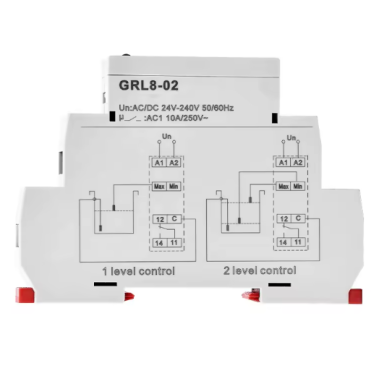
For automatic two-level control, several electrodes installed at different heights in the tank are often used. Their exact function depends on the wiring diagram of the specific relay.
Electrode Typical purpose Common electrode Used as the common conductivity measurement point. Minimum level Defines the lower liquid level limit. Maximum level Defines the upper liquid level limit. Additional electrodes Some models may use additional electrodes for signalling or multi-level control. Electrode spacing:
The minimum and maximum electrodes physically define the desired liquid level control range. The greater the vertical distance between them, the greater the change in liquid quantity between the switching-on and switching-off points.Filling control example
- The liquid in the tank is at the preset maximum level – the filling pump or valve is switched off.
- The liquid is gradually used and its level decreases.
- When the level falls below the lower control electrode, the relay changes its output state.
- The pump, solenoid valve or contactor is switched on.
- The tank begins to fill.
- When the liquid reaches the upper electrode, the relay changes its output state again.
- Filling stops and the cycle repeats automatically.
Emptying control example
- The liquid level in the tank rises.
- When the upper control electrode is reached, the relay activates the emptying circuit.
- The pump starts or the valve opens.
- The liquid level begins to decrease.
- When the preset lower level is reached, the relay changes the contact state.
- The pump or valve is switched off.
Where are liquid level control relays used?- Water tanks – for automatic filling or emptying.
- Wells – for water level monitoring and pump control.
- Water supply systems – for maintaining reserve or operating water levels.
- Drainage systems – for automatically pumping out accumulated water.
- Wastewater systems – when electrodes and equipment suitable for the specific medium are used.
- Industrial tanks – for minimum and maximum level control of process liquids.
- Building engineering systems – for automation of water tanks and pumps.
- Irrigation systems – for monitoring water reserves.
- Pumping stations – for pump automation and protection.
- Alarm systems – for signalling minimum or maximum level status.
How to choose the right level control relay?
- Determine the type of liquid – check whether the liquid is sufficiently electrically conductive.
- Select the control function – filling, emptying, minimum level, maximum level or dry-run control.
- Check the supply voltage – it must match the control circuit of the panel.
- Check the number of electrodes – it must correspond to the required control scheme.
- Evaluate liquid conductivity – if the relay has adjustable sensitivity, the setting must be suitable for the specific medium.
- Check the output contacts – their type and permissible current.
- Evaluate the controlled load – a larger pump will usually require a contactor.
- Check the module width – make sure there is sufficient DIN rail space in the electrical panel.
- Evaluate the electrode material – it must be suitable for the specific liquid and environment.
- Check the wiring diagram of the specific model – terminal functions may differ between manufacturers.
Why is electrical conductivity of the liquid important?
An electrode-type level relay must be able to detect an electrical connection through the monitored liquid. Tap water, well water or process water usually contains dissolved minerals and ions, so it may be sufficiently conductive for electrode-based control.
Very pure, demineralised or distilled water has significantly lower conductivity. Oils, fuels and various organic liquids may have even lower conductivity. In such cases, a standard electrode-type relay may not reliably detect the liquid level.
Practical principle:
If it is unclear whether the monitored liquid is suitable for an electrode relay, its electrical conductivity and the sensitivity range of the specific relay model should be checked before selecting the equipment.Installing electrodes in the tank
Level electrodes are installed at the heights where the liquid control limits must be set. Their position directly affects the automatic operating sequence of the system.
- the common electrode must be installed according to the wiring diagram of the specific relay;
- the lower electrode defines the minimum control level;
- the upper electrode defines the maximum control level;
- the electrodes must not accidentally touch each other;
- the electrodes must be securely fixed;
- liquid movement and turbulence must be taken into account;
- it is recommended to avoid locations where liquid is discharged directly onto the electrodes;
- the electrode material must be chemically suitable for the monitored medium.
Liquid movement:
If the liquid in the tank moves strongly, the electrode may be repeatedly covered and uncovered. In this case, the system may switch frequently. The solution depends on the relay functions, electrode position and the design of the specific system.Pump control via a contactor
The output of a level control relay is often used not to supply the pump motor directly, but to control its control circuit. The relay contact can energise the contactor coil, while the contactor's main contacts switch the pump power supply.
Typical control circuit:
Level electrodes → level control relay → contactor coil → contactor → pump motorThis arrangement separates the sensitive automation circuit from the higher-power motor load and allows appropriately selected motor protection to be used.
Important:
A contactor by itself does not replace motor protection. The pump circuit must include protection against short circuits, overloads and other possible faults suitable for the specific motor and installation.Pump dry-run protection
One common application of level control relays is preventing a pump from operating when there is insufficient water in the tank or well. A pump not designed for dry operation may overheat or suffer mechanical damage if it runs without liquid.
The electrode is positioned at the minimum safe level. When the liquid falls below it, the relay changes the state of the control circuit and can switch the pump off or prevent it from starting until the liquid level is restored.
Important:
The level relay controls only the parameter provided for in its wiring scheme. It does not replace all pump protection devices if thermal, current, phase, pressure or other additional protection is required for the specific system.General installation instructions
- Determine the operating principle of the system. Decide whether the relay will control filling, emptying, signalling or dry-run protection.
- Check the relay supply voltage. It must match the electrical panel control circuit.
- Check the wiring diagram of the specific model. Identify the supply, electrode and output contact terminals.
- Install the relay. Mount it on a suitable DIN rail inside the electrical or automation panel.
- Install the electrodes. Select the minimum and maximum level heights.
- Connect the electrode wires. Follow the terminal diagram of the specific manufacturer.
- Connect the control output. If required, use the relay contact to control a contactor coil.
- Check the protection devices. The supply and pump circuits must be properly protected.
- Switch on the power supply. Check the relay indication and initial contact state.
- Test the minimum level. Check whether the system switches at the intended point.
- Test the maximum level. Check the other switching threshold.
- Test the complete automatic cycle. Make sure that the pump or valve switches on and off in the correct sequence.
Electrical safety:
Connection of the electrical panel and installation of the supply and pump control circuits must be carried out by a qualified specialist in accordance with the documentation of the specific equipment and applicable electrical installation requirements. Before performing connection work, the circuit must be safely disconnected from the power supply.Common selection and installation mistakes
- Selecting a relay without checking whether the liquid is electrically conductive.
- Confusing the filling and emptying operating modes.
- Incorrectly connecting the minimum, maximum and common electrodes.
- Failing to check the relay supply voltage.
- Connecting a high-power pump directly to a relay contact that is not rated for it.
- Failing to consider the motor starting current.
- Installing electrodes too close to the water inlet, causing unstable switching due to turbulence.
- Short-circuiting the electrodes or their wires.
- Selecting an unsuitable electrode material for an aggressive liquid.
- Failing to consider very low electrical conductivity of the liquid.
- Not using a contactor when the controlled load current exceeds the relay contact capacity.
- Failing to test the entire filling or emptying cycle after installation.
Advantages
- ✅ Automatic minimum and maximum liquid level control.
- ✅ Tank filling or emptying can be automated.
- ✅ Can be used for pump dry-run protection.
- ✅ Can generate an overflow or minimum level signal.
- ✅ Modular housing is convenient for installation in an electrical panel.
- ✅ Simple electrode-based level detection principle.
- ✅ Can control a contactor, valve or other automation equipment.
- ✅ No mechanical float mechanism is required in the relay itself.
- ✅ Electrode heights can be selected according to the specific tank.
- ✅ Suitable for various water supply, drainage and industrial automation systems.
Limitations
- ❌ A standard electrode relay is not suitable for all liquids.
- ❌ Liquids with very low electrical conductivity may not be detected.
- ❌ Oil and fuels usually require a different level measurement principle.
- ❌ Electrodes may require periodic inspection or cleaning.
- ❌ Deposits on the electrodes may affect measurement.
- ❌ Aggressive media require suitable electrode material.
- ❌ High-power pumps cannot always be connected directly.
- ❌ Incorrect electrode position may cause improper system operation.
- ❌ Terminal arrangements and operating logic may differ between manufacturers.
- ❌ The relay does not replace other required electrical and motor protection devices.
Quick guide to selecting a liquid level control relay
Choose a modular liquid level control relay when you need to control the liquid level automatically using electrodes installed in a tank. Before ordering, the most important factors to determine are the type of liquid, control mode, supply voltage and parameters of the equipment being controlled.
For filling a tank
Control the inlet pump or valveFor emptying a tank
Control the drainage or discharge pumpFor dry-run protection
Monitor the minimum liquid levelFor a larger pump
Use the relay output to control a contactorSuitable when you need to:- automatically fill a water tank;
- automatically empty a reservoir;
- maintain the liquid level between two preset limits;
- protect the pump from operating when the water level is too low;
- detect the maximum tank filling level;
- detect the minimum liquid level;
- control a contactor or solenoid valve;
- create a compact DIN rail automation solution.
Check before ordering:- which liquid needs to be monitored;
- whether the liquid is sufficiently electrically conductive;
- whether filling or emptying mode is required;
- which supply voltage the relay uses;
- how many electrodes are required for the selected mode;
- whether sensitivity is fixed or adjustable;
- the parameters of the relay output contacts;
- the power of the pump or other load to be controlled;
- whether an additional contactor is required;
- whether the electrode material is suitable for the specific liquid;
- whether the electrodes are supplied with the relay or purchased separately;
- the wiring diagram of the specific model.
Important reminder:
Level control relays from different manufacturers may have different terminals, contact logic, supply voltages and electrode connection principles. Therefore, the relay must be connected according to the wiring diagram of the specific selected model, not merely according to the general principle of level control.FAQ – frequently asked questions
What is a liquid level control relay used for?
It is used to automatically determine the liquid level status and, based on it, control a pump, valve, contactor, alarm or other automation equipment.How does the relay detect the water level?
An electrode-type relay detects electrical conductivity between electrodes installed in the tank. When the liquid reaches an electrode, the relay can detect the changed electrical state.How many electrodes are required?
The number of electrodes depends on the relay design and the selected control mode. Two-level control generally requires a common point and separate minimum and maximum level points, but the wiring diagram of the specific model must always be followed.Can the relay automatically fill a tank?
Yes, if the specific model and its wiring configuration are designed for filling control. When the liquid drops to the lower limit, a pump or valve can be switched on, and when the upper limit is reached, it can be switched off.Can it be used for tank emptying?
Yes, a suitable relay can also operate with the opposite logic – switching the pump on when the liquid reaches a high level and switching it off when the liquid falls to the preset lower limit.Does a level relay protect the pump against dry running?
It can be used as level-based dry-run protection if the specific wiring scheme is designed for this function. However, it does not replace other protection devices required for the pump.Can a pump be connected directly to the relay?
Only if the pump's electrical parameters do not exceed the permissible ratings of the output contacts of the specific relay and such a connection is permitted by the manufacturer. A contactor is generally used for higher-power pumps.Will the relay work with distilled water?
Not necessarily. The electrical conductivity of distilled or very pure water may be too low for a standard electrode-type level relay. The sensitivity parameters of the specific model must be checked.Can it control oil level?
A standard level relay operating on the principle of electrical conductivity is generally unsuitable for oil because oil has poor electrical conductivity. In such a case, a different level detection technology should be selected.Is it suitable for diesel or petrol?
Standard electrode-type water level relays are generally not used for such liquids. In addition to electrical conductivity, flammable liquids are also subject to additional equipment and safety requirements.Can the switching height be adjusted?
In electrode systems, the switching level is primarily determined by the physical installation height of the electrode inside the tank. Moving the electrode changes the monitored liquid level.Why are two different levels required?
The minimum and maximum levels create a control range. This helps prevent continuous switching of the pump on and off due to very small changes in liquid level.Why might the relay switch unstably?
Possible causes include liquid movement, incorrect electrode positioning, dirty electrodes, poor wire connections, incorrect sensitivity or insufficient conductivity of the monitored liquid.Do the electrodes need to be cleaned?
If mineral, biological or other deposits accumulate on them, these deposits may affect electrical contact with the liquid. Periodic maintenance depends on the monitored medium and operating conditions.Is the relay installed inside the tank itself?
Usually not. The modular relay is installed on a DIN rail inside an electrical or automation panel, while only dedicated level electrodes or probes are installed inside the tank.What is most important to check before connecting the relay?
The supply voltage, terminal functions, electrode wiring diagram, control mode, output contact load and whether the monitored liquid is suitable for the electrode measurement principle.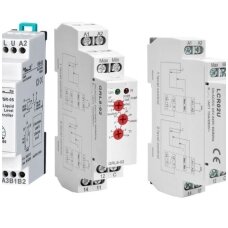 1 - 2 of 2Price 21.05 € VAT incl.( 17.40 € VAT excl. )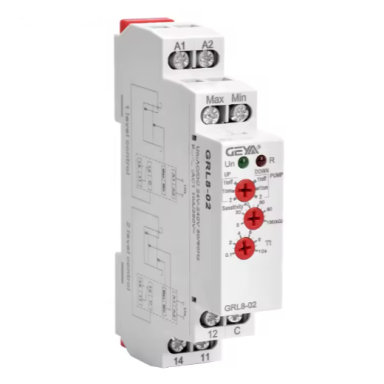
 Liquid level control relay for pumps | up to 10 A | AC/DC 24–240 V | DIN rail mounted | 2-level control | GEYA GRL8-01Code: ESGRL8-01Price 27.19 € VAT incl.( 22.47 € VAT excl. )


