


Phase monitoring | sequence | protection relays, modular | for installation in electrical distribution boxes | panels
-
Modular Phase Monitoring, Sequence and Protection Relays
Modular phase monitoring, sequence and protection relays are designed to monitor the condition of a three-phase electrical network and generate a control signal when an incorrect phase sequence, phase loss, excessive voltage imbalance, overvoltage, undervoltage or another network fault monitored by the specific model is detected.
These relays are most commonly mounted on a DIN rail in electrical distribution boxes, control panels and automation cabinets. They are used in the control and protection circuits of motors, pumps, compressors, fans, refrigeration equipment, production machinery and other three-phase electrical equipment.
Important regarding purpose:
A phase monitoring relay generally does not disconnect a high-power load directly. It monitors the network parameters and uses its output contact to control a contactor, control relay, alarm circuit or another automation circuit. The power circuit must be disconnected by a suitable switching device.Important regarding functions:
Not every phase relay monitors all possible parameters. Some models monitor only phase sequence and phase loss, while others additionally monitor minimum and maximum voltage, phase asymmetry, frequency, neutral conductor condition, or have adjustable switch-on and switch-off delays.Key point:
Choose a modular phase monitoring relay when you need to monitor the condition of a three-phase network and prevent equipment from operating with an incorrect phase sequence, a missing phase or unsuitable voltage. The appropriate model is selected according to network voltage, neutral conductor requirements, monitored parameters, adjustment ranges, delay functions and output contact configuration.Installation
DIN railNetwork
Three-phase ACMonitoring
Phase sequence and conditionProtection
Against network faultsOutput
Relay contactApplication
Motor and automation circuitsWhat is a phase monitoring relay?
A phase monitoring relay is an electrical automation device designed to monitor one or more parameters of a three-phase network. As long as all monitored parameters remain within the permissible limits, the relay output contact maintains its normal operating state. When a fault is detected, the contact changes state and can stop the equipment or transmit a fault signal.
Phase relays are most commonly used to prevent motors from operating in the wrong direction, operating with only two phases, operating under severe voltage imbalance or other unfavourable electrical network conditions.
Depending on the model, the relay may monitor phase-to-phase voltages, phase-to-neutral voltages or both types of parameters.
The relay monitors, while the contactor disconnects:
A phase monitoring relay is usually used in the control circuit. When it detects an unsuitable network condition, it de-energises the contactor coil, and the contactor disconnects the main load supply.Operating principle
- Phase voltage monitoring – the relay continuously checks the condition of the three-phase network.
- Phase sequence detection – it checks whether L1, L2 and L3 are connected in the correct order.
- Phase loss detection – it detects when one phase disappears or its voltage becomes unacceptable.
- Voltage limit monitoring – suitable models monitor overvoltage and undervoltage.
- Asymmetry monitoring – some models evaluate the difference between phase voltages.
- Fault detection – when a preset condition is violated, the relay output state changes.
- Automatic reset – once network parameters return to the permissible range, the relay may automatically return to the operating state after the preset delay.
Main monitored functions
Function What does it monitor? Phase sequence Checks the connection order of L1, L2 and L3, which determines the direction of rotation of a three-phase motor. Phase loss Detected when one of the three-phase network phases is lost or its voltage drops significantly. Undervoltage The relay can disconnect the equipment when the voltage drops below the set threshold. Overvoltage Detects voltage exceeding the set or fixed threshold of the selected model. Phase asymmetry Evaluates whether the phase voltages differ from each other by more than the permitted amount. Neutral conductor monitoring Some 3P+N models can monitor phase-to-neutral voltage and faults related to the neutral conductor. Frequency monitoring Some more universal models additionally monitor the mains frequency. Important:
Before ordering, do not assume that every „phase monitoring relay“ includes all the functions listed in the table. Always check the technical specification of the specific model.Phase sequence monitoring
In a three-phase network, the phase order determines the direction of rotation of a three-phase asynchronous motor. If two phases are swapped during installation or repair, the motor may start rotating in the opposite direction.
This can be dangerous for pumps, compressors, fans, conveyors, lifting equipment and other machines for which a specific direction of rotation is essential.
Typical operation:
Correct phase sequence → relay output active → contactor is allowed to energise
Incorrect phase sequence → relay output disconnected → contactor does not energiseProtection against phase loss
If one phase is lost, a three-phase motor may fail to start or, if already running, enter an unfavourable operating mode. The current in the remaining phases may increase, the motor may lose torque and overheat.
A phase monitoring relay can detect such a condition and disconnect the contactor through the control circuit before the fault causes more serious equipment damage.
Important:
A phase loss relay does not replace a motor protection circuit breaker, overload relay or other required motor protection devices. It complements the protection system by monitoring the condition of the electrical network.Phase voltage asymmetry
In an ideal three-phase network, the voltages of all three phases would be very similar. In practice, differences may occur due to network loads, connections, cables, transformers or other system conditions.
Excessive voltage asymmetry can adversely affect three-phase motors, so phase monitoring relays designed for this purpose can monitor this parameter and disconnect equipment if the permissible limit is exceeded.
Asymmetry adjustment:
Some models allow the permitted percentage of phase voltage imbalance to be set. In other models, the threshold is preset by the manufacturer and cannot be adjusted by the user.Overvoltage and undervoltage monitoring
More universal three-phase protection relays can monitor not only the phase sequence, but also the actual mains voltage level.
If the voltage drops below the set minimum threshold or exceeds the maximum threshold, the relay changes the state of its output contacts and can stop the protected equipment.
- Undervoltage can lead to insufficient motor torque, increased current or incorrect operation of electronic equipment.
- Overvoltage can place additional stress on insulation, power supplies and other electrical system components.
3P and 3P+N relays
Phase monitoring relays may be designed for three-phase systems without a neutral conductor or for three-phase systems with a neutral conductor.
Type Typical application 3P – L1, L2, L3 For monitoring phase-to-phase voltages, phase sequence and phase loss in a three-phase network. 3P+N – L1, L2, L3, N For applications where the relay requires a neutral conductor or additionally monitors phase-to-neutral voltages. Before selecting:
Check whether your system has a neutral conductor and whether the specific relay requires it. 3P and 3P+N relays are not automatically interchangeable.Switch-on and switch-off delay
Some phase monitoring relays have an adjustable response time. A delay can help prevent unnecessary system shutdowns caused by very short network fluctuations.
A reset delay can also be useful for compressors, refrigeration systems or other equipment that should not be restarted immediately after the power supply is restored.
Purpose of the delay:
A short fault delay can filter momentary fluctuations, while a longer restart delay can protect equipment against excessively frequent starts.Technical characteristics
Product group Modular phase monitoring, sequence and protection relays Main purpose Monitoring the condition of a three-phase electrical network and generating a protection signal Mounting type Modular, DIN rail mounting Monitored network Three-phase AC, with or without N depending on model Rated voltage Depends on the specific model and network Phase sequence monitoring Depending on the specific model Phase loss monitoring Depending on the specific model Voltage limits Fixed or adjustable if provided by the model Asymmetry monitoring Fixed or adjustable depending on model Response delay Fixed or adjustable depending on model Output Relay contact, configuration depends on model Indication LED or other status indication depending on model Installation location Electrical distribution boxes, control panels and automation panels Where are phase monitoring relays used?
- Three-phase motor control – for monitoring phase sequence and network condition.
- Pumping stations – to protect pump motors against unsuitable network conditions.
- Compressors – to detect incorrect phase sequence and voltage faults.
- Ventilation systems – to monitor fan rotation direction and the condition of the three-phase supply.
- Refrigeration equipment – for the protection of compressors and other three-phase units.
- Conveyors – to prevent incorrect motor rotation direction.
- Lifting equipment – for monitoring phase sequence and the power supply network.
- Production lines – for general monitoring of three-phase network parameters.
- Automation panels – for controlling contactors, PLC inputs or alarm circuits.
- Generator and backup power systems – for monitoring three-phase source parameters, provided the relay characteristics are suitable for the application.
How to choose the right phase monitoring relay?
- Determine the network voltage – the relay must be designed for the specific three-phase network voltage.
- Check the neutral requirement – determine whether a 3P or 3P+N model is required.
- Select phase sequence monitoring – if motor rotation direction is important.
- Check the phase loss function – especially for motor protection.
- Evaluate voltage monitoring – determine whether minimum and maximum voltage thresholds are required.
- Check asymmetry monitoring – if phase voltage imbalance is important.
- Select adjustable or fixed limits – according to the system requirements.
- Evaluate the delay – determine whether delayed shutdown or restart is required.
- Check the relay output – contact type and permissible control circuit load.
- Check the specific model diagram – connection terminals and operating logic may differ.
Typical phase relay and contactor circuit
A phase monitoring relay is most commonly connected into the contactor control circuit. As long as the network meets the preset conditions, the relay contact allows the contactor coil to remain energised.
Typical principle:
L1 + L2 + L3 → phase monitoring relay → relay output → contactor coil → contactor → three-phase loadIf an incorrect phase sequence, missing phase or another monitored fault is detected, the relay contact de-energises the contactor coil circuit and the load is disconnected.
Does a phase relay replace motor protection?
No. A phase monitoring relay and a motor protection circuit breaker or overload relay monitor different parameters.
Device Main function Phase monitoring relay Monitors electrical network phases, phase sequence, voltage and other specified parameters. Motor protection circuit breaker / overload relay Monitors motor load current and helps protect against overload and other relevant faults. Circuit breaker / fuse Used to protect the circuit against short circuits and other overcurrents covered by the selected protection device. More complete motor protection:
In a practical system, a circuit breaker or fuses, a contactor, motor overload protection and a phase monitoring relay may all be used. The specific solution is selected according to the motor and the overall electrical system design.General installation instructions
- Check the network parameters. Determine the rated voltage of the three-phase network and whether a neutral conductor is used.
- Check the relay functions. Make sure the model monitors the required parameters.
- Install the relay. Mount it on a DIN rail in an electrical or automation panel.
- Connect the phases. Connect L1, L2 and L3 exactly according to the manufacturer's diagram.
- Connect the neutral. If required by the specific model.
- Connect the output contact. It is usually integrated into the contactor or another control circuit.
- Set the limits. If the model is adjustable, set the minimum and maximum voltage, asymmetry or other parameters.
- Set the delay. Select the response and reset time according to the equipment requirements.
- Switch on the system. Check the LED indication and relay output state.
- Check the phase sequence. Make sure the system only allows the load to operate when the sequence is correct.
- Check the fault response. Perform testing only in a safe manner suitable for the specific system.
- Check the reset. Make sure that when the network returns to normal, the relay operates according to the preset logic.
Electrical safety:
Connection work on a three-phase electrical network and electrical panel must be performed by a qualified specialist. Before installation or replacement work is carried out, the circuit must be safely disconnected from the power supply, and the equipment must be connected only according to the specific manufacturer's wiring diagram and applicable electrical installation requirements.Common selection and installation mistakes
- A relay with an unsuitable rated voltage is selected.
- It is not checked whether the specific model requires a neutral conductor.
- It is assumed that every phase relay monitors both voltage limits and asymmetry.
- The phase sequence is mixed up when connecting L1, L2 and L3.
- Minimum and maximum voltage limits are set incorrectly.
- The asymmetry tolerance is set too low, causing unnecessary frequent disconnections.
- The tolerance is set too high, making the protection insufficiently sensitive.
- The response or restart delay is not considered.
- A high-power load is connected directly through the output contact of the phase relay.
- A contactor is not used even though the load requires one.
- The phase monitoring relay is incorrectly treated as complete motor protection.
- The actual system operation and fault response are not tested after installation.
Advantages
- ✅ Helps detect an incorrect phase sequence.
- ✅ Can detect the loss of one phase.
- ✅ Some models monitor undervoltage and overvoltage.
- ✅ Can monitor phase voltage asymmetry.
- ✅ Helps protect three-phase motors against unfavourable network conditions.
- ✅ Convenient to integrate into a contactor control circuit.
- ✅ Modular design suitable for DIN rail mounting.
- ✅ LED indication can make network condition diagnostics easier.
- ✅ Some models provide adjustable voltage, asymmetry and delay limits.
- ✅ Suitable for various industrial, building automation and pump control systems.
Limitations
- ❌ Not all relays monitor all three-phase network parameters.
- ❌ Some models require a neutral conductor.
- ❌ A model designed for one voltage cannot be used in a network with a different voltage.
- ❌ Adjustable limits must be properly matched to the system.
- ❌ Overly sensitive settings may cause unnecessary shutdowns.
- ❌ Limits set too wide may reduce protection effectiveness.
- ❌ The relay output contact is usually intended for a control circuit, not the main power circuit.
- ❌ Does not replace short-circuit and overload protection.
- ❌ Adjustment and terminal diagrams may differ between manufacturers.
- ❌ An incorrectly selected delay may interfere with normal equipment operation.
Quick guide to choosing a phase monitoring relay
Choose a modular phase monitoring relay when you need to monitor the condition of a three-phase electrical network and transmit a control signal when phase sequence, phase loss, voltage or other faults monitored by the specific model occur.
For motor direction
Choose phase sequence monitoringFor phase loss
Check the phase failure functionFor voltage protection
Choose min./max. voltage monitoringFor motor control
Use the relay output to control a contactorSuitable when you need to:- monitor the phase sequence of a three-phase network;
- detect loss of one phase;
- protect a motor against an incorrect rotation direction;
- monitor undervoltage;
- monitor overvoltage;
- monitor phase voltage asymmetry;
- control a contactor coil;
- transmit a fault status to an automation system;
- install three-phase network monitoring in a DIN rail panel.
Check before ordering:- the rated voltage of the three-phase network;
- whether the system has a neutral conductor;
- whether the relay requires N;
- whether phase sequence monitoring is required;
- whether phase loss monitoring is required;
- whether minimum and maximum voltage protection is required;
- whether asymmetry monitoring is required;
- whether the limits must be adjustable;
- whether response or reset delay is required;
- the type and load of the relay output contacts;
- whether the relay will control a contactor, PLC or alarm circuit;
- the wiring diagram of the specific model.
Important reminder:
The functionality of phase monitoring relays can vary significantly. The name „phase monitoring relay“ alone does not indicate whether a specific model monitors voltage limits, phase asymmetry, the neutral conductor or has an adjustable delay. Always check the technical parameters and wiring diagram of the specific model.FAQ – frequently asked questions
What is a phase monitoring relay used for?
It is designed to monitor the condition of a three-phase electrical network and change the state of the control contact when a fault monitored by the specific model is detected.What is phase sequence?
It is the order of the L1, L2 and L3 phases. It determines the direction of rotation of a three-phase motor.What happens if two phases are swapped?
The direction of rotation of a three-phase motor will usually change. A phase sequence relay can detect the incorrect order and prevent the equipment from starting.Does the relay detect phase loss?
Yes, if the specific model includes phase loss monitoring.Do all phase relays monitor voltage?
No. Some are intended only for phase sequence and phase loss, while others additionally include minimum and maximum voltage monitoring.What is phase asymmetry?
It is the difference between phase voltages. Excessive imbalance can be unfavourable for three-phase motors and other equipment.Can the asymmetry threshold be adjusted?
Only on models where the manufacturer provides this adjustment.Does a phase relay require a neutral conductor?
It depends on the model. Some relays connect only to L1, L2 and L3, while others additionally require N.What is the difference between a 3P and a 3P+N relay?
A 3P model operates with three phases, while a 3P+N model is additionally connected to the neutral conductor and may use phase-to-neutral measurements.Can a phase relay disconnect a motor directly?
It is usually intended for the control circuit and uses its contact to control a contactor, which disconnects the main motor power circuit.Does a phase relay replace a contactor?
No. The phase relay monitors the network, while the contactor switches the main power circuit.Does a phase relay replace a motor protection circuit breaker?
No. These devices perform different functions and may be used together.Why is a switch-off delay needed?
It can help prevent the relay from reacting to very short network fluctuations, if such operation is suitable for the specific system.Why is a restart delay needed?
It allows the system to wait for a preset period after the network has recovered before allowing the equipment to start again.Is it suitable for a pump?
Yes. Phase monitoring relays are commonly used in the control and protection circuits of three-phase pumps together with a contactor and other required protection devices.Is it suitable for a compressor?
Yes, provided the functions, voltage and control characteristics of the specific model meet the requirements of the compressor system.Can it be used to monitor a generator network?
Only if the generator voltage, frequency and other parameters comply with the technical characteristics of the specific relay and the overall system design.Does the relay reset automatically after a fault?
On many models, when the network parameters return to the permissible range, the relay automatically restores its output state. The exact operation and delay depend on the specific model.What is most important to check before buying?
The rated network voltage, 3P or 3P+N connection, phase sequence and phase loss functions, voltage and asymmetry monitoring, adjustment limits, delay, output contacts and the wiring diagram of the specific model.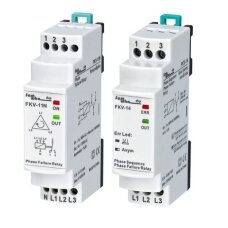 1 - 2 of 2Modular Three-Phase Phase Monitoring | Sequence | Protection Relay | 3x380V | Phase Asymmetry 30% | DINCode: ES-FKV-14Price 21.05 € VAT incl.( 17.40 € VAT excl. )Price 18.97 € VAT incl.( 15.68 € VAT excl. )


