-
Product Catalog
- Security and Surveillance Systems | accessories
- Lighting solutions for industrial | commercial | residential | outdoor environments | accessories
- Automation and Control Systems
- Smart Automated Products | Control | Transmission | Detection
- Electrical distribution and installation
- Solar Energy Generation and Management Equipment
-
HVAC control solutions for heating and ventilation
-
HVAC automation
- Sensors and detectors
- Electric motors
-
Frequency inverters for motor speed regulation
- Optidrive frequency inverters for motor speed control
- Siemens frequency inverters | efficient motor control | process automation
- Schneider Electric frequency inverters | efficient motor control | process automation
- EURA Drives frequency inverters | efficient motor control | process automation
- Frequency inverters
- Air damper drives
- Speed regulators for fans
- Motorized actuators for air dampers | ventilation (HVAC) systems | air ducts
- Modbus modules and power supplies
- Fans for ventilation systems
- Ducts and connections for ventilation | air conditioning systems
- Deflectors | ventilation | ventilation systems
- Dampers for ducts | ventilation | air conditioning systems
- Duct Silencers | Ventilation | Ventilation Systems
- Air Filters for Ducts | Ventilation | Ventilation Systems
- Supply Air Ventilation Dampers
- Diffusers for Ventilation Systems
- Electric heating
- Mobile Air Conditioners | for Indoor Climate Control
- Domestic | industrial air purification systems
- Aromatic diffusers | essential oil diffusers for homes | offices | industrial premises
- Domestic | industrial dehumidifiers | moisture collectors | humidity control solutions
- Domestic | industrial air humidifiers | ultrasonic | fog generators
-
HVAC automation
- Accessories for cars
- Workplace Safety | Electrical Safety Equipment | LOTO
- Technical maintenance | service equipment | fire protection solutions
- Emergency safety | hygiene | sanitary solutions
- Other products
- Quality used products
Frequency inverters for motor speed regulation
-
Frequency inverters for motor speed control
The motor runs as fast as the process needs – not always at 50 Hz. Less energy, soft starting, less mechanical shock.
What do you need? Choose – we'll take you straight to the products:
I only have 230 V (single-phase supply)
Single-phase inverter 0.37–4 kW, three-phase 230/400 V motor connected in delta (Δ)
Single-phase Optidrive →Outdoor, damp or wash-down area
IP66 enclosure – wall-mounted without a separate panel
Eura Drives IP66 →Machine with PLC and PROFINET
Siemens SINAMICS G120C with PROFINET / EtherNet/IP or PROFIBUS
Siemens →Compact machine or conveyor
Schneider Electric Altivar ATV320 / ATV310 – 0.37–11 kW
Schneider Electric →Keypad, filter, choke, resistor
Remote keypad, EMC filter, output choke for long cables, braking resistor
Accessories →All subcategories: Optidrive (Invertek) · Siemens · Schneider Electric · Eura Drives · Other manufacturers · Accessories
 Need more information? Selection guide – selection by current, motor connection, wiring diagram, common mistakes and FAQ. Or ask us.
-
Read more
Frequency inverter guide: from 230 V supply to PROFINET
Here you will find quick selection by situation, how an inverter works, how to size it by motor current, a manufacturer comparison, accessories, a wiring diagram with explanations, the most common mistakes and answers to the key questions.
Colour key: ■ information · ■ benefit, solution · ■ ⚠ check · ■ ⚡ safety, mistakes
Contents: What do you need? · Farm and homestead · How it works · Simple or smart · How to select · Comparisons and savings · Manufacturers · Accessories · For engineers · Diagram · What to check · Mistakes · FAQ · SourcesWhat do you need? Quick selection
Situation Solution Where to look Workshop or farmstead with only 230 V, but the machine has a three-phase motor Single-phase input → three-phase 230 V output. 230/400 V motor connected in delta (Δ). Power up to 4 kW 1.5 kW, 2.2 kW, all 1-ph Ventilation fan or circulation pump, 400 V Three-phase inverter, pump and fan mode, speed from a 0–10 V signal or sensor 1.5 kW, 7.5 kW, all 3-ph Equipment outdoors, in a damp room or washed down IP66 inverter mounted next to the motor, no panel needed EP66 2.2 kW, EP66 5.5 kW, all IP66 Machine controlled by a Siemens PLC via PROFINET SINAMICS G120C with integrated PROFINET / EtherNet/IP interface G120C 5.5 kW, Siemens Conveyor, mixer, packaging machine Compact inverter with 150 % overload for starting, Modbus / CANopen ATV320 3 kW, Schneider 3-ph Motor far away – cable longer than the manual allows Output choke or dV/dt filter between inverter and motor 12 A IP20, accessories High-inertia machinery must stop quickly Inverter with braking transistor + braking resistor 100 Ω 200 W, accessories Control from the panel door or another location Remote keypad with RJ45 cable OLED keypad, 1 m cable ✓ Why it pays off: on a fan or pump, the inverter replaces a damper or throttle valve – flow is controlled by speed, not by resistance. Soft starting without inrush current, less wear on belts and bearings, fewer water hammer shocks in pipework, and often one device instead of a star-delta starter and thermal overload relay (supply-side protection is still required).Farm and homestead: Fazė and Kibirkštis answer
The most common questions from farms, homesteads and workshops. Find your situation.
Grandpa's circular saw is three-phase, but the homestead has only one phase
KibirkštisWhat do we do if bringing in a three-phase supply doesn't pay off?FazėCheck the motor nameplate. If it says 230/400 V, reconnect it in delta (Δ) and fit a frequency inverter from 1-phase 230 V. The saw will run from an ordinary socket and start smoothly. Power – up to 4 kW.The dryer fan roars at full power, but that much isn't needed
KibirkštisCan we slow it down?FazėWith a frequency inverter you turn the speed down as far as needed. The fan gets quieter and uses much less electricity – work it out in the calculator below.The grain auger is too fast and needs slowing down a lot
KibirkštisSo we fit an inverter and that's it?FazėNot quite. The inverter lowers the speed but adds no force. An auger needs a gearbox for force, and the inverter sets the exact speed. An inverter alone won't handle that job.The manure conveyor starts with a jerk and pulls the chain
KibirkštisIs this a job for a mechanic?FazėNo, for an electrician. A frequency inverter starts the conveyor gently and stops it without a jolt – the chain and gearbox last longer. For this work choose HD mode (150 % overload).We want to put the inverter in the barn – it's damp and dusty there
KibirkštisShall we put it in a box?FazėAn ordinary IP20 inverter – only inside a sealed enclosure. Or take IP66: it is sealed itself and mounts straight on the wall next to the motor.The motor says 400/690 V, but there's only one phase at home
KibirkštisWill the same single-phase inverter do?FazėNo. Such a motor needs a three-phase 400 V supply. Or replace the motor with a 230/400 V one. Better to find out now than after buying.FazėDidn't find your case? Take a photo of the motor nameplate and tell us what it drives – we'll do the selection.How a frequency inverter works
The inverter converts the AC supply voltage to DC, and from it transistors (IGBTs) generate a new pulsed three-phase voltage at the required frequency. The speed of an induction motor depends directly on frequency: a 4-pole motor runs at ~1450 rpm at 50 Hz, and at roughly half that speed at 25 Hz.
Supply
1-ph 230 V or 3-ph 400 V, 50 Hz→Rectifier
AC → DC→DC link
capacitors, ~325 V / ~565 V→Inverter (IGBT)
PWM, 0–50 Hz and above→Motor
speed ∝ frequencyℹ How to estimate savings (fans, pumps)
The power of a centrifugal fan or pump theoretically varies with the cube of speed: P₂ = P₁ × (n₂/n₁)³. Reducing speed to 80 %: 0.8³ = 0.51 – about half the power is needed. Example: a fan drawing 5.5 kW at full speed theoretically draws ~2.8 kW at 80 % speed. Real savings are lower due to static pressure in the system and inverter and motor losses, so treat the calculation as an upper limit. For constant-torque machinery (conveyors, compressors), power falls only in proportion to speed.
Simple or smart? 4 control levels
1Manual
Speed is set with the buttons / potentiometer on the inverter or remote keypad. Start via a button or switch.
✓ Workshops, machine tools, fixed-speed fans
2Analogue signal
0–10 V or 4–20 mA from a controller, thermostat or sensor. The inverter's PI controller can maintain pressure or temperature on its own.
✓ Ventilation, constant pressure in water supply
3Modbus RTU / CANopen
Speed, status, current and faults are read via RS485. Several inverters on one line.
✓ Building automation, multiple fans
4PROFINET / EtherNet/IP
The inverter is part of the PLC network; diagnostics and parameters come from the control system.
✓ Production lines, machine builders
Level Optidrive E3 Siemens G120C Schneider ATV320 Eura Drives Keypad / potentiometer ✓ built-in ✓ via keypad (BOP) ✓ built-in ✓ built-in 0–10 V / 4–20 mA, PI ✓ ✓ ✓ ✓ Modbus RTU ✓ RJ45 ✓ separate version ✓ ✓ RS485 PROFINET / EtherNet/IP EtherNet/IP – via external adapter; PROFINET – not available ✓ integrated via communication card depends on series – check The table is a general guide. Check the exact set of interfaces on the product page and in the manufacturer's datasheet.
How to select: 4 steps
1Supply and motor connection
What voltage is available on site and what is stated on the motor nameplate (230/400 V or 400/690 V). This determines the inverter type and the motor connection.
2Motor current, not just kW
The inverter's rated output current must be no less than the motor's rated current at the voltage it will run on. kW is only a guide.
3Type of load
For a fan or pump, rated current is enough. A conveyor, mixer or compressor needs a starting reserve (often 150 % for 60 s) – sometimes one frame size larger.
4Environment and control
IP20 – panel mounting only; IP66 – on the wall next to the motor. How it will be controlled: buttons, 0–10 V, Modbus or PROFINET.
Motor connection by supply
Site supply Inverter Motor 230/400 V Motor 400/690 V 1-ph 230 V 1-ph input → 3-ph 230 V output Delta (Δ) ✗ not suitable 3-ph 400 V 3-ph input → 3-ph 400 V output Star (Y) Delta (Δ) ⚠ The output voltage never exceeds the input voltage: you cannot get 400 V three-phase from a 230 V supply.Example: 3 kW motor, nameplate 230/400 V, Δ 10.4 A / Y 6.0 A (sample values – check your own motor nameplate). On a 1-ph 230 V supply – single-phase inverter with at least 10.4 A output current, motor in Δ. On 3-ph 400 V – three-phase inverter with at least 6.0 A, motor in Y.
Comparisons: single phase, speed and savings
How to run a three-phase motor where there is only one phase
Method Motor power Speed control Starting When it fits Capacitor Drops – motor is weaker None Hard, with a jerk Only temporarily, light load Phase converter (transformer) Full, 3×400 V None Direct-on-line 400/690 V motor or several motors Frequency inverter from 1-ph 230 V Full (230/400 V motor, Δ) Yes Smooth Homestead, farm, workshop, up to 4 kW New three-phase connection Full None (without inverter) Direct-on-line Many powerful machines, but costly and slow How to change speed
Method What it changes Force (torque) Adjustable in operation Frequency inverter Speed over a wide range Does not increase Yes – knob, buttons or automation Gearbox Reduces speed many times Increases by the same ratio No Pulleys and belt Speed slightly Increases slightly No Gearbox + frequency inverter Both together High Yes – best for augers and conveyors How much a fan or pump saves with a frequency inverter
Speed Power (2.2 kW motor) Energy use 100 % (no inverter) 2.2 kW 100 % 90 % ≈ 1.7 kW ≈ 75 % 80 % ≈ 1.2 kW ≈ 53 % 70 % ≈ 0.8 kW ≈ 35 % 60 % ≈ 0.5 kW ≈ 22 % 50 % ≈ 0.3 kW ≈ 13 % Fan power drops roughly with the cube of speed. For a pump with a high static head the saving is smaller. About 3 % inverter losses included. Indicative calculation.
Manufacturers and series we stock
Series Power and supply Key features Where to look Optidrive E3 (Invertek, UK) 1-ph 230 V: 0.37–4 kW
3-ph 400 V: 0.75–37 kWSimple commissioning (14 basic parameters), built-in EMC filter, Modbus RTU / CANopen via RJ45. IP20 and IP66 versions: code ending in “2” – IP20, “A” – IP66. 1-ph, 3-ph Siemens SINAMICS 3-ph 400 V: 0.4–37 kW (G120C etc.)
PM240-2 power modules: 4 and 45 kWG120C – compact, with PROFINET / EtherNet/IP or PROFIBUS. PM240-2 – power section only, operates with a control unit (CU). Siemens Schneider Electric Altivar ATV12: 0.18–0.37 kW 1-ph
ATV320 / ATV310: 0.37–11 kWATV320 – for machines, compact, Modbus / CANopen. ATV310 – simpler “Easy” range. ATV12 – for the smallest motors on 230 V. 1-ph, 3-ph Eura Drives 3-ph 400 V: 0.75–11 kW, 1-ph: 1.5–2.2 kW EP66 – IP66 enclosure with EMC filter; E600 / E810 – for panel mounting. Good value for money. 1-ph, 3-ph Other manufacturers individual models, up to 75 kW LS, Delta MS300, Danfoss Vacon 100 FLOW (75 kW, IP54), Lenze SMVector, Allen-Bradley PowerFlex – for like-for-like replacement when the same model is needed. IP20, IP54/66, industrial Accessories: what you need and when
Accessory When needed Example Remote keypad Control and monitor status from the panel door without opening the panel OPT-2-OPPAD-IN External EMC filter When a stricter EMC category is required or the environment is sensitive (residential buildings, medical) OPT-2-E3016-20 Input choke Weak supply, large transformers nearby, frequent voltage surges, need to reduce harmonics OPT-2-L3010-20 Output choke (dV/dt) Long motor cable, older motor not designed for inverter duty. According to Invertek, it allows cable length to be increased up to 200 % (screened) and 300 % (unscreened). An unscreened cable will not meet EMC requirements OPT-2-M3012-20 Braking resistor Fast stopping, high inertia, overhauling loads. The inverter must have a braking transistor OD-BR100-IN Communication accessories RS485 cables, splitters, Ethernet, PROFIBUS, DeviceNet adapters, PC / Bluetooth dongles for parameter setting OPT-3-STICK-IN For engineers: selection under all conditions
FazėAn engineer starts not from kW but from the motor nameplate, the load and the supply.Step What to check Why it matters 1. Supply Phases and voltage (1-ph 230 / 3-ph 400 V), earthing system TN / TT / IT. Upstream – circuit breaker or fuses per the manufacturer's table. Residual current device: type B for a 3-ph inverter, type F for 1-ph. In an IT network the built-in EMC filter must be disconnected. A type A or AC RCD does not trip correctly with an inverter. 2. Motor Rated current from the nameplate for the connection (Δ / Y) the motor will run in. Motor type: induction, PM, synchronous reluctance. Several motors on one inverter. The inverter is sized by current, kW is only a guide. For several motors: sum of currents, separate thermal protection for each, V/f control. 3. Load Variable torque (fan, pump) – ND, 120 %. Constant torque, heavy start (conveyor, auger, hoist) – HD, 150 %. Speed range, braking. Long operation below ~50 % speed at constant torque – forced cooling or a gearbox. Above 50 Hz torque decreases. High inertia – braking resistor. 4. Cable and EMC EMC category to EN 61800-3 (C1/C2 – residential, C3 – industrial). Screened motor cable, screen earthed at both ends. Maximum cable length – per datasheet. Long cable or old motor – output choke or sine filter. Many inverters – input or DC choke for harmonics. 5. Control and safety V/f, sensorless vector or with encoder. Inputs 0–10 V / 4–20 mA, PID, communication: Modbus RTU, PROFINET, EtherNet/IP, CANopen. STO function. If the machine needs an emergency stop – an inverter with STO at the required SIL / PL level. 6. Environment IP20 / IP21 – for an enclosure, IP55 / IP66 – on a wall, outdoors. Ambient temperature, altitude, PWM frequency. Heat losses (W). Beyond the manufacturer's limits the current is derated per the manufacturer's curves. The enclosure needs space and ventilation. In short: motor nameplate current + load type + supply → inverter size and mode (HD / ND). Environment → IP. Cable and supply → filters and chokes. Machine safety → STO.⚡ This guide helps you find your way but does not replace a design or the manufacturer's manual. UAB „Elektrotechnikos sprendimai“ is not responsible for a selection made solely from this guide – consult an electrician or our specialist before installation.⚠ What to check before buying
KibirkštisBefore ordering, I always take a photo of the motor nameplate – it shows everything: voltage, current, connection.What to check Why it matters Motor nameplate: Δ / Y voltages and currents It determines the inverter and the motor connection Site supply: 1-ph 230 V or 3-ph 400 V A 1-ph inverter is not suitable for a 400/690 V motor Inverter output current ≥ motor current Otherwise the inverter will trip on overload during starting Load type: fan or constant torque Heavy starting needs a current reserve IP rating and location: panel or wall, temperature IP20 outdoors or in damp conditions fails quickly Motor cable length A long cable needs an output choke Control method: DI, 0–10 V, Modbus, PROFINET To avoid extra cards or replacing the inverter Is fast stopping required Then – braking transistor and resistor Type of residual current device in the circuit A type AC RCD is not suitable with an inverter: for a single-phase inverter – type F (or A if permitted by the manufacturer), for a three-phase inverter – type B ✗ Most common mistakes
Mistake Consequence Motor left in star (Y) on a 1-ph 230 V inverter The motor gets too low a voltage, weak torque, overheating, the inverter shows overload Inverter selected by kW, not by current Trips during starting or under load ⚡ Contactor or switch on the output operated while running Overvoltage and current surge – output transistors are destroyed ⚡ Power factor (cos φ) correction capacitors on the output Capacitors and inverter are destroyed Unscreened motor cable, screen not connected Interference with sensors, radio, meters, communication lines ⚡ Type AC residual current device May fail to trip on a fault or trip constantly Control wiring run together with the motor cable Interference on the 0–10 V signal, “drifting” speed Self-ventilated motor running at low speed with full torque for long periods Motor overheats – forced cooling or a larger motor is needed Inverter used as a phase converter for the whole machine Will not work properly or will fail – an inverter is only for motor control, not for supplying contactors, heaters or transformers
⚡ Safe installation – Phase's advice
- After switching off the supply, the DC link capacitors remain charged – before opening the terminals, wait the time stated on the inverter (usually 5–10 min) and measure the voltage.
- Leakage current of inverters with an EMC filter can exceed 3.5 mA – in that case the PE conductor must be at least 10 mm² Cu, or two PE conductors must be connected (EN 61800-5-1).
- Terminate the motor cable screen 360° at both ends – at the inverter and at the motor terminal box.
- Before starting, enter the motor nameplate data (voltage, current, frequency, rpm) – the protection depends on it.
- For the first start, run without the driven machinery or at low speed and check the direction of rotation.
☝ Elsprendimai.eu recommends: for ventilation and pumps up to 37 kW – Optidrive E3 with a remote keypad on the panel door; outdoors or in damp locations – Eura Drives EP66 (IP66); for machines with a Siemens PLC – SINAMICS G120C. For a long motor cable, add an output choke.Diagram: single-phase inverter and three-phase motor – wrong and right
The most common case is a 230 V supply and a three-phase 230/400 V motor. On the left – mistakes we see on site; on the right – how it should be done. The numbers in the diagram correspond to the explanations below it.
KibirkštisI connected the inverter, the motor runs but weakly, gets hot, and after a few minutes the inverter shows overload. Why?
FazėCheck the motor terminal box – most likely it is still connected in star for a 400 V supply. On a 230 V inverter the motor must be connected in delta. Look at the diagram, points 1 to 5.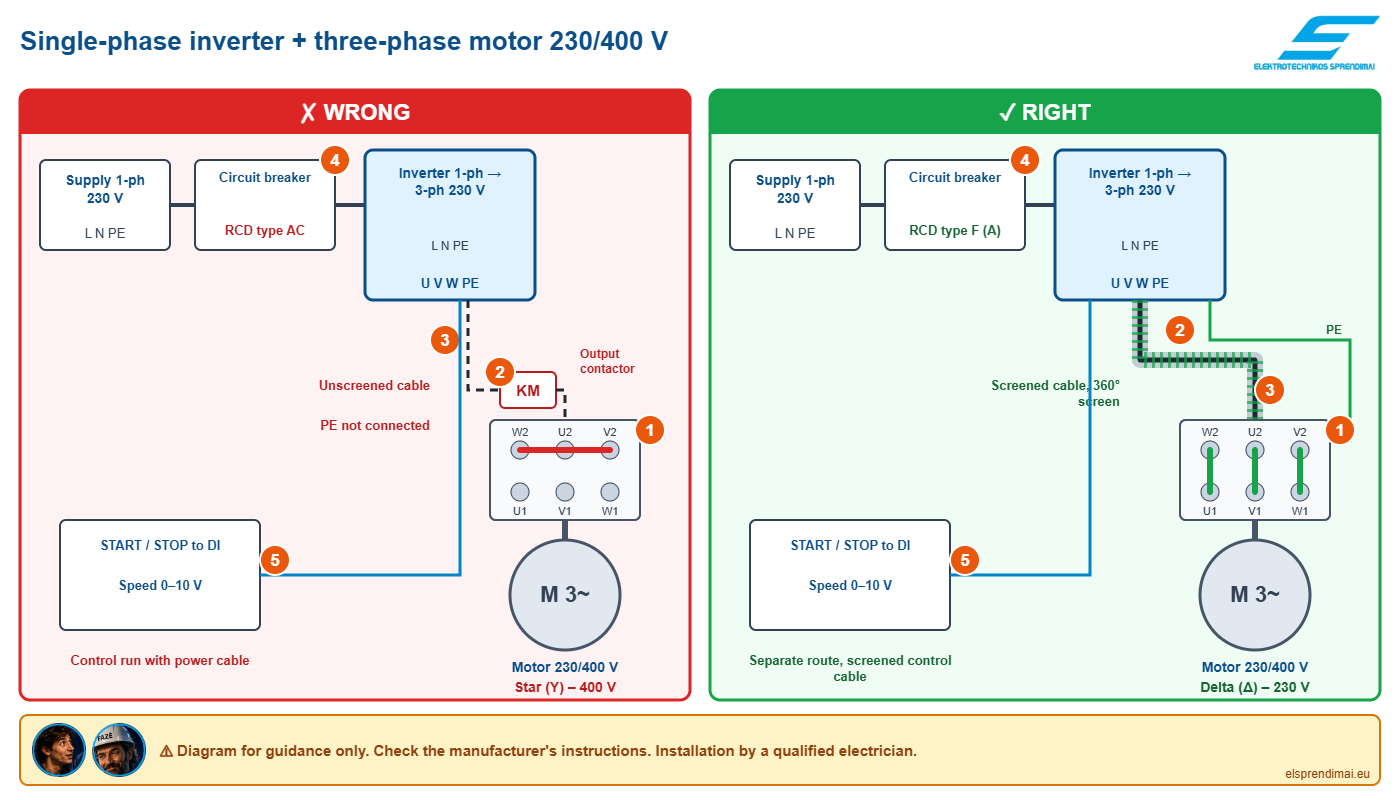 ☝ Click the diagram to open an enlarged version.⚠ The diagram is for guidance only and may contain inaccuracies.
Before connecting, check against the manufacturer's instructions and the markings on the device. The qualified electrician carrying out the installation is responsible for it. UAB „Elektrotechnikos sprendimai“ accepts no liability for the connection or any errors.Why – explanation by diagram number
1Motor connection
✗ 230/400 V motor connected in star (Y).
✓ Motor connected in delta (Δ) – three links U1–W2, V1–U2, W1–V2.
Why: A 1-ph inverter output is 3 × 230 V. The star winding is designed for 400 V, so at 230 V the motor gets only ~58 % of its rated voltage and torque drops to ~⅓. In delta it runs at rated voltage.
2Switching on the output
✗ Contactor between inverter and motor, operated while the motor is running.
✓ The motor is started and stopped via the inverter's control input (DI). A safety isolator on the output – only when the inverter is stopped, or with an early-break auxiliary contact to the inverter's Enable / STO input.
Why: Disconnecting the load while running causes overvoltage; connecting causes a current surge through the IGBTs. The inverter itself starts and stops the motor smoothly.
3Motor cable
✗ Unscreened cable, PE not connected to the motor.
✓ Screened motor cable, screen terminated 360° at both ends, PE at inverter and motor.
Why: The inverter output consists of high-frequency pulses. Without a screen the cable becomes an antenna; the screen returns interference currents to the inverter rather than into other circuits. PE is essential for protection against electric shock.
4Supply-side protection
✗ Type AC residual current device.
✓ Circuit breaker as per the inverter manual, residual current device – type F (or A) for a single-phase inverter.
Why: The fault current of a single-phase inverter has pulsating DC and high-frequency components – a type AC RCD does not “see” them or trips falsely. For three-phase inverters, where smooth DC fault current is possible, type B is used.
5Control wiring
✗ Control wires and potentiometer in the same cable route as the motor cable.
✓ Separate route, screened control cable, crossings at right angles.
Why: Interference from the motor cable is induced in the 0–10 V circuit – speed “drifts” and false starts occur.
Frequently asked questions
Questions from Spark – a young, curious electrician who dares to ask what others won't. Answers from Phase – an experienced engineer.
KibirkštisCan I get 400 V three-phase from a 230 V supply?
FazėNo. A single-phase inverter outputs 3 × 230 V. That is why a 230/400 V motor is connected in delta. A 400/690 V motor is not suitable for a single-phase inverter.
KibirkštisCan a frequency inverter supply a whole machine or replace a phase converter?
FazėNo. An inverter is designed to control one motor (or several motors in parallel). Contactors, transformers, heaters or electronics must not be connected to its output.
KibirkštisCan I run the motor faster than 50 Hz?
FazėYes, if the motor and machine manufacturers allow it. Above 50 Hz the voltage no longer increases, so torque decreases. On a fan, power rises with the cube of speed – you will quickly overload the motor.
KibirkštisCan one inverter control several motors?
FazėYes, in V/f mode, if the inverter current is no less than the sum of the motor currents and each motor has its own thermal protection. Vector mode is not suitable for multiple motors.
KibirkštisWhen is a braking resistor needed?
FazėWhen the machinery must stop faster than it would coast to a stop, or the load “drives” the motor (hoists, inclines). Fans and pumps usually don't need one – a longer deceleration time is enough.
KibirkštisIs it suitable for a single-phase motor?
FazėStandard inverters control three-phase motors. Special models exist for single-phase PSC (permanent split capacitor) motors; motors with a centrifugal switch and start capacitor are not suitable. Ask us – we will select one.
KibirkštisHow long can the motor cable be?
FazėThe permissible length is stated in the inverter manual and depends on power rating and EMC category. For a longer cable, an output choke is fitted.Sources
- Invertek Drives – Optidrive E3 model data, output and EMC filter and input choke specifications (invertekdrives.com).
- Siemens – SINAMICS G120C and PM240-2 technical data.
- Schneider Electric – Altivar ATV12, ATV310, ATV320 data; FAQ on single-phase input and motor control.
- Eura Drives – E600, E810, EP66 series data.
- EN 61800-5-1 – Adjustable speed electrical power drive systems – Safety requirements.
- EN 61800-3 – Adjustable speed electrical power drive systems – EMC requirements.
Checked 2026-10-15. Examples and calculations are indicative – final data are specified by the equipment manufacturer or the project design.
From a single fan to a production line
Frequency inverters, keypads, filters, chokes and braking resistors – all in one place. Send us a photo of the motor nameplate and tell us what will be driven: we will select the inverter and send you a quote.
Get a quote