Audio amplifier selection guide
The audio amplifier is the heart of the system. The wrong choice means distortion, unstable operation and prematurely worn-out speakers. This guide will help you choose the right type in 3 minutes.
● Blue – information ● Green – benefit ● Orange – ⚠ check ● Red – ⚡ safety / mistakes
What do you need? Quick selection
|
Situation |
Solution |
Where to look |
|
Hotel / shop – background music in different rooms |
100V multi-channel amplifier (2–4 zones) |
Multi-channel → |
|
School / barracks – music + ALARM announcements |
100V PA amplifier with ALARM input |
100V PA → |
|
Factory / warehouse – voice announcements in a noisy environment |
100V PA 240–480W high-power amplifier |
100V PA → |
|
Restaurant / café – music + the option to speak through a microphone |
PA amplifier with built-in mixer (MIC + AUX) |
With mixer → |
|
Home / office – music via a phone app or Spotify |
WiFi amplifier with AirPlay 2 / Spotify Connect |
WiFi / Multiroom → |
|
Home cinema / HiFi – high quality, 5.1 or stereo system |
Stereo / 5.1 amplifier with HDMI ARC, optical, Bluetooth |
Stereo / Hi-Fi → |
● 100V / 70V constant-voltage line – why is it the standard?
In low-impedance (4–16 Ω) systems, every speaker requires separate impedance matching and cable length directly affects signal losses. In 100V technology the amplifier raises the signal to 100V, each speaker has a built-in transformer – and the problems disappear.
Cables up to 500 m
Minimal signal losses even over long runs
Automatic impedance compatibility
No parallel / series circuit calculations
Power taps 1–8W for each zone
The volume of each speaker is set with the transformer tap selector
ALARM priority
The emergency signal takes over the system automatically – regardless of the active source
Fault isolation
One disconnected speaker does not affect the rest of the line
Suitable for: hotels, shops, schools, military bases, barracks, hospitals, factories, sports arenas, outdoor spaces.
Amplifier types – comparison
|
Type |
Power |
Zones |
Suitable for |
100V / 70V PA
Audac CPA, Adastra RMS, BST UPA, Audiophony AMP |
30–4×480W |
1–4 |
Installed PA systems, long cable runs, many speakers |
PA with mixer
Audac COM series, BST UPC |
120–350W |
1–5 |
Restaurants, cafés, shops – microphone + background music in one |
Multi-channel 100V
Audac PMQ, CAP series |
4×120–4×480W |
2–4 |
Hotels, office complexes – different volume in the lobby, corridors, conference rooms |
WiFi / Network
DW series |
30–120W |
1–2 |
Multiroom, AirPlay 2, DLNA, Spotify Connect – music over the network up to 24bit/192kHz |
Stereo / Hi-Fi / 5.1
MINI502 etc. |
2×50–2×200W |
2 |
Homes, offices, small commercial spaces – Bluetooth, HDMI ARC, 5.1 support |
● How to calculate the required amplifier power?
Step 1. Add up the tap values of all speakers. E.g.: 20 speakers × 2W tap = 40W total load.
Step 2. Multiply by 1.25 (25% headroom for long-term reliability): 40W × 1.25 = 50W minimum amplifier.
Step 3. Choose the nearest higher model – e.g. 60W or 120W.
Example – school: 30 classrooms with one 2W speaker each = 60W + 25% = 75W → CPA12 (120W) with headroom for emergency announcements.
⚠ What to check before buying
|
Check |
Why it matters |
|
Do the speakers have a 100V transformer? |
Without a transformer, a 100V amplifier will damage 4–8Ω speakers |
|
Does the total tap power exceed the amplifier rating? |
Overload → overheating → protection tripping or failure |
|
Is ALARM (emergency announcement) required? |
Not all PA amplifiers have an ALARM input – check the specification |
|
Number of channels = number of zones? |
Each zone = a separate channel; 4 zones require a 4-channel amplifier |
|
Are you planning rack mounting? |
All professional PA amplifiers come in 1U rack format – check the rack depth requirements |

Kibirkštis: “When installing a 100V system for the first time, people often ask – how many speakers can be connected? The answer: as many as you like, as long as the total tap sum does not exceed the amplifier’s rated power. That is the only number you need to know.”
✗ Most common mistakes
|
Mistake |
Consequence |
|
A standard 8Ω speaker is connected directly to the 100V amplifier output |
The speaker burns out immediately – a 100V transformer is mandatory |
|
An undersized amplifier is chosen (total tap sum = amplifier power) |
Constant 100% load → overheating → shortened service life |
|
ALARM signal via WiFi / Bluetooth |
Wireless protocols may lag or fail – the emergency signal must be wired |
|
⚡ Amplifier installed in a cabinet without ventilation |
Rack-format PA amplifiers generate heat – a 1U air gap above and below is mandatory |

⚡ Fazė’s tip – installation: 100V amplifiers are 230V AC mains-powered devices. The power cable is installed by a qualified electrician. The ALARM input must be connected to the building’s fire alarm control panel – not to a simple push button. Keep the rack cabinet doors ventilated: the operating temperature must not exceed the limit specified by the manufacturer (usually 0–40°C).
☝ Elsprendimai.eu recommends
For all audio systems we recommend buying the speakers and the amplifier together – this ensures 100V impedance compatibility. If in doubt – call: +370 620 72733.
FAQ – Kibirkštis asks, Fazė answers
How many speakers can be connected to one 100V amplifier?
As many as you like – as long as the total tap sum of all speakers does not exceed 80% of the amplifier’s rated power. For a 120W amplifier – up to 96W total load (e.g. 48 speakers at a 2W tap).
Can a 100V amplifier be used with standard 8Ω speakers?
Yes, but only via separate 100V line transformers. Some PA amplifiers also have a low-impedance 4–16Ω output – then no transformer is needed. Check the specification.
What cable is used for a 100V line?
Standard audio installation cable 2×0.75 mm² or 2×1.5 mm² (depending on line length and power). For longer lines (>100m) and higher power – 2×1.5 mm². Shielded cable is only required where there is strong electromagnetic interference nearby.
Is a 100V amplifier suitable for outdoor audio systems?
The amplifier itself is installed indoors (in a rack cabinet). Speakers designed for outdoor use have the appropriate IP protection (IP55–IP66). 100V technology is ideal for outdoor sound reinforcement thanks to long cable runs.
What is the difference between a Class D and a Class AB PA amplifier?
Class D – high efficiency (85–90%), less heat, compact. Class AB – slightly better sound quality at low loads, but generates more heat and is heavier. For PA systems, Class D is the optimal choice.
Can a WiFi amplifier be used together with a 100V PA system?
Yes – the WiFi amplifier can serve as a music source; its line output is connected to the AUX input of the 100V PA amplifier. This gives you a smart music source with centralised audio distribution.
Sources (checked 2026-10-20): Audac.eu – CPA/COM/CAP/PMQ series specifications; Adastra-av.com – RMS series; BST-audio.com – UPA/UPC series; Audiophony.com – AMP series; IEC 60268-1 sound system standards.
Need help choosing an audio system?
Tell us about the site – number of rooms, area, whether ALARM is needed – and we will prepare a solution within one day.
● +370 620 72733 ✉ Send an e-mail
100V line wiring diagram
✗ Kibirkštis does it wrong:
Connects 8Ω speakers directly to the 100V output – without a transformer. The speakers burn out at the first switch-on.
✓ Fazė does it right:
Each speaker has a 100V transformer with a tap selector. Total tap sum = 80% of the amplifier power.
⚠ Attention: The diagram is for guidance only. Before installation, check against the manufacturer’s instructions. A qualified electrician is responsible for installation. UAB “Elektrotechnikos sprendimai” is not liable for connection errors.

Audio music amplifiers are an important part of audio systems designed to increase sound signals so they can be effectively reproduced through speakers. These amplifiers are commonly used in both home and professional audio systems, ensuring that music, speech, and other sounds are transmitted with the highest quality and clarity.
Key Features:
Power:
Amplifiers vary in power, measured in watts (W), and typically range from several dozen to several hundred watts. Higher power allows for louder and clearer sound.
Sound Quality:
High-end amplifiers have a good signal-to-noise ratio, ensuring that sound reproduction is clean and distortion-free. They can support both analog and digital signals.
Various Connections:
Amplifiers often have multiple inputs and outputs, allowing connections to various audio sources such as CD players, streaming devices, TVs, and computers.
Design:
Amplifiers can be compact and portable or larger, with a professional design suited for studios and concert halls. Most models have a sleek appearance that complements other audio components.
Technological Features:
Modern amplifiers may have advanced features like Bluetooth or Wi-Fi connectivity, allowing music streaming directly from mobile devices wirelessly.
Adjustment Options:
Amplifiers often provide the ability to adjust volume levels, tone, and balance, allowing users to customize the sound to their personal preferences.
Applications:
Home Audio Systems: Amplifiers are an essential part of any home theater or music listening device, ensuring high sound quality.
Professional Audio Systems: Commonly used in concerts, events, and recording studios, allowing for the creation and reproduction of high-quality sound.
Car Audio Systems: Specialized amplifiers designed for car audio systems, significantly improving sound quality and volume.
Advantages:
Better Sound Quality: Amplifiers help produce clearer and deeper sound, allowing for enjoyment of music and movies at a whole new level.
High Power: The ability to play louder without compromising sound quality, ensuring clarity even in large spaces.
Customization Options: The ability to connect to various audio sources and adjust sound parameters according to individual needs.
Types:
Integrated Amplifiers: Combine both amplifier and preamplifier functions, ideal for home systems.
Separate Amplifiers: Professional models, often used in studios and concert halls, providing greater control and better sound quality.
Speaker Amplifiers: Specifically designed for speakers, ensuring optimal sound.
Portable Amplifiers: Compact models designed for outdoor use or travel.
Audio music amplifiers are an essential part of any audio system, ensuring that listening to music, movies, and other sounds is not only enjoyable but also flawless.


 1 - 7 of 7
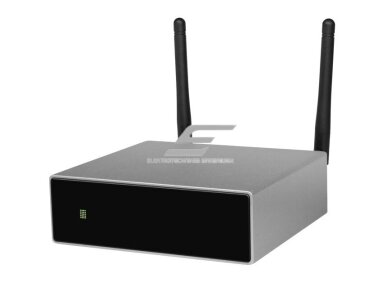
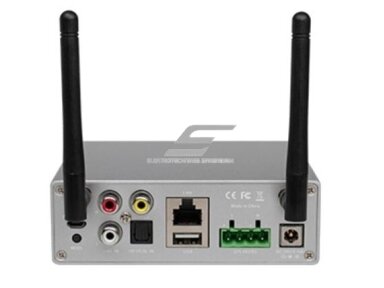
 Wi-Fi and Bluetooth audio amplifier | 2x50W / 2x30W | 24VDC | 4-8Ω | 24bit/192kHz | 120x113x37mmCode: ES-DW0250

 Audio power amplifier | 800W | 70V / 100V / 4-16Ω | 230V | 483x337x49mmCode: ES-PA-800

 Audio music amplifier | 5.1 channel | 230V | with Bluetooth | USB | SDCode: ES-AV-985

 Smart WiFi audio transmitter | with Bluetooth | 24bit/192kHz audio playback | AirPlay/DLNA/NAS supportCode: DW01

 Stereo amplifier with Bluetooth | audio enhancement | 2×30W (8Ω) / 2×50W (4Ω) | HDMI ARC | Subwoofer OutCode: MINI502

 WiFi Smart Stereo Amplifier | Unlimited-distance music streaming | 24bit/192kHz | AirPlay/DLNA/Qplay/NAS/UPnP | Multiroom integrationCode: DW0235

 WiFi smart stereo amplifier | distance-free music streaming | 24bit/192kHz | AirPlay/DLNA/Qplay/NAS/Bluetooth 5.0 | Multi-room and network streamingCode: DW0250