Rigid aluminium busbars · power distribution · 4 m bars
Aluminium busbars | 15–100 mm | selection guide
Flat aluminium busbars for distribution board main busbars, power equipment connections and custom-designed electrical systems. Below: busbar selection by current, a range of 16 sizes with cross-sections and weights, an aluminium vs copper comparison, and recommendations on contact joints and installation.

 Asking: Kibirkštis – a young electrician who is not afraid to ask. Answering: Fazė – an experienced engineer.
Key point: An aluminium busbar is selected according to its permissible continuous current, thermal conditions and mechanical strength of the structure, not just by price or cross-sectional area. For the same cross-section, a wider and thinner busbar often has a larger heat-dissipating surface than a narrower and thicker one. However, the current-carrying capacity also depends on the electrical conductivity of the aluminium alloy, mounting position, panel temperature, busbar spacing, surface condition and contact quality. The AD31T alloy must not automatically be treated as equivalent to pure electrical-grade aluminium.
Quick busbar selection by current
The load ranges and busbar sizes below are intended for preliminary design selection. They are not declared rated currents of the busbars. Final selection is made after checking the electrical conductivity of the specific aluminium alloy, busbar temperature, design, installation environment and switchgear requirements.
|
Design load current |
Preliminary sizes |
Cross-section |
What must be checked? |
|
Up to 160 A |
3 × 20 or 3 × 30 mm |
60 / 90 mm² |
Temperature, joint design and current-carrying capacity. |
|
Up to 250 A |
4 × 40 or 5 × 40 mm |
160 / 200 mm² |
Electrical conductivity of the Al alloy and cooling. |
|
Up to 400 A |
5 × 50 or 6 × 60 mm |
250 / 360 mm² |
Thermal conditions, terminals and supports. |
|
Up to 630 A |
6 × 80 or 60 × 10 mm |
480 / 600 mm² |
Current-carrying capacity, busbar arrangement and short circuit. |
|
Up to 800 A |
80 × 10 or 100 × 10 mm |
800 / 1000 mm² |
Testing of the entire busbar system and contact temperature. |
|
1000 A and above |
Designed individually |
By calculation |
Several busbars per phase or a different system may be required. |
⚠ Important: the sizes in the table are not a verified minimum for current-carrying capacity. A particular busbar may not be suitable for the stated load. The DIN 43671 current table for copper busbars must not be used to determine aluminium busbar ratings simply by changing the material name. Selection is verified for the whole busbar system according to IEC / EN 61439 and the project conditions.
Full range: sizes, cross-section, weight
The aluminium busbar range covers 16 size variants. Bar length is 4000 mm. The cross-section is calculated from nominal dimensions, and the weight is approximate, based on aluminium density and catalogue busbar data.
|
Dimensions (width × thickness, length) |
Cross-section |
kg/m |
Bar weight, kg |
Current-carrying capacity |
Material |
|
15 × 3 mm, 4 m |
45 mm² |
0.125 |
0.50 |
To be checked* |
AD31T |
|
20 × 3 mm, 4 m |
60 mm² |
0.175 |
0.70 |
To be checked* |
AD31T |
|
30 × 3 mm, 4 m |
90 mm² |
0.250 |
1.00 |
To be checked* |
AD31T |
|
30 × 5 mm, 4 m |
150 mm² |
0.405 |
1.62 |
To be checked* |
Aluminium |
|
40 × 4 mm, 4 m |
160 mm² |
0.450 |
1.80 |
To be checked* |
AD31T |
|
30 × 6 mm, 4 m |
180 mm² |
0.500 |
2.00 |
To be checked* |
AD31T |
|
40 × 5 mm, 4 m |
200 mm² |
0.550 |
2.20 |
To be checked* |
AD31T |
|
40 × 6 mm, 4 m |
240 mm² |
0.650 |
2.60 |
To be checked* |
AD31T |
|
50 × 5 mm, 4 m |
250 mm² |
0.680 |
2.72 |
To be checked* |
AD31T |
|
60 × 5 mm, 4 m |
300 mm² |
0.825 |
3.30 |
To be checked* |
AD31T |
|
30 × 10 mm, 4 m |
300 mm² |
0.810 |
3.24 |
To be checked* |
Aluminium |
|
60 × 6 mm, 4 m |
360 mm² |
0.960 |
3.84 |
To be checked* |
AD31T |
|
80 × 6 mm, 4 m |
480 mm² |
1.300 |
5.20 |
To be checked* |
AD31T |
|
60 × 10 mm, 4 m |
600 mm² |
1.620 |
6.48 |
To be checked* |
Aluminium |
|
80 × 10 mm, 4 m |
800 mm² |
2.160 |
8.64 |
To be checked* |
Aluminium |
|
100 × 10 mm, 4 m |
1000 mm² |
2.700 |
10.80 |
To be checked* |
Aluminium |
* The current-carrying capacity depends on the specific material and busbar system design; it cannot be reliably determined from dimensions alone. Weight is approximate. Mass and dimensional tolerances may differ between aluminium alloys.
Cross-section example: an 80 × 6 mm busbar has a cross-section of 480 mm², a linear weight of about 1.3 kg/m, and a full 4 m bar weighs about 5.2 kg. The price shown on the product page is for one 4 m bar.
Where aluminium busbars are used
Distribution boards and main switchboards Power distribution main busbars, phase conductor connections and other busbar assemblies specified in the design.
Transformer substations Busbar systems of low-voltage switchgear, power circuit connections and transformer terminal connections.
Industrial electrical equipment High-current distribution assemblies, power equipment connections, distribution cabinets and electrical structures.
DC systems Purpose-designed connections in DC power distribution and energy storage systems, taking into account their electrical and contact requirements.
Aluminium busbars may be used for N or PE purposes only in a system selected and verified by the designer. The design, marking, cross-section and connections of N and PE busbars must comply with the applicable electrical safety requirements.
Aluminium, copper or flexible busbar?
|
Busbar type |
When to choose |
What to consider |
|
Rigid aluminium (this group) |
When lower weight, larger cross-section power distribution and a cost-effective design matter. |
Aluminium alloy, oxidation, contacts, temperature and mechanical loads. |
|
Rigid copper |
When high electrical conductivity and a more compact busbar assembly matter. |
Higher weight and material cost; thermal and mechanical verification is also required. |
|
Tinned copper |
When specific contact surface protection or a compatible contact solution is required. |
A tin coating does not automatically mean suitability for any Al–Cu joint. |
|
Flexible laminated busbar |
When small displacements need to be compensated or the connection must fit complex geometry. |
Check that the exact bending, current and connection parameters are suitable. |
View copper and tinned busbars at elsprendimai.eu →
Weight comparison: an aluminium busbar of the same cross-section and length weighs approximately 3.3 times less than a copper one. However, for the same current requirement an aluminium busbar may need a larger cross-section, so the weight of the whole structure should only be compared using the sizes actually selected.
Installation: keeping the aluminium busbar joint from overheating
Even a busbar with a correctly selected cross-section can overheat if the bolted joint is made incorrectly. With aluminium it is especially important to ensure proper contact surface condition, compatible connection components and stable clamping pressure.
1. Contact surfaces Clean and prepare the surfaces according to the joint installation procedure. Treatment of the aluminium oxide layer must meet the joint requirements.
2. Al–Cu compatibility When connecting aluminium to copper, use bimetallic or other approved connection components designed for such joints.
3. Bolts and washers Use bolts, washers and clamping elements suitable for the connection system design. Observe the specified tightening torque.
4. Busbar supports Provide adequate insulation clearances, mechanical fixing and resistance to short-circuit electrodynamic forces.
⚠ Contact paste: use it only where specified for the particular connection system. Paste does not make an incompatible copper terminal suitable for aluminium and does not replace the required clamping force.
Electrical safety: an aluminium busbar is a bare electrical conductor. It may only be installed in a suitable structure, with the required clearances to other conductive parts, insulating supports and protection against direct contact. Work must be carried out by qualified electrical professionals.
Diagram: bolted aluminium busbar joint – wrong and right
✗ WRONG
Aluminium busbar
↓
Unsuitable Al–Cu contact
Unprepared surface, incompatible parts or incorrect clamping
↓
The contact heats up
Increased contact resistance can cause local overheating, contact deformation and failure.
✓ RIGHT
Aluminium busbar
↓
Compatible contact joint
Suitable Al–Cu component, surface preparation and tightening
↓
Verified electrical contact
The risk of joint heating is reduced and the contact system performs as intended.
How many kW does the current correspond to?
Below are approximate loads of a three-phase system at 400 V line-to-line voltage and power factor cos φ = 1. These figures describe the electrical load, not the current-carrying capacity of a specific aluminium busbar.
|
Current |
Approximate power, 400 V |
Typical application |
|
160 A |
111 kW |
Sub-distribution |
|
250 A |
173 kW |
Building distribution board |
|
400 A |
277 kW |
Main low-voltage switchboard |
|
630 A |
436 kW |
Substation switchgear |
|
800 A |
554 kW |
Higher-power distribution |
|
1000 A |
693 kW |
High-power distribution system |
|
1250 A |
866 kW |
Industrial power distribution |
Formula: P = √3 × U × I × cos φ. For reactive loads cos φ may be less than 1. In all cases, the busbar system is selected according to current and its design conditions, not just by the power value in kilowatts.
FAQ
Kibirkštis How does an aluminium busbar differ from a copper one?
Fazė An aluminium busbar is lighter than a copper one of the same size, but copper has higher electrical conductivity. Therefore, for a system of equivalent current the aluminium busbar cross-section may need to be larger. Contact design, temperature and overall project cost should also be compared.
Kibirkštis Is AD31T the same as pure electrical-grade aluminium?
Fazė No. AD31T is an aluminium alloy designation, not a synonym for pure aluminium. Different chemical composition and temper affect conductivity and mechanical properties. When calculating busbar resistance and current-carrying capacity, parameters appropriate to the specific alloy must be used.
Kibirkštis Can I use an aluminium busbar for direct current?
Fazė Yes, if the busbar is properly designed for the DC system. Continuous current, busbar resistance, losses, protective devices, voltage and contact compatibility must be assessed. Not all AC corrections need to be applied to direct current, but the thermal and mechanical requirements remain.
Kibirkštis Can aluminium and copper busbars be connected directly?
Fazė Only with a connection system approved for this combination of metals. An unsuitable Al–Cu contact joint can lose reliable clamping pressure and overheat. In practice, compatible bimetallic transition pieces or special contact solutions are used. Contact paste is not enough if the joint itself is unsuitable.
Kibirkštis How are N and PE busbars selected?
Fazė The N busbar is selected according to the expected neutral conductor current, including possible effects of harmonic currents. The PE busbar is selected according to the protective conductor function, fault current, disconnection time and design requirements. The use of aluminium for these functions must be clearly permitted and verified in the specific electrical design.
Kibirkštis How much does a four-metre aluminium busbar weigh?
Fazė The weight depends on the busbar cross-section and the material density. For example, a 30 × 5 mm aluminium 4 m busbar weighs about 1.62 kg, 80 × 6 mm about 5.2 kg, and 100 × 10 mm about 10.8 kg. All figures are approximate: the exact weight may vary due to the alloy and manufacturing tolerances.
Kibirkštis Can an aluminium busbar be painted or additionally insulated?
Fazė Only with coatings suitable for electrical structures and after assessing the thermal properties. Painting may change heat dissipation, and an insulating sleeve may change cooling conditions. Contact surfaces must not be covered with an insulating coating if this contradicts the connection system requirements. Any change must be included in the busbar design verification.
Kibirkštis Does a larger busbar cross-section always mean a higher current-carrying capacity?
Fazė Generally a larger cross-section reduces electrical resistance, but the current-carrying capacity is also determined by busbar shape, surface area, aluminium alloy and cooling. Two busbars with the same 300 mm² cross-section, for example 30 × 10 mm and 60 × 5 mm, may have different thermal characteristics. Therefore, the most suitable busbar is selected based on calculations for the whole system.
Aluminium busbars for switchboards and projects
Need an aluminium busbar for a specific panel or power distribution system? Specify the required size, aluminium alloy, quantity and project purpose. We will help clarify the range, delivery terms and the need for compatible installation solutions.
View aluminium busbars Contact us
Busbar current-carrying capacity, contacts, N / PE use and short-circuit withstand are verified against the requirements of the specific electrical design. Electrical installation work must be carried out by qualified professionals.
Range: 4 m aluminium busbars
Aluminium busbar for conductive links in electrical panels and equipment. Select according to load current, bar dimensions, contact design and installation conditions.
Technical data
Weight is approximate, based on catalogue data. Linear weight is given per metre; the product price is for one 4 m bar.
Application and installation
For electrical distribution and control panels and equipment connections. Use as an N or PE bar requires a design selected and verified by the designer.
Current capacity depends on temperature, cooling, bar arrangement and connections. Cross-section alone does not determine current capacity; check manufacturer documentation and the panel design.
Prepare and tighten aluminium contacts according to the connection manufacturer’s instructions. Use a compatible connection system for Cu–Al joints; contact paste alone does not replace proper connection selection.
A bare busbar is not insulated. Suitable supports, insulation clearances and protection against contact are required. Check short-circuit withstand.


 1 - 8 of 8


 Aluminium power distribution busbar | 30 × 5 mm | 4 mCode: ES30X5

 Aluminium power distribution busbar | 30 × 10 mm | 4 mCode: ES30X10

 Aluminium power distribution busbar | 60 × 10 mm | 4 mCode: ES60X10

 Aluminium power distribution busbar | 80 × 10 mm | 4 mCode: ES80X10

 Aluminium power distribution busbar | 100 × 10 mm | 4 mCode: ES100X10
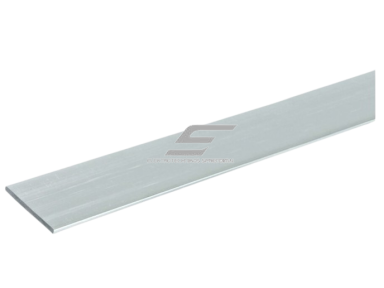
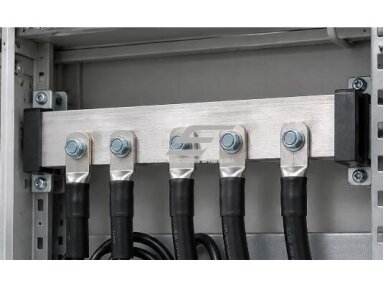 Aluminium power distribution busbar | 6x80mm | 4m | AD31TCode: YBA10-06-080
 Aluminium power distribution busbar | 5 × 40 mm | 4 m | AD31TCode: YBA10-05-040
 Aluminium power distribution busbar | 4 × 40 mm | 4 m | AD31TCode: YBA10-04-040


