


Eye nuts for overhead power lines and energy infrastructure fastening assemblies
-
Eye Nuts for Overhead Lines and Energy Infrastructure Fastening
Eye nuts for overhead lines are mechanical fastening elements with a closed eye and internal thread, designed for connecting and mechanically securing components of overhead power lines, supports, insulators, cables, clamps and other energy infrastructure. The nut is screwed onto a compatible threaded element, while the integrated eye is used to connect another fastening element, hook, bracket, cable or line hardware.
This product group may include eye nuts with different dimensions, thread types, eye sizes and mechanical characteristics. Available options may include hot-dip galvanized carbon steel models as well as variants with additional corrosion protection intended for outdoor use and energy infrastructure fastening assemblies.
Important mechanical load information:
The eye nut must be selected according to the load of the specific fastening assembly, thread type and dimensions of the bolt or threaded element used. The external dimensions of the nut alone do not indicate its allowable working load.Important thread information:
Before ordering, it is essential to check the internal thread standard, diameter and pitch. Different thread systems or different thread pitches may be mechanically incompatible even when their nominal dimensions appear similar.Main principle:
Choose an eye nut when it is necessary to connect a threaded fastening element to an eye-type fastening point in an overhead line or energy infrastructure assembly. The correct model is selected according to the thread, mechanical load, eye dimensions, material and environmental conditions.Type
Eye nutApplication
Overhead-line fastening assembliesMaterial
Carbon steelProtection
Hot-dip galvanizing or corrosion-resistant coatingConnection
Internal thread + closed eyeUse
Outdoor energy infrastructureWhat is an eye nut for overhead lines?
An eye nut is a one-piece mechanical fastening element combining two functions: an internal thread and a closed fastening eye. The threaded section allows the nut to be screwed onto a compatible bolt, stud or other threaded element, while the eye provides a fastening point for other line hardware.
This type of construction is widely used where a simple, compact and mechanically reliable connection is required between a threaded support element and another overhead-line fastening component.
Depending on the model, eye nuts may differ in overall dimensions, internal eye diameter, thread type, material, surface protection and allowable mechanical load.
Design principle:
An eye nut is not simply a standard nut with an additional ring. The eye section is an integral structural part of the fastening element, therefore the mechanical properties of the complete product must be evaluated according to the technical data of the specific model.How does an eye nut work?
- Threaded connection – the nut is screwed onto a compatible external thread.
- Mechanical fastening – the thread transfers the load to the support bolt, stud or other fastening element.
- Eye connection – the closed eye forms a fastening point for another mechanical element.
- Force transfer – mechanical load from the eye is transferred through the nut body to the threaded connection.
- Corrosion protection – zinc or another protective coating helps reduce environmental effects on the steel product.
Main parameters of eye nuts
Parameter What should be evaluated? Internal thread It must precisely match the thread standard, diameter and pitch of the bolt or stud being used. Eye size Determines the size of the fastening component that can be inserted into the eye. Overall dimensions Important when evaluating available space in the support assembly and compatibility with other components. Material Depends on the model; carbon steel may be used. The specific steel grade should be checked for the individual product. Surface protection Hot-dip galvanizing or another corrosion protection specified by the manufacturer. Mechanical load Must be checked according to the technical specification of the specific model and project requirements. Hot-dip galvanizing and corrosion protection
Overhead-line fastening components are often used outdoors, therefore protecting steel surfaces against corrosion is important for the long-term durability of the entire fastening assembly.
Protection type Properties Hot-dip galvanizing The steel surface is coated with a zinc layer that helps protect the product against atmospheric corrosion. Other corrosion-resistant coating Specific properties and environmental suitability depend on the coating technology used. Thread selection
The internal thread is one of the most important parameters when selecting an eye nut. Not only the nominal diameter, but also the thread system and thread pitch must match.
Practical principle:
If an existing bolt or fastening element has a specified thread, for example an inch-based UNS thread, the eye nut must be selected for exactly the same thread standard and pitch. A similar diameter alone is not sufficient.
Where are eye nuts used?- On overhead power line supports – for connecting fastening hardware to a threaded element.
- In insulator fastening assemblies – where the specific design requires an eye-type connection.
- In cable and guy-wire systems – for forming mechanical connection points.
- For installing line hardware – for connecting clamps, brackets or other compatible elements.
- On wooden and other supports – together with suitable bolts or threaded studs.
- In energy infrastructure – in other mechanical fastening assemblies intended by the manufacturer.
How to select the correct eye nut?
- Determine the thread type – metric, inch or another type according to the fastening element used.
- Check the thread diameter – it must precisely match the diameter of the bolt or stud.
- Check the thread pitch – threads with different pitches are not compatible.
- Evaluate the internal eye size – the connected component must fit freely and correctly inside the eye.
- Evaluate the mechanical load – the characteristics of the selected model must meet the requirements of the assembly.
- Select suitable protection – corrosion resistance is important for outdoor use.
- Check overall dimensions – the nut must fit in the intended installation location.
- Check the documentation of the specific product – when the project has specific material, coating or mechanical load requirements.
Main selection principle:
First check thread compatibility, then the eye dimensions and mechanical load. Only after that should the overall product dimensions and surface protection be evaluated.Mechanical load
Overhead-line fastening components may be subjected to continuous conductor or cable tension, wind, ice loading, structural weight and other mechanical forces. Therefore, the mechanical characteristics of an eye nut must be evaluated together with the complete fastening assembly.
If a minimum breaking load or another mechanical load value is specified for a particular model, it applies only to that model and must not automatically be assigned to other eye nuts in the same product group.
Do not use external dimensions alone as a load criterion:
A larger eye nut does not necessarily have a higher certified or declared load-bearing capacity. Mechanical characteristics must be checked in the documentation for the specific product.Installation principle
Before installation
- check the thread type;
- check the thread diameter and pitch;
- inspect the eye and body;
- check the protective coating;
- evaluate the intended mechanical load.
During installation
- screw the nut onto a compatible thread;
- the thread should turn freely without forced engagement;
- use suitable installation tools;
- avoid damaging the zinc or other protective coating;
- orient the eye according to the design of the fastening assembly.
After installation
- check the thread engagement depth;
- evaluate the position of the eye;
- check for deformation;
- make sure the connection is not loose;
- inspect the complete fastening assembly.
General installation instructions
- Check the project requirements. Determine the required thread, eye size and mechanical load.
- Check the threaded element. Its thread must be undamaged, clean and compatible with the nut.
- Inspect the eye nut. It must not be cracked, deformed or severely damaged by corrosion.
- Start threading by hand. The first thread turns should engage without excessive force.
- Do not force incompatible threads. If the nut binds during the first turns, check the thread type.
- Tighten according to project or manufacturer requirements. Do not apply an arbitrarily excessive tightening torque.
- Connect the eye hardware. Check that the connected component fits correctly inside the eye.
- Check the load direction. The assembly must be installed according to its intended design.
- Check the protective coating. The zinc or other protective layer must not be significantly damaged during installation.
- Perform a final inspection. Check the complete mechanical assembly before applying load.
Do not use damaged threads:
If the thread is deformed, severely corroded or mechanically damaged, the connection may not provide the intended load-bearing capacity. The suitability of such a component must be evaluated before installation.What should be checked after installation?
- whether the nut is screwed onto the correct thread;
- whether sufficient thread engagement length has been achieved;
- whether the eye is free from deformation;
- whether the connected element is positioned freely and correctly inside the eye;
- whether the corrosion-resistant coating is undamaged;
- whether there are any visible cracks or mechanical damage;
- whether the complete fastening assembly corresponds to the intended design.
Common selection and installation mistakes
- Selecting the nut only by approximate thread diameter.
- Ignoring thread pitch or thread standard.
- Attempting to force components with different thread systems together.
- Failing to evaluate the required mechanical load.
- Using an eye that is too small for the connected fastening component.
- Selecting the product only by its overall external dimensions.
- Damaging the zinc or other corrosion-resistant coating during installation.
- Using a deformed or cracked eye nut.
- Overtightening and damaging the thread.
- Applying the mechanical characteristics of one specific model to all similar nuts.
Advantages
- ✅ Combines a threaded connection and an eye connection in one component.
- ✅ Compact mechanical fastening design.
- ✅ Suitable for various overhead-line hardware assemblies.
- ✅ Models with different dimensions and thread types are available.
- ✅ Carbon steel construction is suitable for mechanical fastening applications.
- ✅ Hot-dip galvanizing can improve resistance to atmospheric corrosion.
- ✅ The closed eye reduces the possibility of the connected element becoming disengaged.
- ✅ Simple and clear mechanical connection principle.
Limitations
- ❌ Not suitable for an incompatible thread type or pitch.
- ❌ The same external size does not guarantee the same load-bearing capacity.
- ❌ Mechanical load capacity depends on the specific model.
- ❌ A damaged thread may reduce connection reliability.
- ❌ Severe damage to the protective coating may reduce corrosion resistance.
- ❌ Eye size must be compatible with the connected hardware.
- ❌ The eye shape must not be modified arbitrarily.
- ❌ Load data for one specific product must not be applied to another model without confirmation.
Quick Eye Nut Selection Guide
Select an eye nut for overhead lines according to the threaded element used, the line hardware being connected and the intended mechanical load. The most important factors are exact thread compatibility and the correct eye size.
By thread
Check the type, diameter and pitchBy load
Check the mechanical data of the specific modelBy eye
Check the dimensions of the hardware being connectedBy environment
For outdoor use, select appropriately protected steelSuitable when you need to:- connect a threaded element to an eye connection;
- attach overhead-line hardware to a support;
- form a fastening point for an insulator or clamp;
- connect a cable, bracket or another compatible element;
- use a carbon steel mechanical fastening element;
- use a hot-dip galvanized component for outdoor conditions;
- select a variant with a different thread or eye size;
- create a compact energy infrastructure fastening assembly.
Check before ordering:- the internal thread standard;
- the nominal thread diameter;
- the thread pitch;
- the internal eye diameter;
- the overall product dimensions;
- the material and steel grade, if important for the project;
- the type of surface protection;
- the mechanical load-bearing capacity of the specific model;
- compatibility with the hardware being connected;
- project and operating environment requirements.
Important reminder:
An eye nut is only one component of the complete mechanical fastening assembly. The final load-bearing capacity of the assembly also depends on the bolt, stud, support, connected hardware, thread engagement depth and other system components.FAQ – Frequently Asked Questions
What is an eye nut used for?
It is designed to connect a threaded fastening element to an eye-type connection in overhead lines, supports and other mechanical energy infrastructure assemblies.Do all eye nuts have the same thread?
No. The thread type, diameter and pitch depend on the specific model.Why is thread pitch important?
Threads with the same or similar diameter may have different pitches. An incorrect pitch prevents a proper and reliable threaded connection from being formed.What does a hot-dip galvanized eye nut mean?
It means that the steel product has been coated with a layer of zinc using the hot-dip galvanizing process to improve protection against atmospheric corrosion.Can a galvanized eye nut be used outdoors?
Hot-dip galvanized steel components are commonly used in outdoor infrastructure, but the corrosion requirements of the specific environment must be checked according to the project and product specification.Do all eye nuts in this group have the same load-bearing capacity?
No. Mechanical load-bearing or breaking load depends on the specific model, its dimensions, material and construction.Is a larger eye nut always stronger?
Not necessarily. Mechanical strength cannot be reliably determined from the external dimensions of the product alone.How should the eye size be selected?
The internal eye size must be compatible with the component that will be connected to it – a hook, bracket, clamp or other line hardware.Can the eye be widened or bent?
Arbitrary deformation of the product is not recommended, as this may alter its mechanical properties.Can an eye nut with damaged threads be used?
It is not recommended. Damaged threads may reduce connection reliability and load-bearing capacity.Should the thread be lubricated?
This depends on the specific product, installation method and project requirements. Lubricant should not be applied arbitrarily if it may alter tightening conditions or be incompatible with the protective coating.What does minimum breaking force mean?
It is a mechanical characteristic specified for a particular product and related to the load at which the product may fail. It must not automatically be considered the allowable continuous working load.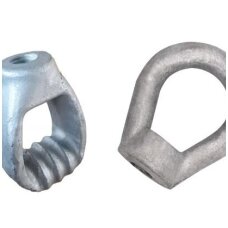 1 - 3 of 3Eye nut for overhead lines | hot-dip galvanized | 63.5x76.2mm | Ø38mm | carbon steelCode: ES-30201A03Price 9.00 € VAT incl.( 7.43 € VAT excl. )Eye nut with support groove | for poles | hot-dip galvanized | 141kN | 1.021"-8 UNS-2B | Q235 carbon steelCode: ES-30206A02Price 3.41 € VAT incl.( 2.82 € VAT excl. )Price 8.57 € VAT incl.( 7.08 € VAT excl. )


