


Composite sewer manhole | technical access covers
-
SMC composite manhole and technological opening covers
SMC composite manhole covers are designed to cover underground technical, technological and service openings where mechanical strength, corrosion resistance, lower weight and specialised sealing properties matter. Such covers can be used at fuel stations, petroleum product storage and distribution areas, in the chemical industry, at process pipeline junctions and on other technical sites.
SMC – Sheet Molding Compound – is a moulded composite material that may contain polyester resin, glass fibre, mineral fillers and functional additives. The structure, formed at high temperature and pressure, makes it possible to produce rigid, corrosion-resistant and relatively lightweight technical covers.
Key idea:
Choose an SMC composite manhole cover when you need a strong, corrosion-resistant and lighter cover for a technical opening, while a specific site may also require additional sealing, resistance to petroleum products or chemicals, and a defined load class.Material
SMC compositeResistance
To corrosion and environmental exposureConstruction
Cover + frameSealing
Depending on the specific modelSurface
Anti-slip profileUse
For technical and industrial areasWhat is an SMC composite manhole cover?
An SMC manhole cover is a moulded composite structure consisting of a cover and a frame. The SMC material uses resin, glass fibre reinforcement, fillers and functional additives, and the product is formed in a process under pressure and temperature.
Such structures can be an alternative to traditional cast iron or steel covers for technical openings, especially when lower product weight and corrosion resistance are required.
Depending on the model, the cover may have several sealing levels, removable inner elements, bolted fastening, additional handles or special locking mechanisms.
SMC is not ordinary plastic:
It is a glass-fibre-reinforced moulded composite intended for structural products where the ratio of mechanical strength, weight and resistance to environmental exposure is important.Main structural parts
Structural part Purpose Main cover Covers the technical opening and carries service loads according to the class of the specific product. Frame Installed around the perimeter of the opening and forms the supporting base for the cover. Inner removable cover In some models it provides an additional closing and sealing level. Sealing ring Helps to seal the joint between the structural elements. Fixing bolts Help to press down and mechanically secure the cover. Removable handle sleeve / opening Can be used for lifting the cover or for servicing. Mechanical strength and loads
A glass-fibre-reinforced SMC structure can be manufactured for high mechanical loads. This allows covers of this type to be used not only in pedestrian zones but also in vehicle traffic zones, provided the specific model is certified for it.
Resistance to corrosion and chemicals
One of the main advantages of composite covers – they do not rust the way unprotected steel or cast iron does. Therefore SMC structures can be suitable for more aggressive technical environments.
Certain models can be resistant to petrol, diesel, lubricants and various chemicals.
Double-seal construction
Some covers intended for fuel stations and technological openings use a double removable construction – a main top cover and an additional inner sealing element.
Such a solution can create an additional barrier between the underground cavity and the external environment.
Typical construction:
Top cover → sealing element → inner removable cover → additional seal → frameAnti-slip surface
The top surface of the cover can be moulded with a raised textured pattern. Such a surface increases grip and can reduce the risk of slipping for pedestrians and vehicles.
This is especially relevant at fuel stations, service areas and other zones where water, dirt or residues of petroleum products may get onto the cover.
Lower weight
SMC covers can be approximately 30–50 % lighter than cast iron covers. The exact difference depends on the structures compared, the diameter and the load class.
Lower weight can make transport, installation, maintenance and periodic removal of the cover easier.
- Easier to transport – lower unit mass.
- More convenient to install – especially for smaller models.
- Simpler servicing – easier to remove during maintenance.
- Less of a corrosion problem – no need for the same rust protection as cast iron or steel structures.
Temperature resistance
SMC composites can be manufactured for use over a wide temperature range of –60 °C to +150 °C.
Where are SMC composite covers used?
- At fuel stations – for service openings of underground process units and tanks.
- At petroleum product depots – for technical access openings.
- In the chemical industry – in process zones exposed to corrosion, provided material compatibility is confirmed.
- On industrial sites – for underground utility systems.
- In service areas – for technical manholes and utilities.
- At storage terminals – for servicing underground systems.
- At pipeline junctions – for access to valves, connections and other infrastructure.
- In other aggressive technical environments – where corrosion resistance and lower structural mass are important.
How to choose the right cover?
- Determine the opening size – the inner and outer diameter or other installation dimensions.
- Determine the load zone – pedestrian, light or heavy vehicle traffic.
- Check the load class – according to the project and the documents of the specific product.
- Assess exposure to fuel and chemicals – check material compatibility.
- Choose the sealing construction – single or additional inner sealing.
- Check the seal material – especially where there is contact with fuel or chemicals.
- Check the temperature range – of the whole product, not only of the SMC material.
- Consider locking – whether protection against unauthorised opening is required.
- Check the installation frame – its geometric and anchoring requirements.
General installation procedure
- Check the dimensions of the opening and the cover. Use the technical drawing of the specific model.
- Check the load requirements. The cover class must match the installation zone.
- Prepare the supporting base. It must be stable and suitable for the intended loads.
- Install the frame. Maintain the geometry and level specified by the manufacturer.
- Check the sealing elements. They must be clean and undamaged.
- Fit the inner cover. If such a construction is provided.
- Install the main cover. Check that it rests fully on the frame.
- Tighten the fixing elements. Follow the manufacturer's instructions.
- Check the cover level. The surface must not create a hazardous step.
- Check the tightness. If this is a requirement of the specific system.
- Carry out a final inspection. Assess stability, fixing and safe opening.
Maintenance and periodic inspection
- Periodically check the mechanical condition of the cover and frame.
- Inspect for cracks or impact damage.
- Clean the bearing and sealing surfaces.
- Check the condition of the rubber gaskets.
- Check the fixing bolts and locks.
- Remove sand, stones and other dirt from the seat.
- If the surface is contaminated with fuel or oil, clean it according to the site safety procedures.
- Check that the cover does not rattle in the frame.
- Carry out an additional inspection after a strong impact or unusual load.
- Do not use damaged structural elements until they have been assessed or replaced.
Most common selection and installation mistakes
- The cover is chosen only by diameter, without considering the load class.
- Contact with petrol, diesel or chemicals is not assessed.
- The chemical resistance of SMC is checked, but not the seal material.
- A double cover is automatically assumed to be fully airtight.
- The supporting base of the frame is prepared improperly.
- The frame is installed deformed or not stably enough.
- Dirt or hard particles are left between the sealing surfaces.
- The real vehicle load and the nature of the traffic are not assessed.
- The temperature range of the product is not checked.
- No periodic inspection of the cover, gaskets and fasteners is carried out after installation.
Advantages
- ✅ SMC composite does not rust like traditional unprotected metal.
- ✅ Can be lighter than a comparable cast iron structure.
- ✅ High mechanical strength is possible.
- ✅ Models designed for vehicle loads are available.
- ✅ Double sealing is possible.
- ✅ An anti-slip surface is possible.
- ✅ Can be resistant to petroleum products and chemicals, depending on the model.
- ✅ Lower weight can make installation and servicing easier.
- ✅ Suitable for specialised industrial and technological openings.
Limitations
- ❌ Not all SMC covers have the same load class.
- ❌ Chemical resistance depends on the specific substance and concentration.
- ❌ Seals may have different chemical and temperature resistance than the SMC body.
- ❌ Double sealing does not in itself guarantee airtightness.
- ❌ A properly prepared supporting base is required.
- ❌ A composite structure damaged by impacts must be assessed before further use.
- ❌ Technical models for explosive or fuel zones must be chosen according to project and certification requirements.
Quick guide to choosing an SMC composite cover
SMC composite manhole cover should be chosen according to the installation opening, the actual load and the environmental conditions. For fuel stations and chemical zones, it is additionally important to assess the sealing and resistance to petroleum products.
For a vehicle zone
Check the load classFor fuel / chemicals
Check the chemical resistanceFor a tighter opening
Choose multi-level sealingSuitable when you need to:- cover an underground process opening;
- install technical access at a fuel station;
- use a corrosion-resistant structure;
- reduce the cover weight compared with heavy metal solutions;
- use a profiled anti-slip surface;
- install an additional inner sealing cover;
- use a model designed for vehicle loads;
- install a cover in a more aggressive industrial environment.
Check before ordering:- the dimensions of the opening and frame;
- the overall diameter of the cover;
- the frame height;
- the cover thickness;
- the load class;
- resistance to petrol and diesel;
- resistance to specific chemicals;
- the number of sealing levels;
- the seal material;
- the operating temperature range;
- the anti-slip properties of the surface;
- the fixing or locking system;
- the technical drawing and test documents of the specific model.
Important reminder:
The suitability of an SMC cover for a fuel station, the chemical industry or a potentially explosive zone is not determined by its material alone. It is necessary to check the load class, chemical resistance and sealing properties of the specific model.FAQ – frequently asked questions
What is SMC?
SMC stands for Sheet Molding Compound – a moulded composite material that usually contains resin, glass fibre, fillers and functional additives.Does an SMC cover rust?
SMC composite does not rust like traditional steel or cast iron, so a corrosion-resistant structure is one of the main advantages of this solution.Is it lighter than a cast iron cover?
It can be approximately 30–50 % lighter, but the actual difference depends on the specific models being compared.Can the cover withstand cars?
Only if the declared load class of the specific model is suitable for a vehicle zone.Why is double sealing needed?
It creates an additional barrier between the external environment and the inside of the manhole and can improve protection against the penetration of liquids or vapours, depending on the design of the specific model.Is the surface anti-slip?
Some models have a textured, profiled surface designed for better grip.What is the operating temperature range?
Approximately –60 °C to +150 °C, but the range of the final specific cover must be checked in its technical documentation.Does the cover need maintenance?
Yes. The frame, cover, fixing bolts, sealing rings, bearing surfaces and any mechanical damage must be checked periodically.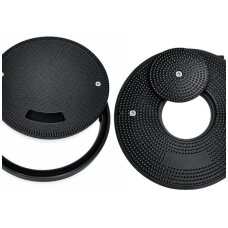 1 - 13 of 13Composite sewer manhole / technical access cover | hatch | 1045x1045x58mm | 800kg | SMCCode: ES-HDC-009Price 106.48 € VAT incl.( 88.00 € VAT excl. )Composite sewer manhole / technical access cover | hatch | 900x900x57mm | 800kg | SMCCode: ES-HDC-008Price 90.36 € VAT incl.( 74.68 € VAT excl. )Composite sewer manhole / technical access cover | hatch | 800x800x57mm | 800kg | SMCCode: ES-HDC-007Price 65.39 € VAT incl.( 54.04 € VAT excl. )Composite sewer manhole / technical access cover | hatch | 700x700x45,4mm | 800kg | SMCCode: ES-HDC-006Price 37.70 € VAT incl.( 31.16 € VAT excl. )Composite sewer manhole / technical access cover | hatch | 600x600x38,2mm | 800kg | SMCCode: ES-HDC-005Price 31.31 € VAT incl.( 25.88 € VAT excl. )Composite sewer manhole / technical access cover | hatch | 500x500x44mm | 800kg | SMCCode: ES-HDC-004Price 22.80 € VAT incl.( 18.84 € VAT excl. )Composite sewer manhole / technical access cover | hatch | 450x450x35,6mm | 800kg | SMCCode: ES-HDC-003Price 16.41 € VAT incl.( 13.56 € VAT excl. )Composite sewer manhole / technical access cover | hatch | 400x400x35,9mm | 800kg | SMCCode: ES-HDC-002Price 14.28 € VAT incl.( 11.80 € VAT excl. )Composite sewer manhole / technical access cover | hatch | 300x300x35,6mm | 800kg | SMCCode: ES-HDC-001Price 8.23 € VAT incl.( 6.80 € VAT excl. )Composite sewer manhole / technical access cover | hatch | Ø900mm | C250 | two-part cover | SMC | blackCode: ES-JQCO900D-H-C250Price 1028.50 € VAT incl.( 850.00 € VAT excl. )Composite sewer manhole / technical access cover | hatch | Ø900mm | D400 | two-part cover | SMC | blackCode: ES-JQCO900D-H-D400Price 1028.50 € VAT incl.( 850.00 € VAT excl. )Composite sewer manhole / technical access cover | hatch | Ø900mm | C250 | SMC | blackCode: ES-JQCO900D-C250Price 998.25 € VAT incl.( 825.00 € VAT excl. )Composite sewer manhole / technical access cover | hatch | Ø900mm | D400 | SMC | blackCode: ES-JQCO900D-D400Price 998.25 € VAT incl.( 825.00 € VAT excl. )


