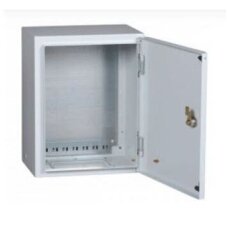
Steel surface-mounted electrical enclosures | boxes
-
Steel surface-mounted enclosures – for automation, control and distribution
Enclosures with a mounting plate are intended for equipment that is not mounted on a DIN rail alone: contactors, thermal overload relays, PLC controllers, frequency drives, power supplies, terminal blocks and cable ducts. The plate is removable – it is convenient to assemble the equipment on a workbench and only then fit it into the enclosure.
Quick selection
Situation What to choose Where to look Outdoors, washed rooms, agriculture Sealed enclosure IP65 / IP66 with mounting plate Enclosures IP65 | IP66 Production, workshops; indication must be visible IP54 enclosure, transparent door available Enclosures IP54 Large automation or power distribution Floor-standing enclosure with plinth, up to 1800 mm high Enclosures IP54 Basement, warehouse IP44 enclosure Enclosures IP44 Modular enclosures, incoming enclosures with a space for a meter IP31 enclosure with DIN rails and lock Enclosures IP31 Only modular breakers and relays Modular metal enclosure Metal modular enclosures What the IP rating means
IP Protection Suitable for IP30 / IP31 Against objects > 2.5 mm; IP31 – also against vertically falling drops Dry indoor rooms: apartments, offices, stairwells IP44 Against objects > 1 mm and splashing water Basements, warehouses, workshops IP54 Dust-protected, splash-resistant Production areas, garages, under a canopy IP65 Fully dust-tight, resistant to water jets Outdoors, washed rooms, agriculture IP66 Fully dust-tight, resistant to powerful water jets Outdoor sites, car washes, ports ⚠ What to check before buying
What to check Why it matters Module count or mounting plate size Equipment must fit with a 20–30 % reserve for future expansion and cable routing Depth Contactors, frequency drives and power supplies often need ≥ 200 mm IP rating At least what the environment requires; the actual IP also depends on the cable entries Door and lock Solid or with a window (for meters); a lock when the enclosure is accessible to unauthorised persons Cable entries Knock-outs, sealing plates or PG glands – see the sealing products ℹ Heat-dissipating equipment (frequency drives, power supplies, transformers) warms the air in a closed enclosure. Choose a roomier housing or provide ventilation. Outdoors and in unheated rooms, condensation is reduced by an enclosure heater with a thermostat. For sealing cable entries, see the sealing products group.✗ Most common mistakes
Mistake Consequence Enclosure chosen “exactly” with no reserve No room to add circuits, equipment overheats, hard to service IP31–IP44 enclosure installed outdoors Moisture and condensation – corrosion, nuisance RCD tripping IP65 enclosure with leaky cable entries Actual IP is much lower than declared Door and housing not earthed ⚡ If insulation fails, the housing can become live ⚡ Safety. The housing and door of a metal enclosure are connected to protective earth (PE). Enclosures are installed and equipment is connected by a qualified electrician with the power disconnected.Frequently asked questions
What depth of enclosure is needed?
Modular breakers fit in 125–150 mm, contactors and power supplies usually need 200–250 mm, frequency drives depend on the manufacturer's dimensions, often 250–300 mm.
Is a mounting plate included?
In most enclosures in this group – yes, as stated in the product name. Floor-standing enclosures with a plinth are supplied without a plate; it can be bought separately.
What is the difference between IP65 and IP66?
Both are fully dust-tight; IP66 withstands more powerful water jets (e.g. pressure washing).
Send us your equipment list or diagram – we will select the enclosure size, depth and accessories. Contact us.