


Electric hot air curtains
-
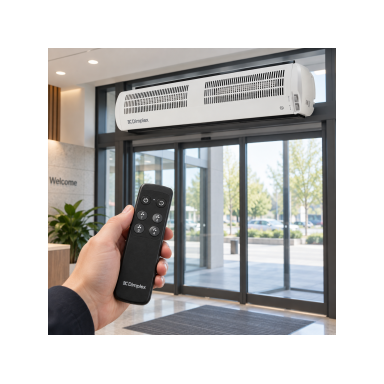
Electric heated air curtains are installed above doors or gates to create a directed warm airflow that helps reduce cold air infiltration and heat loss. Suitable for commercial, administrative, warehouse, industrial and other frequently used entrances.
-
Electric Heated Air Curtains
Electric heated air curtains are devices installed above doors, gates or other frequently opened entrances. They create a directed airflow barrier between indoor and outdoor areas. Their main purpose is to reduce uncontrolled cold air infiltration and the loss of heated indoor air when doors are open.
An integrated electric heating element additionally heats the supplied air, helping to improve thermal comfort in the entrance area.
Key principle:
An air curtain should not be selected only by its heating capacity in kW. Door or gate width and height, airflow velocity, airflow volume, installation height, door opening frequency, wind exposure, building pressure balance and the required control strategy must also be evaluated.Purpose Reduction of heat losses through open doors Heating Electric heating element Power supply 230 V or 400 V, depending on model Installation Usually above doors or gates Key parameters Airflow, air velocity, installation height, heating capacity Control Manual, thermostat, door contact or BMS What is an electric heated air curtain?
An electric air curtain combines a fan, airflow outlet, electric heating element and control system. The fan draws in room air and directs it across the doorway at increased velocity.
This creates an aerodynamic barrier that limits the mixing of indoor and outdoor air. The electric heating element raises the discharge air temperature and can improve comfort around the entrance.
An air curtain is not simply an electric heater.
Its primary function is to separate two air zones using a correctly formed airflow. High heating capacity alone does not guarantee effective protection of a wide or tall doorway.How do heat losses occur through open doors?
When an external door or gate is opened, indoor and outdoor air begins to mix. Warm indoor air can escape while colder, denser outdoor air enters the building.
The intensity of this process depends on:
- the difference between indoor and outdoor temperatures;
- door or gate dimensions;
- opening duration;
- number of opening cycles per hour;
- wind speed and direction;
- indoor-to-outdoor pressure difference;
- ventilation and exhaust systems;
- building height and stack effect.
Energy efficiency
In buildings where doors or gates are opened frequently, uncontrolled air infiltration can increase the load on the heating system. A properly selected and controlled air curtain can reduce this airflow exchange.
- helps reduce cold air infiltration;
- helps reduce loss of heated indoor air;
- reduces temperature fluctuations near entrances;
- can reduce heating system load fluctuations;
- improves comfort for staff and visitors;
- helps manage the entrance-zone microclimate more effectively.
Important for energy assessment:
an electric air curtain itself consumes electricity. Energy efficiency should therefore be assessed by comparing reduced heat losses with the electricity consumed by the fans and heating elements.How to select an electric air curtain?
- Determine the opening width. The air curtain should cover the entire door or gate width.
- Determine the installation height. Check the manufacturer's maximum recommended installation height.
- Evaluate airflow volume. Airflow in m³/h should be assessed together with discharge air velocity.
- Evaluate air throw. The airflow should reach the floor or opposite edge of the opening with sufficient velocity.
- Determine the required heating capacity. Consider the desired discharge-air temperature rise and building conditions.
- Check the electrical supply. Verify 230 V or 400 V supply, current and protective device requirements.
- Evaluate door usage. Consider both the number of openings and how long the doors remain open.
- Evaluate wind exposure. Façade orientation and prevailing wind can strongly affect performance.
- Check building pressure balance. Negative indoor pressure may draw additional outdoor air inside.
- Select a control strategy. Consider thermostat, door contact, fan-speed control and BMS integration.
Why is kW alone not enough?
Heating capacity indicates the output of the electric heating element, but does not show whether the air stream can effectively reach the floor from an installation height of 2.5 m, 3 m or 4 m.
For designers, the key parameters should be evaluated together:
opening dimensions + installation height + airflow volume + air velocity + heating capacity + building pressure balance.230 V or 400 V?
Lower-power air curtains may be designed for a single-phase 230 V supply. Higher-capacity electric models typically use a 400 V three-phase supply.
Automatic control and BMS
From the perspective of building management and energy efficiency, control strategy can be as important as nominal heating capacity.
- doors closed – air curtain off or operating at reduced output;
- doors opened – fan speed automatically increased;
- low temperature – one or more heating stages activated;
- set temperature reached – heating reduced or switched off;
- doors closed – system returns to standby after a defined delay.
Some models may support integration with a Building Management System (BMS). Available communication and control functions must always be checked in the technical documentation of the specific model.
What should the designer evaluate?
- door or gate width and height;
- installation height;
- actual mounting location;
- outdoor design temperature;
- indoor design temperature;
- façade orientation and wind exposure;
- door opening frequency and duration;
- ventilation balance;
- exhaust ventilation influence;
- building height and stack effect;
- required airflow;
- air velocity at floor level;
- electric heating capacity;
- available electrical capacity;
- control and automation strategy.
Common selection and design mistakes
- Selecting the air curtain only by kW.
- Ignoring maximum installation height.
- Using a unit shorter than the doorway width.
- Ignoring air velocity at floor level.
- Ignoring wind exposure.
- Ignoring negative building pressure.
- Operating maximum heating continuously.
- Not using a door contact where appropriate.
- Not checking available electrical capacity.
Advantages
- ✅ Helps reduce cold air infiltration through open doors.
- ✅ Helps reduce heated-air losses.
- ✅ Improves comfort near entrances.
- ✅ Does not require a hot-water heating circuit.
- ✅ Can be automatically controlled according to door status.
- ✅ Multiple heating stages may be available.
- ✅ Selected models can be integrated into building automation.
Limitations
- ❌ High-capacity units may require significant electrical power.
- ❌ Incorrectly selected units may fail to cover the whole opening.
- ❌ Negative building pressure can reduce performance.
- ❌ Strong side winds can deflect the airflow.
- ❌ Higher kW does not compensate for insufficient airflow.
- ❌ Continuous maximum heating can increase electricity consumption.
Check before ordering:- door or gate width and height;
- installation height;
- air curtain length;
- airflow in m³/h;
- air velocity and recommended installation height;
- heating capacity in kW;
- 230 V or 400 V supply;
- rated current;
- fan speed stages;
- heating stages;
- thermostat and door-contact support;
- BMS or external-control options;
- manufacturer technical documentation.
FAQ
Does an air curtain heat the whole room?
Its primary purpose is to form an air barrier at the entrance. It may heat the entrance area, but should not automatically be treated as the main heating system.Does more kW mean a better air curtain?
No. Airflow volume, air velocity and maximum installation height are equally important.How long should the air curtain be?
The airflow should cover the full width of the door or gate. Wider openings may require several units.Does the air curtain need to operate continuously?
Not necessarily. A door contact, thermostat, timer or building automation can be used to reduce unnecessary operation.Can an air curtain be connected to BMS?
Some models support external control or communication interfaces. This must be checked for the specific model.1 - 4 of 4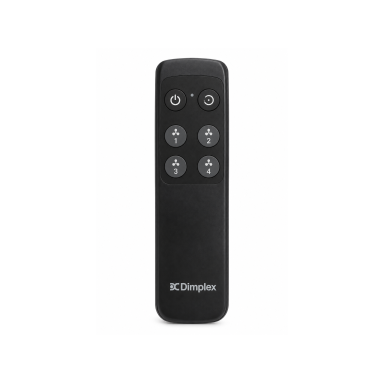
 Price 26.60 € VAT incl.( 21.98 € VAT excl. )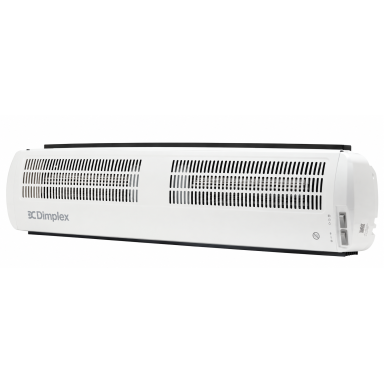
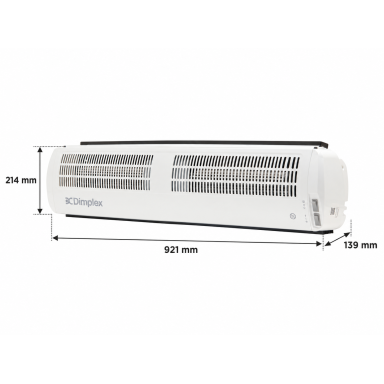 Electric air curtain Dimplex AC | 3000/6000W | 230V | 8.3m/s | 214x921x139 | IP21 | Dimplex AC6WCode: 400001832Price 463.55 € VAT incl.( 383.10 € VAT excl. )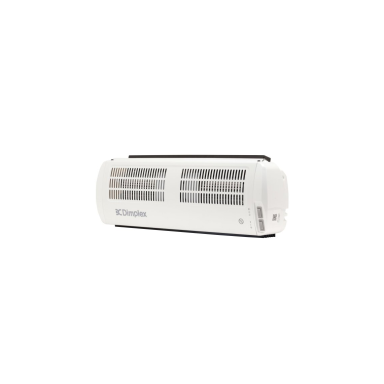
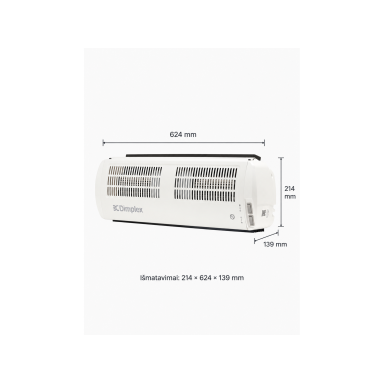 Electric air curtain | 2450/4500W | 230V | 5.5m/s | 214x624x139mm | IP21 | Dimplex AC45WCode: 400001831Price 410.47 € VAT incl.( 339.23 € VAT excl. )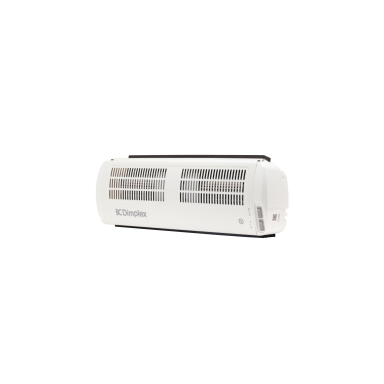
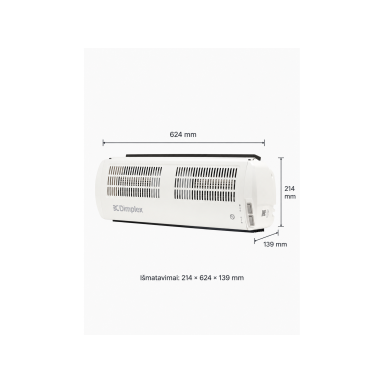 Electric air curtain Dimplex AC | 1300/3000W | 230V | 6.2m/s | 214x624x139mm | IP21 | Dimplex AC3WCode: 400001830Price 378.61 € VAT incl.( 312.90 € VAT excl. )


