Selection guide: how to choose an IP surveillance camera
An IP camera transmits video digitally over a network: Wi-Fi, a network cable (PoE) or mobile data (4G). Recordings are stored on the camera's microSD card, on a recorder (NVR) or in the cloud, and you view the footage on your phone or computer. This category offers around 140 cameras from 23.68 € to 1,020.70 € incl. VAT. This guide will help you decide in a few minutes what type of camera you need, how it will be connected and where you will store the recordings.
Blue – information Green – your benefit Orange – ⚠ check this Red – ⚡ safety and mistakes
What type of camera do you need?
The camera form factor is not just about looks. It determines how the camera is mounted, whether it can be rotated, how it appears to a vandal and how long the image stays clear. Prices include VAT, as of 2026-10-26.
|
Type |
Design and operation |
Best for |
Where to find |
|
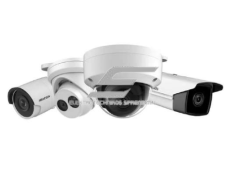
Bullet (cylindrical) |
Elongated housing with a sun shield, aimed once during installation. Highly visible – also acts as a deterrent. |
Façade, driveway, fence, warehouse perimeter |
IMOU (12 pcs, from 31.27 €) · Hikvision (8 pcs, from 66.87 €) · Dahua |
|
Dome (domed) |
Lens under a transparent dome, harder to tell where it is pointing. Often impact-resistant (IK10). |
Stairwells, corridors, shops, ceilings and eaves |
Dome Hikvision (4 pcs, from 76.67 €) |
|
Turret ("eyeball") |
Ball-shaped lens without a glass dome – no IR reflection at night, cobwebs and raindrops interfere less. |
Eaves, entrances, terraces – when you want a dome look without reflections |
Turret (7 pcs, from 36.86 €) |
|
PT (pan-tilt) |
Pans horizontally and tilts vertically via the app, can track a person. Zoom is digital or via a second lens. |
Apartment, yard, country house – when one camera has to cover the whole area |
PT cameras (52 pcs, from 23.68 €) – separate PT guide |
|
PTZ (pan-tilt with optical zoom) |
Like PT, but with optical zoom – details at tens of metres with no loss of quality. |
Large premises, car parks, factories, farms |
PTZ (2 pcs, from 654.15 €) |
|
Cube (compact) |
Small desk or wall camera, usually with Wi-Fi and two-way audio. |
Nursery, office, checkout – indoors only |
Cube (7 pcs, from 29.04 €) |
|
EZVIZ (brand category) |
Smart home cameras with the EZVIZ app: indoor, outdoor, battery-powered. |
Homes and small businesses that want simple setup from a phone |
EZVIZ (33 pcs, from 26.50 €) |
|
Other and accessories |
Special-purpose cameras, protective silicone covers |
As required |
Other (5 pcs) · Silicone covers |
What you gain by choosing the right camera
-
You see what you need: a face at the door, a licence plate at the gate or the whole yard – not the sky and a wall.
-
Notifications are triggered by people and vehicles, not by every tree shadow – when the camera or NVR has human/vehicle detection.
-
Recordings survive an internet outage or a stolen camera if you use an NVR or the cloud.
-
The system grows with you: cameras can be added to the same recorder and app.
A single camera or a system with an NVR?
|
Solution |
How it works |
When to choose |
|
Camera + microSD |
Each camera records to its own card, live view in the app. |
1–3 cameras at home, a simple start with no extra equipment. |
|
Cameras + NVR |
All cameras record to one device with a hard drive; video is shown on a monitor (HDMI) and in the app. |
4 or more cameras, businesses, longer archive, recordings must survive camera theft. |
|
Cloud |
Recordings are stored on the manufacturer's server under a subscription. |
When the camera may be stolen or damaged and there is nowhere to place an NVR. |
Recorders are in the video recorders (NVR / DVR) category, hard drives and cards in the storage media category.
⚠ The camera and the NVR have to "speak the same language". The simplest option is cameras and an NVR from the same manufacturer (e.g. IMOU with IMOU, Hikvision with Hikvision). Third-party cameras can often be connected via ONVIF, but then not all functions (human detection, siren, pan-tilt) will work. Check compatibility in the manufacturer's list or ask us.
Wi-Fi, PoE, 4G or battery?
|
Connection |
What you need |
Advantages |
Limitations |
|
Wi-Fi |
A router and a 230 V socket near the camera |
Quick installation, no network cable to run |
Depends on signal strength; many cameras support 2.4 GHz only |
|
PoE |
CAT5e/CAT6 network cable and a PoE switch or an NVR with PoE |
Most stable connection, power and data over one cable |
Cable up to 100 m; a cable route has to be laid |
|
4G |
A SIM card with a data plan |
Works where there is no internet |
Monthly fee, depends on operator coverage |
|
Battery + solar panel |
A sunny location, Wi-Fi or 4G |
No wiring at all |
Event-based recording, not continuous; shorter runtime in winter |
PoE switches, injectors and other network equipment are in the network accessories category, solar panels here.
Resolution and lens: what you will see and how far
The field of view of a fixed camera is determined by the lens focal length (mm): the smaller the number, the wider the view, but the fewer details at a distance. Resolution (MP) defines how much detail can be made out when zooming into a recording.
|
Lens |
Field of view (approx.) |
Best for |
|
2.8 mm |
~100–110° |
Yard, room, terrace – wide view at close range |
|
3.6–4 mm |
~80–90° |
Entrance, driveway – an all-round choice |
|
6 mm |
~50–55° |
Gate, path, parking space further from the camera |
|
Varifocal / optical zoom |
Adjustable |
When you need details at long range – PTZ or motorised lens cameras |
Angles are approximate – exact values depend on the sensor and are given on each product page.
Rule of thumb
For homes and small businesses, 4–5 MP is usually enough. 8 MP (4K) is worth it when one camera covers a large area and you want to zoom into details in the recording. Higher resolution also means a higher bitrate – the drive fills up faster and a stronger connection is needed.
IMOU, EZVIZ, Hikvision or Dahua?
|
Manufacturer |
App |
Best suited for |
|
IMOU (a Dahua brand) |
IMOU Life |
Homes and small businesses: Wi-Fi, 4G, battery cameras, Wi-Fi NVRs |
|
EZVIZ (a Hikvision brand) |
EZVIZ |
Homes: simple setup from a phone, smart home integration |
|
Hikvision |
Hik-Connect |
Professional systems: PoE cameras, NVRs with AcuSense, commercial sites, businesses |
|
Dahua |
DMSS |
Professional systems: PoE cameras and NVRs |
Within one system, it is best to stick to one manufacturer: one app, all functions work with the NVR, simpler maintenance.
⚠ What to check before buying

Kibirkštis: "I bought an 8 MP camera for the gate, but I still can't read the licence plate – the camera hangs on the house, 25 metres from the gate…"
|
What to check |
Why |
|
Indoor or outdoor (IP66 / IP67) |
An indoor camera used outdoors fails due to moisture and frost |
|
Distance to the target and lens |
With a wide lens you won't see distant details, even at high resolution |
|
Connectivity at the camera location |
Wi-Fi signal, 4G coverage or a cable route of up to 100 m for PoE |
|
Where recordings are stored |
A microSD card is usually not included; an NVR needs a hard drive |
|
NVR compatibility |
Same-brand equipment – all functions; via ONVIF – only some |
|
Night vision |
IR – black and white; with a spotlight or ColorVu-type technology – in colour |
✗ Most common mistakes
|
Mistake |
Consequence |
|
Camera mounted too high (5–6 m) |
Only the tops of heads and caps are visible, faces cannot be recognised |
|
Lens facing the sun or a bright light |
Image is "washed out", objects appear dark |
|
Cameras and NVR from different manufacturers without a compatibility check |
Detection, pan-tilt or notifications do not work |
|
Default password left unchanged, firmware not updated |
The camera becomes a target for hackers |
|
Outdoor network cable without surge protection |
A lightning surge damages the camera, PoE switch or NVR |
|
⚡ Filming a neighbour's property, the street, other people's windows |
Personal data protection requirements (GDPR) may be breached. Monitor only your own property, use privacy masking zones and a warning sign |

⚡ Safe installation – Fazė's tip
Mount outdoor cameras at a height of 2.5–3.5 m, route cables with a drip loop pointing down, and keep connectors and power adapters in a sealed junction box (IP65). Outdoor PoE runs should use outdoor-rated cable and be no longer than 100 m; at the building entry point it is worth installing a
data line surge protector. Place the NVR in a dry, ventilated location, preferably with a UPS. New outdoor 230 V circuits must be installed by a qualified electrician.
☝ Elsprendimai.eu recommends
FAQ
Kibirkštis: What is the difference between an IP camera and an analogue one?
Fazė: An IP camera transmits video digitally over a network and can work stand-alone with an app; an analogue camera (HD-TVI, AHD) is connected to a DVR via coaxial cable. For new systems, IP is usually the choice.
Kibirkštis: Is an NVR required?
Fazė: No. 1–3 cameras can record to a microSD card. An NVR is worth it when you have more cameras, need a longer archive or recordings must survive camera theft.
Kibirkštis: What resolution should I choose?
Fazė: For homes, 4–5 MP is usually enough. More detail at a distance comes not only from resolution but also from the right lens – 6 mm or optical zoom.
Kibirkštis: Can cameras from different manufacturers be connected to one NVR?
Fazė: Often yes, via ONVIF, but some functions may not work. The most reliable option is cameras and an NVR from the same manufacturer.
Kibirkštis: How long can a PoE cable run be?
Fazė: Up to 100 m from the switch or NVR. Beyond that, you need an intermediate switch or extended-range PoE equipment.
Kibirkštis: Can I film the street in front of my house?
Fazė: You should monitor your own property. If public space or a neighbour's property falls into the frame, use privacy masking zones and mark the monitored area with a warning sign.
Sources: IEC 60529 (IP protection ratings); IEC 62262 (IK impact resistance); IEEE 802.3af/at (PoE); ONVIF Profiles S/G/T; Regulation (EU) 2016/679 (GDPR); IMOU, EZVIZ, Hikvision and Dahua technical data; elsprendimai.eu product pages. Checked on 2026-10-26.
⚠ This guide is for reference only. Before buying, check the technical data of the specific model on the product page and in the manufacturer's manual. UAB "Elektrotechnikos sprendimai" is not liable for product selection made on the basis of this guide.
We will design your video surveillance system
Tell us what you want to monitor, how many cameras you need, and whether power, internet and a cable route are available. We will propose cameras, a recorder, a hard drive and mounting accessories with pricing.
Get a quote →