Modular equipment guide: what to install in the panel and how to choose without mistakes
Modular equipment means devices mounted on a DIN rail (35 mm): protection, control, monitoring and measuring devices. This guide works as a signpost: it shows which device you need for your situation, explains how to choose residual current protection (30 / 100 / 300 mA, RCD or RCBO) and leads you to the right product group. Exact parameters are given in each product description.
Colour key: ■ information · ■ benefit, solution · ■ ⚠ check · ■ ⚡ safety, mistakes
ELSprendimai recommends – selection in 30 s ↓ Equip the whole panel →
What do you need? Quick selection
|
Situation |
Solution |
Where to find it |
|
Protect the cable and circuit against overload and short circuit |
Circuit breaker (MCB), curve B or C |
Circuit breakers |
|
Protect people against electric shock: sockets, bathroom, outdoor circuits |
Residual current device 30 mA + circuit breakers or RCBO 30 mA |
Residual current devices, RCBO |
|
So that a leakage in one circuit does not trip the whole house |
A separate RCBO for each circuit or several RCD groups |
Circuit breakers with residual current protection (RCBO) |
|
Fire protection at the incomer, long outdoor or farm building lines |
RCD 100 mA or 300 mA (not for protection of persons) |
Residual current devices |
|
Protect appliances against a broken neutral, overvoltage or undervoltage |
Voltage monitoring relay |
Voltage relays |
|
Three-phase motor, pump, compressor: phase loss, sequence, asymmetry |
Phase monitoring / sequence relay |
Phase monitoring relays |
|
Critical single-phase load when phase voltages are unstable |
Automatic phase selector |
Phase selectors |
|
Do not exceed the supply capacity (e.g. water heater + heating + EV charging) |
Power limiter or current relay with priority load shedding |
Power limiters, Current relays |
|
Control a water heater, heating or ventilation from a thermostat or timer |
Modular contactor (by utilisation category) |
Modular contactors |
|
Switch on lighting at dusk |
Photo relay with sensor |
Photo relays |
|
Staircase and corridor lighting from push buttons |
Staircase lighting relay (automatic switch-off) |
Staircase relays |
|
Delay, cyclic operation, start sequence |
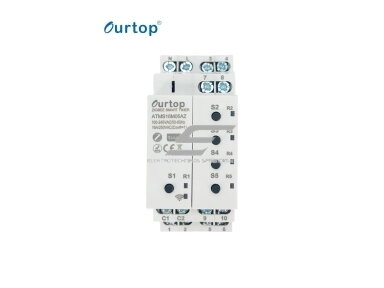
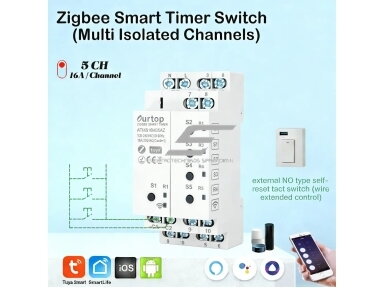
Time relay |
Time relays |
|
Panel heating / ventilation, frost protection |
Modular thermostat |
Modular thermostats |
|
See current and voltage on the panel door or on the DIN rail |
Digital ammeter / voltmeter |
Ammeters and voltmeters |
|
Meter energy, monitor remotely |
Modular meter, monitoring equipment |
Measuring and monitoring equipment |
|
Level control of a well, tank or drainage |
Liquid level control relay with electrodes |
Liquid level relays |
|
Indication and manual control in the panel |
Modular indicator lamps, switches, buzzers |
Modular signalling equipment |
|
Fire extinguishing inside a panel or server room |
Automatic aerosol extinguisher |
Aerosol extinguishers |
|
Surge protection (lightning, switching) |
Surge protection device (SPD) – a voltage relay does not replace it |
Surge protection devices |

KibirkštisAnd if I need protection, control and measurement all at once – where do I start?

FazėWith a list of circuits. For each circuit – protection (breaker and residual current), then control (contactor, relay), and finally monitoring and measurement. If there are many circuits, the
panel configurator will compile the list and calculate the number of modules.
Residual current protection: 30, 100 or 300 mA? RCD or RCBO?
⚡ The most important rule: additional protection of persons against electric shock is provided only by
≤30 mA residual current protection. 100 mA and 300 mA devices do not protect people – they are intended for fire protection and selectivity. More details –
VIP guide to RCDs and RCBOs.
|
Sensitivity IΔn |
What it protects |
Where to use |
|
30 mA |
People (additional protection against direct contact) and the installation |
Socket circuits, bathroom, kitchen, outdoor sockets and lighting, garage, children's rooms |
|
100 mA |
The installation against fire caused by leakage current |
Long outdoor lighting lines, farm buildings where 30 mA trips without reason due to background leakage – only where protection of persons is not required or is provided downstream |
|
300 mA |
The building against fire, selectivity |
Incomer, feeders to distribution boards (often selective type S) |
|
Solution |
Advantages |
When to choose |
|
RCD (residual current device) + circuit breakers |
Cheaper with many circuits; one device protects 2–4 circuits |
Apartments, houses, when circuits can be split into several RCD groups |
|
RCBO (breaker with residual current protection) |
Each circuit is fully independent; a leakage does not trip other circuits |
Fridge, heating, server, alarm, outdoor circuits – wherever a common trip is undesirable |
⚠ Check: RCD does not protect against overload. Its rated current must not be lower than that of the circuit breaker upstream, and the circuits downstream of the RCD are always protected by circuit breakers. An RCBO solves this in a single device.
Type AC, A, F or B – according to the load
|
Type |
Detects |
Typical loads |
|
AC |
Only sinusoidal alternating residual current |
Resistive loads: heating elements, simple lighting. In new installations it is increasingly replaced by type A |
|
A |
AC + pulsating direct current |
Universal choice for homes: LED, household electronics, dishwashers, washing machines, induction hobs |
|
F |
A + mixed-frequency currents |
Single-phase frequency converters: heat pumps, inverter washing machines, air conditioners |
|
B |
F + smooth direct current |
Three-phase frequency converters, some EV chargers and PV inverters – when required by the equipment manufacturer |
KibirkštisIs type B mandatory for an EV charging station?
FazėNot always. If the station has integrated 6 mA DC detection (RDC-DD), a type A 30 mA device is sufficient. If not – type B is required. See the station manual.
Circuit breaker: B, C or D curve
|
Curve |
Instantaneous tripping |
Where to use |
|
B |
3–5 × In |
Household, resistive loads, long lines, socket circuits |
|
C |
5–10 × In |
General purpose: motors, LED lighting circuits with high inrush currents, compressors |
|
D |
10–20 × In |
Transformers, large motors, welding equipment |
⚠ Check: the rated current of a circuit breaker is chosen according to the cable, not the appliance. Typically Cu 1.5 mm² – 10 A, 2.5 mm² – 16 A, but the installation method, grouping and line length are decisive. The breaking capacity (4.5 / 6 / 10 kA) must not be lower than the prospective short-circuit current at the point of installation.
Monitoring and control relays: which does what
|
Device |
What it monitors |
What it does |
Group |
|
Voltage relay |
Phase voltage, broken neutral |
Disconnects the load when the voltage is outside the set limits and reconnects it after a delay |
Voltage relays |
|
Phase monitoring relay |
Presence of 3 phases, sequence, asymmetry |
Prevents starting or stops the motor (via a contactor) |
Phase monitoring relays |
|
Phase selector |
Voltage of each phase |
Automatically switches a single-phase load to a suitable phase |
Phase selectors |
|
Current relay |
Circuit current |
Disconnects a lower-priority load when the current exceeds the limit |
Current relays |
|
Power limiter |
Power consumption |
Limits the total load so that the main breaker does not trip |
Power limiters |
|
Contactor |
— |
Switches a high-power load according to the control signal |
Modular contactors |
|
Time relay |
Time |
Delay on / off, cycles |
Time relays |
|
Staircase relay |
Push-button pulse |
Switches the light on for a set time |
Staircase relays |
|
Photo relay |
Illuminance (lx) |
Switches on lighting at dusk |
Photo relays |
|
Liquid level relay |
Level via electrodes |
Controls the pump by min / max level |
Liquid level relays |
Also commonly used in panels: impulse relays (lighting from several places), interface relays (for PLC and automation signals), DIN rail sockets, DIN rail power supplies, ATS / MTS changeover switches for generators.
⚠ Contactors: choose by utilisation category. AC-1 – resistive loads (heating, water heater), AC-3 – motors, AC-7a/7b – household loads. A contactor selected by AC-1 for a motor will overheat and burn its contacts.
Calculating panel space
1 module ≈ 17.5–18 mm of DIN rail. Approximate widths:
|
Device |
Modules |
|
Circuit breaker 1P / 3P |
1 / 3 |
|
RCD 2P / 4P |
2 / 4 |
|
RCBO 1P+N |
1–2 (depending on series) |
|
RCBO 4P |
4–7 (depending on series) |
|
Modular contactor 20–25 A |
1–2 |
|
Voltage, time, photo relay |
1–3 |
|
Meter 1-phase / 3-phase |
1–2 / 3–7 |
✓ Tip: leave at least 20% free modules for expansion and heat dissipation. Choose the enclosure in the
distribution boards group.
⚡ Safe installation – Fazė's tip
All work in the panel only with the voltage disconnected and its absence verified. Tighten terminals to the torque specified by the manufacturer: a loose terminal is the most common cause of panel overheating. Test the RCD with the „T“ button at least every six months.
⚠ What to check before buying
-
Number of poles: 1P, 1P+N, 2P, 3P, 4P – according to the network (1-phase / 3-phase) and earthing system (TN-C-S, TN-S, TT).
-
Rated current and curve – according to the cable and load.
-
Residual current sensitivity and type – 30 / 100 / 300 mA; AC / A / F / B.
-
Breaking capacity (kA) – according to the short-circuit current.
-
Compatibility: busbars, auxiliary contacts and shunt trips fit only their own series – see accessories for circuit breakers.
-
Control voltage (contactor coils, relay supply): 230 V AC, 24 V AC/DC, etc.
✗ Most common mistakes
-
100 mA or 300 mA RCD for a socket circuit – people remain unprotected.
-
Neutral from one RCD group connected to another group – constant nuisance tripping.
-
Type AC RCD for inverter appliances – the relay can be „blinded“ and fail to trip.
-
One 30 mA RCD for the whole house – a single fault disconnects everything, including the fridge and heating.
-
Contactor chosen by AC-1 for a motor – overheats, contacts burn.
-
Panel without spare space – a year later there is no room for a new circuit or a limiter.
Frequently asked questions
Asked by Kibirkštis – a young, curious electrician who dares to ask what others won't. Answered by Fazė – an experienced engineer.
KibirkštisWhy does the RCD trip for no obvious reason?
FazėThe most common causes: mixed circuit neutrals, moisture in outdoor junction boxes, too much electronics in one circuit (background leakages add up) or damaged insulation. Split the circuits and measure the insulation resistance.
KibirkštisRCBO or RCD with breakers – which is better?
FazėTechnically both protect equally. An RCBO costs more, but each circuit is independent. In practice: for critical circuits –
RCBO, for the others –
RCD blocks of 2–4 circuits.
KibirkštisDoes a voltage relay protect against lightning?
FazėNo. A voltage relay reacts within tens of milliseconds or longer, while a lightning or switching surge lasts microseconds. Protection against them is provided by
surge protection devices. Best of all – both together.
KibirkštisCan I use 300 mA at the incomer and 30 mA in the circuits?
FazėYes, this is a common selective scheme. Use a selective (type S) 300 mA RCD at the incomer so that in case of a leakage in a circuit the 30 mA device trips first.
Other related guides
VIP guide to RCDs and RCBOs · Photo relay guide · Ammeter and voltmeter guide · ATS changeover switch guide · All product selection guides
Standards referred to: HD 60364-4-41 (protection against electric shock), EN 61008-1 (RCD), EN 61009-1 (RCBO), EN 60898-1 (circuit breakers), EN 62423 (type F and B RCDs), EN 60947-4-1 (contactors). Checked 2026-11-06.
This guide is for information only. UAB „Elektrotechnikos sprendimai“ accepts no responsibility for product selection based solely on this guide. Electrical installation work must be carried out by a certified electrician; the final decision is determined by the design and applicable requirements.
The whole panel – in one order
Circuit breakers, RCDs, RCBOs, monitoring relays, contactors and enclosures – all in one place. Experience in the electrical field since 1998. Send us your list of circuits – we will select compatible components and send you an offer. Can't find the model you need in the catalogue? Some products are supplied to order.
Equip the panelGet an offer

 1 - 4 of 4
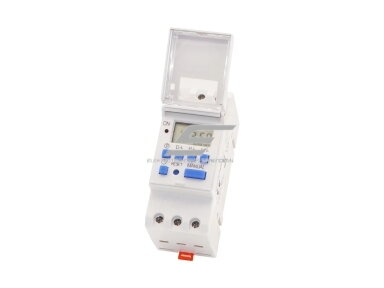
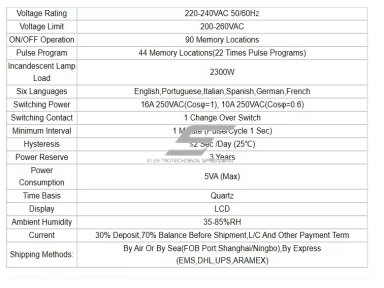
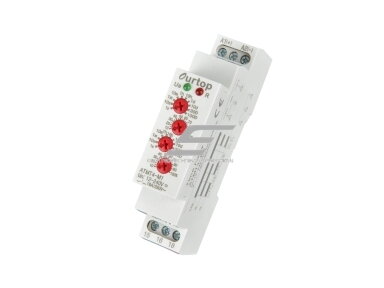
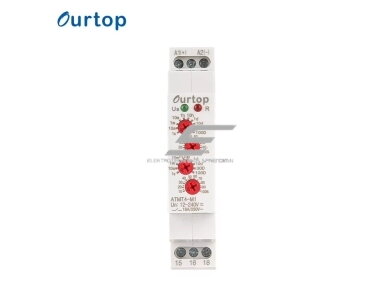
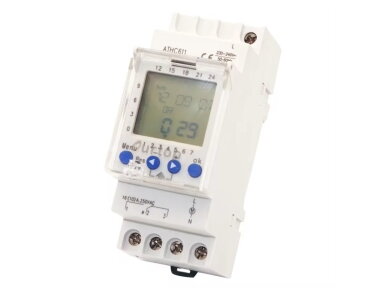
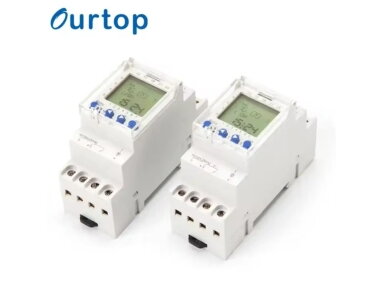
 Digital weekly time switch | LCD | 16 A | 220–240 V AC | 1 CO | 3-year reserve | DIN 2 modules | OURTOP ATHC15ACode: ATHC15A