Products catalog

Air quality meters | CO2 | VOC sensors

  • A CO₂ sensor shows when a room is short of fresh air. For homes and offices we offer CO₂ monitors with a display, app or audible alarm, and for ventilation systems CO₂ sensors with 0–10 V, 4–20 mA and Modbus RTU outputs to control heat recovery units, fans and frequency inverters. The range also includes VOC, HCHO and PM2.5 sensors and CO (carbon monoxide) detectors.

  • CO₂ sensor guide: a monitor for your home or a sensor to control ventilation

    This guide gives you quick selection by situation, CO₂ limits according to EN 16798-1, risk zones for people in schools and kindergartens, particulate matter (PM2.5, PM10) limits, a comparison matrix of all the main sensors in this category, an explanation of signals (0–10 V, 4–20 mA, Modbus), common mistakes and answers to practical questions. Exact specifications are given in each product description.

    Colour key: ■ information · ■ benefit, solution · ■ ⚠ check · ■ ⚡ safety, mistakes

    What do you need? Quick selection

    Situation Solution Where to look
    Bedroom or child's room: you want to know when to open the window Stationary CO₂ monitor with an NDIR sensor and phone notifications SAWF-08P, ES-TWNC5000, ES-H900CO2
    Office, classroom, meeting room Monitor with a clear display and audible alarm, so everyone ventilates, not just the owner ES-TWNC5000, DM176, ES-MCH3B
    After renovation, new furniture, odours Multifunction monitor: CO₂ plus TVOC and formaldehyde (HCHO) ES-IAQM-129-B, ES-A200-CM
    On-site inspections, car Portable battery-powered monitor measuring CO₂ and CO ES-PT04
    Quick check of several rooms, no app needed Portable 5-in-1 indicative monitor with battery: CO₂, TVOC, HCHO, temperature and humidity TTAKA7 B / TTAKA7 J
    Heat recovery unit or fan with a 0–10 V input Room CO₂ sensor with analogue output and 24 V supply RSMFF-3, RSMFG-3, RCMFG-3
    Flush-mounted box, 230 V only Flush-mounted CO₂ controller with 85–264 VAC supply FCMF8-R
    Ventilation of a whole floor or zone based on extract air Duct CO₂ sensor in the extract duct DSCDG3-4, DCMFG-2R, ES-LFG202
    Building automation (BMS) via Modbus Sensor with Modbus RTU (RS485); analogue output not required DSCDG0-4, RSMFF-3, ES-YYS
    Dust, smoke, fireplace, living next to a busy road Particulate matter (PM2.5 / PM10) monitor. A CO₂ monitor does not detect dust SAWF-07P, ES-A200-CM
    Greenhouse CO₂ controller with automatic control and 0–5000 ppm range ES-SA-1600P
    Gas boiler, fireplace, stove ⚡ You need a CO (carbon monoxide) detector, not a CO₂ monitor ES-PTH-21D, ES-PT04

    Ventilate when needed, not by the clock

    CO₂ concentration shows how much exhaled air has built up in a room. A monitor reminds you to open the window when the air gets stuffy, while a sensor in the ventilation system increases airflow only when people are in the room.

    • At home: better sleep and fewer headaches in closed rooms.
    • In offices and classrooms: attention and productivity, especially in the afternoon.
    • In ventilation systems: lower heating and electricity costs, because the fan does not run at full capacity in an empty room.

    Monitor or control: two different product groups

    Both groups measure CO₂; the difference is where the reading goes. A monitor shows it to people, while a sensor sends a signal to the ventilation equipment.

    ■ CO₂ monitor: for home, office, classroom

    • Display, app or audible alarm.
    • Powered via USB or battery, no installation needed.
    • Range typically 400–5000 ppm.
    • Smart models connect via Tuya or Matter (Apple Home, Google Home, Alexa).

    ■ CO₂ sensor: for ventilation automation

    • Analogue output 0–10 V, 0–20 / 4–20 mA or PWM.
    • Modbus RTU (RS485) for building automation.
    • Supply 24 V AC/DC or 230 V, installed by an electrician.
    • Room, flush-mounted or duct housing.

    How much CO₂ is too much? Limits and recommendations

    CO₂ is measured in ppm (parts per million). Outdoor air contains about 400 ppm, so an indoor reading is never lower. The European standard EN 16798-1 classifies ventilation quality into categories based on how much CO₂ builds up indoors above the outdoor level.

    Outdoor air
    ~400 ppm
     
    Lowest possible indoor reading
    Category I
    up to ~950 ppm
     
    High expectations: classrooms, sensitive people
    Category II
    up to ~1200 ppm
     
    Normal level for new buildings
    Category III
    up to ~1750 ppm
     
    Acceptable, but already stuffy
    Category IV
    above 1750 ppm
     
    Poor air quality, drowsiness, headaches

    Scale 400–2400 ppm. Absolute values calculated for outdoor air at ~400 ppm. The standard applies stricter limits to bedrooms.

    Room Recommended limit How to set it
    Bedroom, child's room 800–1000 ppm Phone notification or ventilation boost from 900–1000 ppm
    Living rooms, office ~1000 ppm Ventilation starts ramping up at about 800 ppm, full capacity at 1200 ppm
    Classroom, meeting room 950–1000 ppm Audible alarm or automatic ventilation, as occupancy is high and CO₂ rises fast
    Greenhouse Depends on the crop Often 800–1200 ppm with CO₂ dosing. Here the sensor controls the CO₂ supply as well, not just ventilation

    In practice: start with a 1000 ppm limit and monitor readings for a week. If the air is still stuffy in the evening, lower the limit in 100 ppm steps.

    ⚡ Risk zones for people: schools and kindergartens

    In a classroom or kindergarten group, 20–30 people breathe in a small space at the same time, so CO₂ rises several times faster than in a flat. In a 2019 study by the Lithuanian National Passive House Association, the average CO₂ concentration during lessons in 11 Vilnius schools reached 1660 ppm. In primary classrooms readings rose to 3183 ppm, in senior classes to 5152 ppm. Such concentrations exceed even the 8-hour workplace limit for adults.

    CO₂ Zone Effect on people
    up to 1000 ppm Safe zone Good conditions for learning and working. Target for classrooms and bedrooms
    1000–1400 ppm Caution zone Attention and concentration decline, drowsiness sets in. Studies show decision-making quality starts to deteriorate from ~1000 ppm
    1400–2500 ppm Ventilation required Headaches, fatigue, stuffiness. Children remember less and tire faster
    2500–5000 ppm Unacceptable for a learning space Severe fatigue and headaches. Such concentrations indicate that ventilation is not working or is completely inadequate
    5000 ppm Workplace 8 h limit Long-term exposure limit for an adult worker: NIOSH and OSHA 5000 ppm, EU: 9000 mg/m³
    30 000 ppm Short-term exposure limit No longer than 15 min (NIOSH). Shortness of breath, increased heart rate
    40 000 ppm Immediately dangerous to life NIOSH IDLH limit. Indoors this occurs only with a CO₂ leak: cellars with CO₂ cylinders, refrigeration equipment, dry ice, fermentation

    At these concentrations CO₂ is not poisonous like carbon monoxide, but it is the most reliable indicator that exhaled air, moisture, viruses and other pollutants are building up in a room. Relative to body weight, children inhale more air than adults, so they are also more sensitive to particulate matter.

    Room Risk Solution Where to look
    Classroom CO₂ can exceed 2000 ppm during a 45-minute lesson A monitor in every classroom with a clear display and audible alarm; ventilate during every break DM176, ES-TWNC5000
    Kindergarten group room and nap room During the afternoon nap in a closed room, CO₂ rises unnoticed Monitor with phone notifications for staff; CO₂-controlled ventilation in the nap room SAWF-08P, ES-TWNC5000
    Gym, assembly hall Many people and high physical exertion Duct CO₂ sensor in the extract air, ventilation speed based on CO₂ DSCDG3-4, RSMFF-3
    After renovation, new furniture Formaldehyde (HCHO) and TVOC from paints, adhesives and furniture Multifunction monitor before children return ES-IAQM-129-B, ES-A200-CM
    Kitchen with gas appliances Carbon monoxide (CO) from poor combustion CO detector near the gas appliances ES-PTH-21D
    Heating season, school next to a road Outdoor PM2.5 enters through the windows PM monitor, heat recovery unit with a high-grade filter SAWF-07P, ES-A200-CM
    Fazė

    ⚡ Installation in childcare facilities: Fazė's tip

    • Mount the monitor out of children's reach, at about 1.5 m on an interior wall. Secure the power cables so they cannot be pulled.
    • Use battery-powered devices only if the battery compartment can be closed securely. Do not keep spare batteries in children's rooms.
    • In a classroom, choose a monitor with clear indication that everyone can see: green, yellow, red or an audible alarm.
    • Readings must be visible to staff, not just to the device owner. Smart monitors send notifications to a phone.
    • 230 V equipment and ventilation automation must be connected by a qualified electrician.

    Particulate matter (PM2.5, PM10): what a CO₂ monitor does not show

    Particulate matter is dust, soot and smoke particles suspended in the air. PM10 are particles up to 10 µm in diameter, PM2.5 up to 2.5 µm. Fine PM2.5 particles penetrate deep into the lungs, making them the most harmful to health. CO₂ shows whether a room is ventilated enough, while PM shows whether the air is clean. These are two different measurements, and one does not replace the other.

    Indoor source What to do
    Cooking, especially frying or grilling Switch on a cooker hood that vents outdoors and ventilate briefly but intensively
    Fireplace, stove, candles, incense Watch the PM2.5 reading. A reading that stays high means poor draught or leaks
    Outdoor pollution: roads, solid-fuel boiler houses in the heating season When outdoor PM is high, airing through the window makes indoor air worse. A heat recovery unit with a high-grade filter (ePM1 per ISO 16890) helps
    Renovation, sanding, construction Measure before and after the work. In industry, dust is monitored by fixed sensors with signal output

    Limits (µg/m³)

    Indicator WHO guideline (2021) EU limit from 2030 (Directive 2024/2881)
    PM2.5 annual 5 10
    PM2.5 daily 15 25, may be exceeded up to 18 days per year
    PM10 annual 15 20
    PM10 daily 45 45, may be exceeded up to 18 days per year

    These limits apply to outdoor air. There are no mandatory PM limits for indoor spaces, so use the WHO guidelines as a reference. Short spikes while cooking are normal; what matters is that the reading drops back quickly.

    For Solution Where to look
    Home, office: PM2.5 and PM10 on your phone Smart PM monitor with 3-level warning, Apple Home, Google Home, Alexa SAWF-07P
    Complete air quality monitoring in one device 8-in-1 analyser: CO₂, PM2.5, PM10, TVOC, T, RH and AQI ES-A200-CM
    Production, warehouse, workshop Industrial PM1.0 / PM2.5 / PM10 sensor with 4–20 mA, RS485 and IP67 ES-YA-FD100

    Selection matrix: the main sensors in this category

    The table lists key specifications from manufacturer data. The category contains more models; these represent each use case.

    Product Type Measures Output / communication Power supply
    Monitors: display and notify
    Sonoff AirGuard CO₂ SAWF-08P Stationary, smart CO₂ (NDIR), temperature, humidity Matter over Wi-Fi: Apple Home, Google Home, Alexa see description
    ES-TWNC5000 Stationary, smart CO₂ (NDIR) 400–5000 ppm, T, RH Wi-Fi, Tuya Battery 1600 mAh
    ES-H900CO2 Stationary, smart CO₂, temperature Wi-Fi, Tuya see description
    ES-MCH3B Stationary, smart CO₂ 500–5000 ppm Tuya 5 V DC
    DM176 Mini, desktop CO₂ (NDIR) 400–5000 ppm LED display, audible alarm see description
    ES-IAQM-129-B Multifunction CO₂ 400–5000 ppm, TVOC, HCHO, T, RH Wi-Fi, Tuya see description
    ES-PT04 Portable CO₂, CO, temperature, humidity Bluetooth, USB Battery
    TTAKA7 B / TTAKA7 J Portable, indicative CO₂ up to 5000 ppm, TVOC, HCHO, T, RH Colour display, no connectivity Battery 2000 mAh
    Sonoff AirGuard SAWF-07P Stationary, smart PM2.5, PM10, T, RH (no CO₂) Wi-Fi: Apple Home, Google Home, Alexa see description
    ES-A200-CM 8-in-1 analyser CO₂ (NDIR), PM2.5, PM10, TVOC, T, RH, AQI Audible and visual alarm, data logging see description
    Sensors for ventilation control
    RSMFF-3 Room transmitter CO₂ 400–2000 ppm, T, RH 3 × 0–10 V / 0–20 mA / PWM, Modbus RTU 24 V DC
    RSMFG-3 Room transmitter CO₂ 400–2000 ppm, T, RH 3 × 0–10 V / 0–20 mA / PWM, Modbus RTU 24 V AC/DC
    RCMFF-3 Room sensor-controller CO₂ 400–2000 ppm, T, RH 0–10 V / 0–20 mA / PWM, Modbus RTU 24 V DC
    RCMFG-3 Room sensor-controller CO₂ 400–2000 ppm, T, RH 0–10 V / 0–20 mA / PWM, Modbus RTU 24 V AC/DC
    FCMF8-R Flush-mounted sensor-controller CO₂ 400–2000 ppm, T, RH 0–10 V / 0–20 mA / PWM, Modbus RTU 85–264 V AC
    FCMFG-R Flush-mounted sensor-controller CO₂ 400–2000 ppm, T, RH 0–10 V / 0–20 mA / PWM, Modbus RTU 24 V AC/DC
    DSCDG3-4 Duct, IP54 CO₂ (NDIR) 0–2000 ppm, T, RH 3 × 0–10 V / 4–20 mA / PWM, Modbus RTU 24 V AC/DC
    DSCDG0-4 Duct, IP54 CO₂ (NDIR) 0–2000 ppm, T, RH Modbus RTU only 24 V AC/DC
    DCMFG-2R Duct sensor-controller, IP54 CO₂ 0–2000 ppm, T, RH 0–10 V / 0–20 mA / PWM, Modbus RTU 24 V AC/DC
    ES-LFG202 Duct, IP65 CO₂ RS485, 4–20 mA, 0–10 V 16–30 V DC
    LFG201 Sensor CO₂ 0–10 000 ppm 0–10 V 16–30 V DC
    ES-YYS Wall-mounted with transmitter CO₂ 400–5000 ppm and air quality RS485, 4–20 mA see description
    Special applications
    ES-SA-1600P CO₂ controller CO₂ 0–5000 ppm, T, RH Automatic control, LCD, audible and visual alarm see description
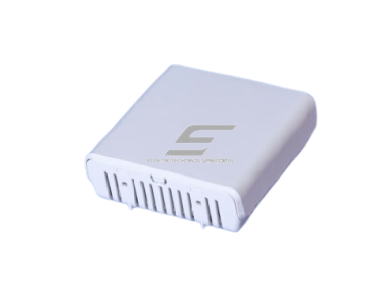
    Room VOC sensor Room VOC Volatile organic compounds (VOC) 4–20 mA, 0–10 V, Modbus RS485 see description
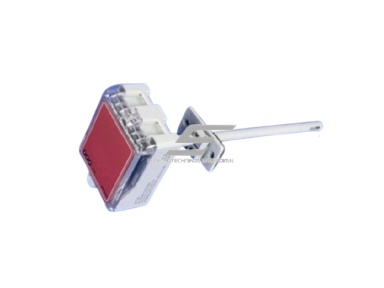
    Duct VOC sensor Duct VOC VOC in extract air 4–20 mA, 0–10 V, Modbus RS485 see description
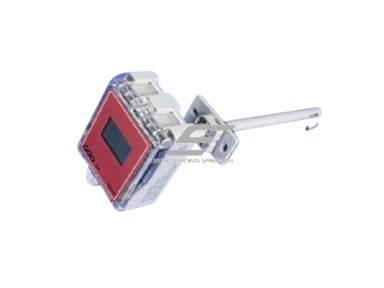
    Duct VOC sensor with LCD Duct VOC with LCD VOC, local display 4–20 mA, 0–10 V, Modbus RS485 see description
    CO detector ES-PTH-21D CO detector, portable CO (carbon monoxide) 0–1000 ppm, T, RH Display, alarm Battery
    ES-YA-FD100 Industrial, IP67 PM1.0, PM2.5, PM10, HCHO, TVOC 4–20 mA, RS485, alarm see description

    “See description” means the parameter is given on the product page. The 3 outputs of Sentera sensors are dedicated to CO₂, temperature and humidity respectively. The output type (0–10 V, mA or PWM) is selected in the settings.

    Signals and communication: 0–10 V, 4–20 mA, Modbus or relay

    Signal When to choose What to watch for
    0–10 V Heat recovery units, EC fans, frequency inverters with analogue input The most common option. Check that the device accepts exactly 0–10 V, not 2–10 V
    4–20 mA Long cable runs, industry, electrically noisy environments A current signal is less sensitive to cable length and interference than a voltage signal
    PWM Some EC fans Suitable only if the fan input is designed for PWM
    Modbus RTU (RS485) Building automation (BMS), several sensors on one line Address and communication parameters must be set. Use twisted-pair cable
    Relay / automatic control Greenhouses, simple on/off switching at a threshold Check the relay load rating. Switch larger motors via a contactor

    Controlling the fan via a frequency inverter (VFD)? The 0–10 V CO₂ signal can be connected directly to the inverter's analogue input. See the wiring diagram in the frequency inverters category.

    Wiring diagrams: sensor, controller and Modbus

    The four most common integration scenarios. Terminal names depend on the model, so always check the instructions for the product and the controlled device when wiring.

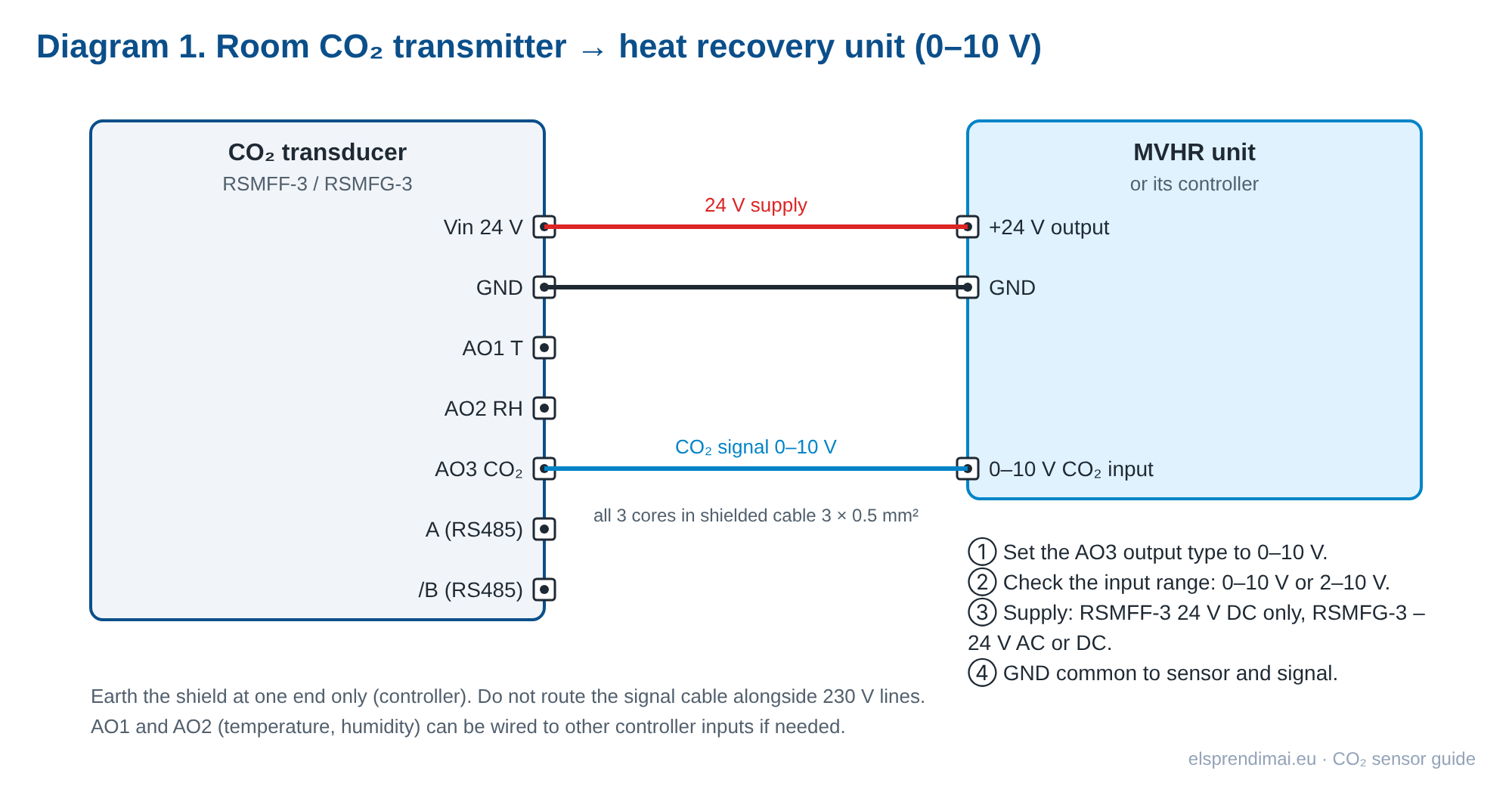
    Connecting a CO₂ transmitter to the 0–10 V input of a heat recovery unit

    Room transmitter RSMFF-3 or RSMFG-3 is powered from the heat recovery unit's 24 V output, and the CO₂ signal (AO3) goes to its 0–10 V input.

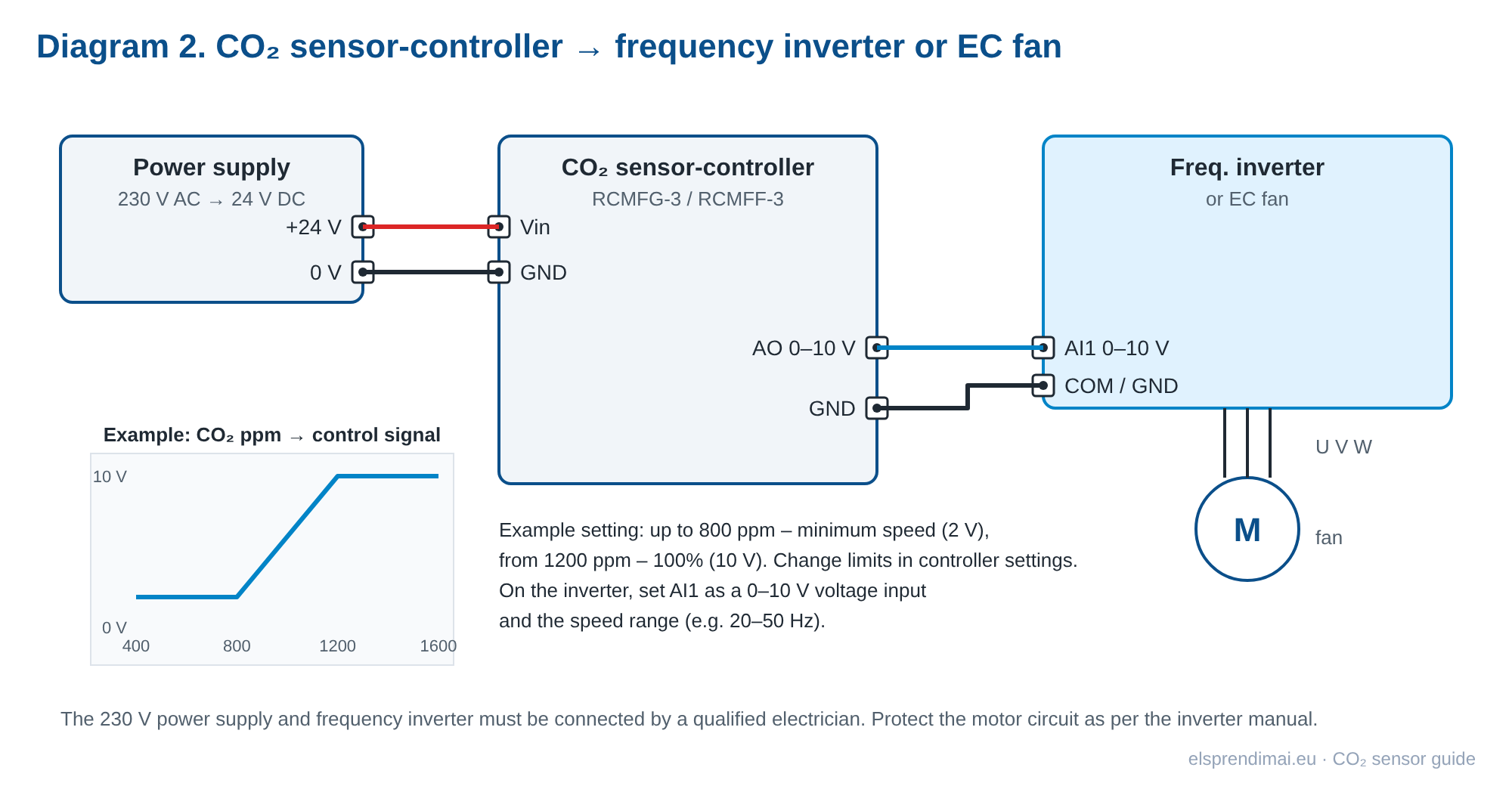
    Connecting a CO₂ sensor-controller to a frequency inverter or EC fan

    Sensor-controller RCMFG-3 generates the fan speed signal itself. Suitable for a frequency inverter with a 0–10 V analogue input or an EC fan.

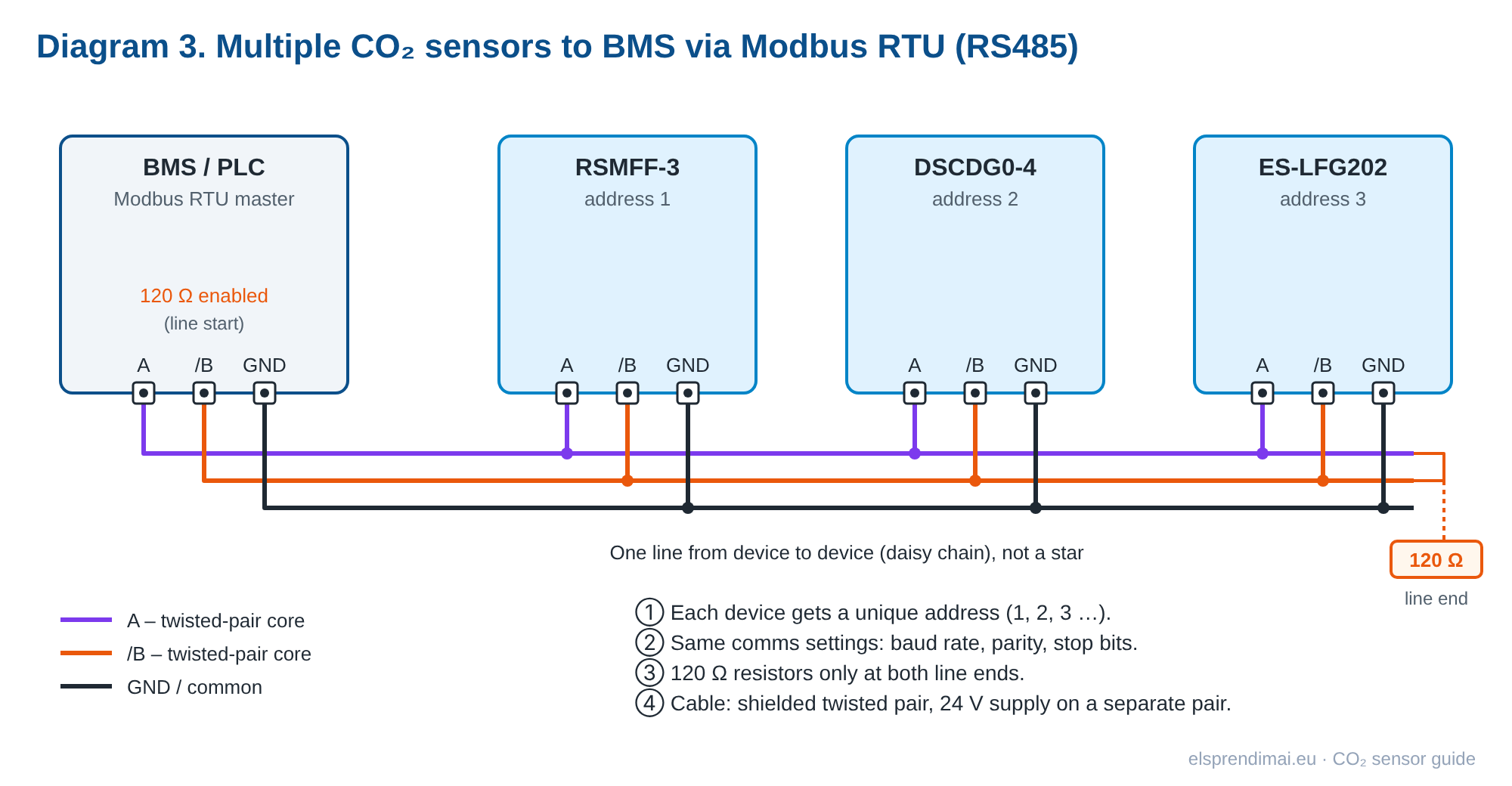
    Connecting several CO₂ sensors to a BMS via Modbus RTU

    Modbus RTU line with RSMFF-3, DSCDG0-4 and ES-LFG202. Devices are connected in a daisy chain, with 120 Ω termination resistors at both ends.

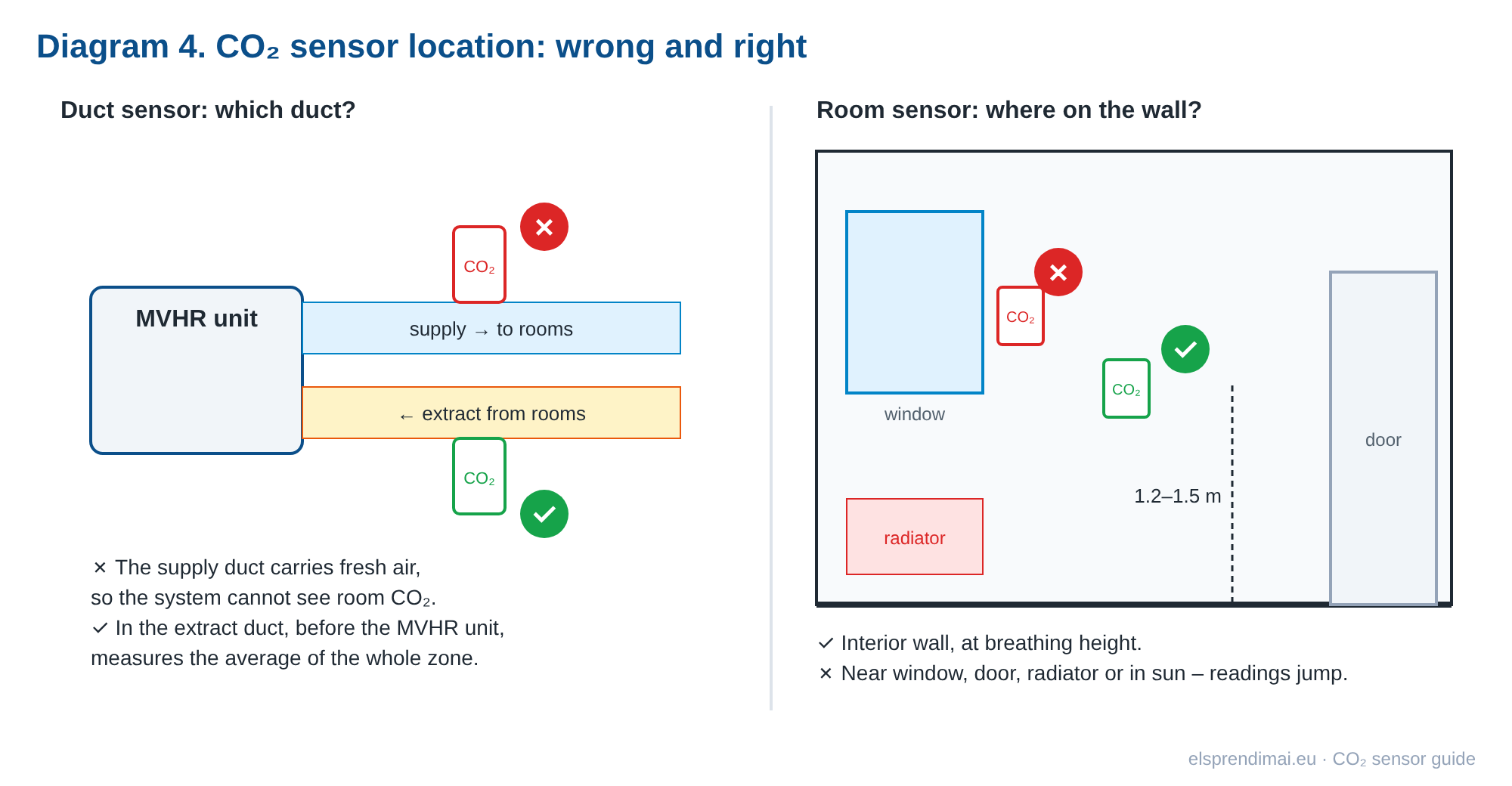
    CO₂ sensor mounting location in the duct and in the room

    A duct sensor is installed in the extract duct; a room sensor on an interior wall at 1.2–1.5 m.

    Fazė
    FazėBefore connecting a sensor, I always check three things in the controlled device's manual: the input type (0–10 V or 2–10 V), whether it provides a 24 V supply, and whether GND is common to signal and power.

    ⚠ What to check before buying

    Kibirkštis
    KibirkštisBefore buying a CO₂ sensor, I always clarify three things: where the reading will be sent, what power supply is available on site, and what signal the controlled device expects.
    What to check Why it matters
    Sensor type: NDIR An NDIR sensor measures CO₂ optically, accurately and stably. Cheap “eCO₂” sensors only estimate CO₂ from VOC and can be inaccurate
    Range 400–2000 ppm is enough for rooms. Greenhouses and industry need 0–5000 ppm or more
    Output and communication Must match the input of the heat recovery unit, controller or BMS: 0–10 V, mA, PWM or Modbus
    Power supply 24 V AC and 24 V DC are not the same. There are models for 24 V DC only, 24 V AC/DC and 230 V
    Mounting location A room sensor measures one room; a duct sensor measures extract air from the whole zone
    Automatic calibration Most sensors self-calibrate and expect the room to be ventilated down to outdoor air level at least occasionally

    ✗ Common mistakes

    Mistake Consequence
    A CO₂ monitor is placed next to a gas boiler as “carbon monoxide protection” A CO₂ monitor does not detect carbon monoxide (CO). A life-threatening hazard goes unnoticed
    The sensor is installed next to a window, door or directly above a desk Readings jump due to draughts or people's breath, and ventilation runs erratically
    A 24 V DC sensor is connected to a 24 V AC transformer The sensor does not work or fails. Choose an AC/DC version or a suitable power supply
    The 0–10 V analogue signal is routed together with 230 V cables Interference, the fan speed “hunts”. Use shielded cable and a separate route for the signal
    A monitor without NDIR is chosen because it is cheaper Inaccurate readings, people stop trusting the device and stop ventilating
    Expecting a CO₂ monitor to show dust or smoke CO₂ and particulate matter are different measurements. Dust needs a PM sensor
    A duct sensor is installed in the supply duct It measures fresh air, so the system does not “see” room CO₂. The sensor must be in the extract duct
    Fazė

    ⚡ CO₂ ≠ CO and safe installation: Fazė's tip

    • CO₂ (carbon dioxide) indicates ventilation quality. CO (carbon monoxide) is a poisonous gas. Next to a boiler, fireplace or stove you need a CO detector.
    • Disconnect power to the controller and the heat recovery unit before connecting the sensor.
    • 230 V flush-mounted controllers and power supplies must be connected by a qualified electrician.
    • Connect signal and power wires according to the manufacturer's diagram, as fan inputs differ.

    ☝ Elsprendimai.eu recommends: mount a room CO₂ sensor at 1.2–1.5 m on an interior wall, away from windows, doors, radiators and direct sunlight. This is the height at which people breathe.

    Frequently asked questions

    Questions from Kibirkštis, a young and curious electrician. Answers from Fazė, an experienced elsprendimai.eu specialist.

    Kibirkštis
    KibirkštisWhat CO₂ limit should I set for ventilation?
    Fazė
    FazėFor most rooms, 1000 ppm is a good starting point. For classrooms and bedrooms, a lower limit of about 900–950 ppm is worth choosing. In systems with 0–10 V control, ventilation is often set to start ramping up at 800 ppm and run at full capacity at 1200 ppm.
    Kibirkštis
    KibirkštisWill a CO₂ monitor detect carbon monoxide?
    Fazė
    FazėNo. CO₂ and CO are different gases and are measured by different sensors. Next to a gas boiler or fireplace you need aCO detector. If you want one portable device for both gases, choose theES-PT04.
    Kibirkštis
    KibirkštisWhat is the difference between a transmitter and a sensor-controller?
    Fazė
    FazėA transmitter, e.g. theRSMFF-3, only passes on measurements: CO₂, temperature and humidity as three separate signals. The heat recovery unit or controller makes the decision. A sensor-controller, e.g. theRCMFG-3, generates the fan control signal itself based on the set threshold.
    Kibirkštis
    KibirkštisCan I connect a CO₂ sensor to my heat recovery unit?
    Fazė
    FazėIn most cases yes, if the heat recovery unit has a 0–10 V or Modbus input for a CO₂ sensor. Check the unit's manual: what signal it accepts and whether it can supply the sensor with 24 V.
    Kibirkštis
    KibirkštisWhy does the monitor show more than 400 ppm in an empty room?
    Fazė
    FazėCO₂ does not disperse immediately after people leave; in a closed room it takes several hours. If the reading stays high even after ventilating, recalibrate the sensor in outdoor air according to the manufacturer's instructions.
    Kibirkštis
    KibirkštisIs it worth ventilating when outdoor pollution is high?
    Fazė
    FazėIn the heating season and near busy roads, outdoor PM2.5 is sometimes higher than indoors. Then it is better to open the window briefly rather than leave it ajar. The best solution is a heat recovery unit with a good filter plus a PM monitor, such as theSAWF-07P, which shows when the outdoor air is cleaner.
    Kibirkštis
    KibirkštisHow many CO₂ monitors does a school or kindergarten need?
    Fazė
    FazėOne in each classroom or group room, as CO₂ rises differently in different rooms. A shared sensor in the corridor does not reflect classroom air. If the building has mechanical ventilation, it is worth installing duct sensors in the extract so the system increases airflow automatically.
    Kibirkštis
    KibirkštisRoom or duct sensor?
    Fazė
    FazėA room sensor controls based on a single room, so it suits a flat, meeting room or classroom. A duct sensor in the extract duct measures the average of all rooms in the zone and is simpler to install when one system serves several rooms.
    Kibirkštis
    KibirkštisCan you help select a sensor for a specific heat recovery unit?
    Fazė
    FazėYes. Send us the model of your heat recovery unit or controller and a description of the rooms. We will select a compatible sensor, power supply and cable and send you a quotation.

    Sources

    Manufacturer data and standards used in this guide. Verified 2026-10-29.

    This guide is for orientation only; make your final decision based on the manufacturer's datasheet and your system requirements. UAB “Elektrotechnikos sprendimai” accepts no liability for product selection based on this guide.

    CO₂ sensor, power supply and control in one order

    CO₂ monitors, ventilation sensors, VOC and CO sensors, frequency inverters and power supplies in one place. Send us the model of your heat recovery unit or fan and the required control logic: we will select compatible components and send you a quotation. Can't find the model you need in the catalogue? Some products are supplied to order.

    Get a quotation
    Read more
    Smart indoor air quality monitor Sonoff AirGuard SAWF-07P with monitoring function | PM2.5 / PM10 / temperature, relative humidity measurement | Wi-Fi | Apple Home / Google Home / Alexa
    Code: SAWF-07P

    Smart indoor air quality monitor Sonoff AirGuard SAWF-07P is designed for real-time monitoring of PM2.5 and PM10 particulate matter, air temperature, and relative humidity. The device operates via Wi-Fi and is compatible with Apple Home, Google Home, and Amazon Alexa, making it easy to integrate into smart home systems. Fast data updates, clear alerts, and data history logging help you respond promptly to changes in air quality and maintain a healthy indoor microclimate at home or in the office. 

    Price 52.03 € VAT incl.
    ( 43.00 € VAT excl. )
    Smart indoor air quality monitor Sonoff AirGuard CO₂ SAWF-08P | CO₂, temperature, humidity | Matter over Wi-Fi | NDIR sensors | integration with Apple Home, Alexa, Google Home
    Code: SAWF-08P

    Smart air quality monitor designed for continuous monitoring of CO₂ concentration, temperature, and relative humidity in indoor spaces. The device uses high-class NDIR technology – you receive real-time, highly accurate data approximately every ~5 seconds, while the Matter over Wi-Fi protocol ensures seamless integration with major smart home systems (Apple Home, Google Home, Alexa, etc.) 

    Price 54.45 € VAT incl.
    ( 45.00 € VAT excl. )
    Smart CO₂ meter with WiFi (Tuya) | NDIR, 400–5000 ppm, temperature, humidity, 1600 mAh | Elsp Group ES-TWNC5000
    Code: ES-TWNC5000

    Free-standing CO₂ meter with NDIR sensor that measures CO₂ in the 400–5000 ppm range, temperature and humidity. Readings and history in the Tuya Smart app via WiFi, powered by a 1600 mAh battery.

    Price 112.38 € VAT incl.
    ( 92.88 € VAT excl. )
    Room VOC sensor | 4–20 mA, 0–10 V DC, Modbus RS485 | indoor air quality measurement
    Code: SKU#165269503298491561

    Wall-mounted VOC sensor that measures indoor air pollution by volatile organic compounds. It transmits the signal via 4–20 mA, 0–10 V DC or Modbus RS485 for demand-controlled ventilation.

    Price 133.10 € VAT incl.
    ( 110.00 € VAT excl. )
    Duct VOC sensor | 4–20 mA, 0–10 V DC, Modbus RS485 | duct air quality measurement
    Code: SKU#165269858844822821

    Duct VOC sensor that measures extract air pollution by volatile organic compounds for a whole zone. It transmits the signal via 4–20 mA, 0–10 V DC or Modbus RS485 to a ventilation controller or BMS.

    Price 157.30 € VAT incl.
    ( 130.00 € VAT excl. )
    Digital duct VOC sensor with LCD display | 4–20 mA, 0–10 V DC, Modbus RS485
    Code: SKU#165270814946854031

    Digital duct VOC sensor with LCD display that measures extract air pollution and shows the reading on site. It transmits the signal via 4–20 mA, 0–10 V DC or Modbus RS485 to a ventilation controller or BMS.

    Price 185.86 € VAT incl.
    ( 153.60 € VAT excl. )
    Price 263.67 € VAT incl.
    ( 217.91 € VAT excl. )
    411.33 € You save 147.66 €
    Portable air quality monitor | CO₂ | CO | temperature | humidity | Bluetooth | USB | for home | office | car
    Code: ES-PT04

    Portable air quality monitor designed for continuous monitoring of the most important environmental parameters at home, in the office, car, workshop, or warehouse. The device measures carbon dioxide (CO₂) concentration, carbon monoxide (CO) level, temperature, and humidity in real time, allowing users to quickly evaluate indoor air quality and react promptly to dangerous changes. This meter is especially relevant for people who care about a healthier working or living environment, better ventilation, a comfortable microclimate, protection against dangerous CO gas levels, energy saving, and efficient air circulation. 

    Price 121.61 € VAT incl.
    ( 100.50 € VAT excl. )
    Multifunctional Indoor Air Quality Analyzer | 8-in-1 | NDIR CO₂ | PM2.5 | PM10 | TVOC | Temperature | Humidity | AQI | Audible and Visual Alarm | Data Logging
    Code: ES-A200-CM

    8-in-1 indoor air quality analyzer designed for continuous monitoring of indoor microclimate and room pollution levels. Multiple high-sensitivity sensors integrated into one compact device allow simultaneous measurement of the most important air parameters, storage of data history, transmission of information, and instant warning about deteriorating environmental conditions. The device is intended for homes, offices, laboratories, server rooms, workshops, warehouses, production facilities, as well as smart ventilation systems. 

    Price 716.93 € VAT incl.
    ( 592.50 € VAT excl. )
    Digital | smart CO2 | air quality meter | sensor | 5VDC | 500-5000PPM | Tuya | black
    Code: ES-MCH3B

    Advanced carbon dioxide meter designed for use in homes, classrooms, offices, and other indoor spaces. This device ensures accurate CO2 measurements and is controlled via the Tuya APP, allowing convenient data monitoring and parameter setting via a smartphone. It uses an NDIR (Non-Dispersive Infrared) sensor, which guarantees long-term accuracy and fast response. 

    Price 209.52 € VAT incl.
    ( 173.16 € VAT excl. )
    CO₂ controller with automatic control | 0–5000 ppm | ±1 ppm accuracy | LCD display | audible/visual alarm | temperature + humidity | for greenhouses, HVAC, indoor spaces
    Code: ES-SA-1600P

    CO₂ (carbon dioxide) controller designed for air quality monitoring and automatic control. The device not only accurately measures CO₂ concentration (0–5000 ppm), but can also control external devices such as fans, dampers, or CO₂ supply valves. Thanks to its high accuracy (up to 1 ppm), wide operating range, and integrated audible and visual alarm, this model is suitable for both residential and professional applications – from homes to greenhouses or industrial facilities. 

    Price 470.56 € VAT incl.
    ( 388.89 € VAT excl. )
    Digital | smart | multifunctional | wireless CO2 | TVOC | HCHO | temperature | humidity | air quality meter | sensor | 400–5000 PPM | -10...+40°C | 20–80% RH | black | Wi-Fi | Tuya
    Code: ES-IAQM-129-B

    A smart indoor air quality monitor designed for both professionals and home users who care about their health and the quality of their living environment. The device measures various air parameters: from carbon dioxide and temperature to particulate matter PM2.5/PM10 and volatile organic compounds (TVOC, HCHO). Integrated with the TUYA Smart platform, this device enables real-time data monitoring via a mobile app, activates audio and visual alerts, displays historical data, and ensures a safe and healthy indoor environment. 

    Price 260.97 € VAT incl.
    ( 215.68 € VAT excl. )
    Industrial dust and air quality sensor | PM1.0 / PM2.5 / PM10 | HCHO / TVOC | LED display | 4–20 mA / RS485 | audible and visual alarm | IP67
    Code: ES-YA-FD100

    Industrial dust and air quality sensor designed for continuous real-time environmental monitoring. This detector simultaneously measures PM1.0, PM2.5, PM10 particulate matter, formaldehyde (HCHO), TVOC, temperature, and humidity, ensuring comprehensive air quality control. Thanks to its IP67 protection rating, fast response time (≤6 s), and integrated alarms, this device is suitable for both industrial facilities and sensitive environments where safety and health standards must be ensured. 

    Price 540.58 € VAT incl.
    ( 446.76 € VAT excl. )
    Digital | Wireless CO | Temperature | Humidity | Air Quality Meter | Sensor | 0-1000 PPM | Portable | Orange
    Code: ES-PTH-21D-O

    Portable carbon monoxide (CO) detector – a reliable and essential safety device designed to monitor dangerous carbon monoxide (CO) gas levels in real time, as well as additionally measure temperature and humidity. The compact device is suitable for use in homes, apartments, campers, garages, or while camping.

    The device uses a high-precision electrochemical CO sensor, ensuring a fast response to dangerous gas concentrations. Thanks to the integrated audible (85 dB) and visual alarm (LED + display), the user is immediately informed of potential danger. 

    Price 68.20 € VAT incl.
    ( 56.36 € VAT excl. )
    Digital | Wireless CO | Temperature | Humidity | Air Quality Meter | Sensor | 0-1000 PPM | Portable | Black
    Code: ES-PTH-21D-B

    Portable carbon monoxide (CO) detector – a reliable and essential safety device designed to monitor dangerous carbon monoxide (CO) gas levels in real time, as well as additionally measure temperature and humidity. The compact device is suitable for use in homes, apartments, campers, garages, or while camping.

    The device uses a high-precision electrochemical CO sensor, ensuring a fast response to dangerous gas concentrations. Thanks to the integrated audible (85 dB) and visual alarm (LED + display), the user is immediately informed of potential danger. 

    Price 68.20 € VAT incl.
    ( 56.36 € VAT excl. )
    Duct CO2 sensor | carbon dioxide concentration meter | RS485 / 4-20mA / 0-10V | 16-30VDC | IP65
    Code: ES-LFG202

    A duct-mounted CO₂ sensor designed for ventilation, HVAC, industrial processes and building automation systems. This high-quality CO₂ transmitter allows precise monitoring of carbon dioxide levels in ventilation ducts or other air flow systems and transmits data to control systems via analog or digital signals.

    The device is designed to operate in demanding environments – the IP65 housing protection, wide power supply range and multiple signal outputs allow it to be integrated into various BMS, HVAC and industrial automation systems. 

    Price 401.19 € VAT incl.
    ( 331.56 € VAT excl. )
  • privacy policy

    Information