Copper power cable · for fixed installation
CYKY-L cables | 2–5 cores | 1.5–16 mm² | selection guide
One cable – from a lighting circuit to a three-phase supply to a workshop. Below you will find the full range in a single matrix, cross-section and length selection tables, and the mistakes that most often cost a second visit.
2–5
cores: L, N, PE, L1–L3
1.5–16 mm²
copper conductor cross-section
1 m
cut to the length you need

 Asked by Kibirkštis – a young electrician who isn't afraid to ask. Answered by Fazė – an experienced engineer.
Key point:
CYKY-L is chosen when you need a robust copper cable with PVC insulation and sheath that can be laid in walls, conduits, cable trunking, outdoors and – following the rules – in the ground. The cable type is only the start: the right cable is determined by the number of cores (single-phase or three-phase system), the cross-section (load current and installation method) and the length (voltage drop).
Information and selection Suitable / recommended ⚠ Check ⚡ Safety and mistakes
Quick selection by situation
|
Situation |
Most common choice |
View |
|
Lighting circuit, 230 V |
3×1.5 mm² (L, N, PE) |
3×1,5 |
|
Socket-outlet circuit, 230 V |
3×2.5 mm² |
3×2,5 |
|
Water heater, dedicated higher-power circuit 230 V |
3×4 mm² or 3×6 mm² – depending on power and length |
3×4 · 3×6 |
|
Single-phase supply to a flat or house |
3×10 mm² – depending on the main fuse and the design |
3×10 |
|
Three-phase motor, pump, compressor (no N) |
4×2.5 / 4×4 / 4×6 mm² – when no neutral is needed |
4×2,5 · 4×4 · 4×6 |
|
Three-phase cooker, 16 A workshop socket, three-phase outlet |
5×2.5 mm² |
5×2,5 |
|
Garage, outbuilding, three-phase supply |
5×4 / 5×6 mm² – larger cross-section for a longer run |
5×4 · 5×6 |
|
Three-phase supply, distribution board, EV charger circuit |
5×10 / 5×16 mm² – according to the design |
5×10 · 5×16 |
|
Control or signalling circuit without PE |
2×1.5 mm² |
2×1,5 |
⚠ Check: the table shows the most common cases. The final cross-section is determined by the load current, installation method and circuit length – see the two tables below.
The full range in one matrix
Click the size you need to open the product page. All sizes are sold by the metre.
|
Cores \ mm² |
1,5 |
2,5 |
4 |
6 |
10 |
16 |
Purpose |
|
2 cores |
2×1,5 |
2×2,5 |
2×4 |
– |
– |
– |
No PE – special circuits only |
|
3 cores |
3×1,5 |
3×2,5 |
3×4 |
3×6 |
3×10 |
– |
230 V: L, N, PE |
|
4 cores |
4×1,5 |
4×2,5 |
4×4 |
4×6 |
– |
– |
400 V without N: L1, L2, L3, PE |
|
5 cores |
5×1,5 |
5×2,5 |
5×4 |
5×6 |
5×10 |
5×16 |
400 V: L1, L2, L3, N, PE |
Green cell – in our range. Can't find the size you need or need a larger quantity for a project? Write to us – we will send you a quote.
How many cores: 2, 3, 4 or 5?
3 cores – single-phase 230 V
Phase L, neutral N and protective PE. The standard for lighting, sockets and single-phase appliances.
5 cores – three-phase 400 V
L1, L2, L3, N and PE. The universal three-phase choice: suits both three-phase and mixed (three-phase + single-phase) loads.
4 cores – three-phase without N
L1, L2, L3 and PE. Suitable for three-phase motors that do not need a neutral. If the circuit will also feed single-phase loads – choose 5 cores.
2 cores – no PE
Only L and N, no protective conductor. Not suitable for Class I appliances or socket-outlets – special or control circuits only.
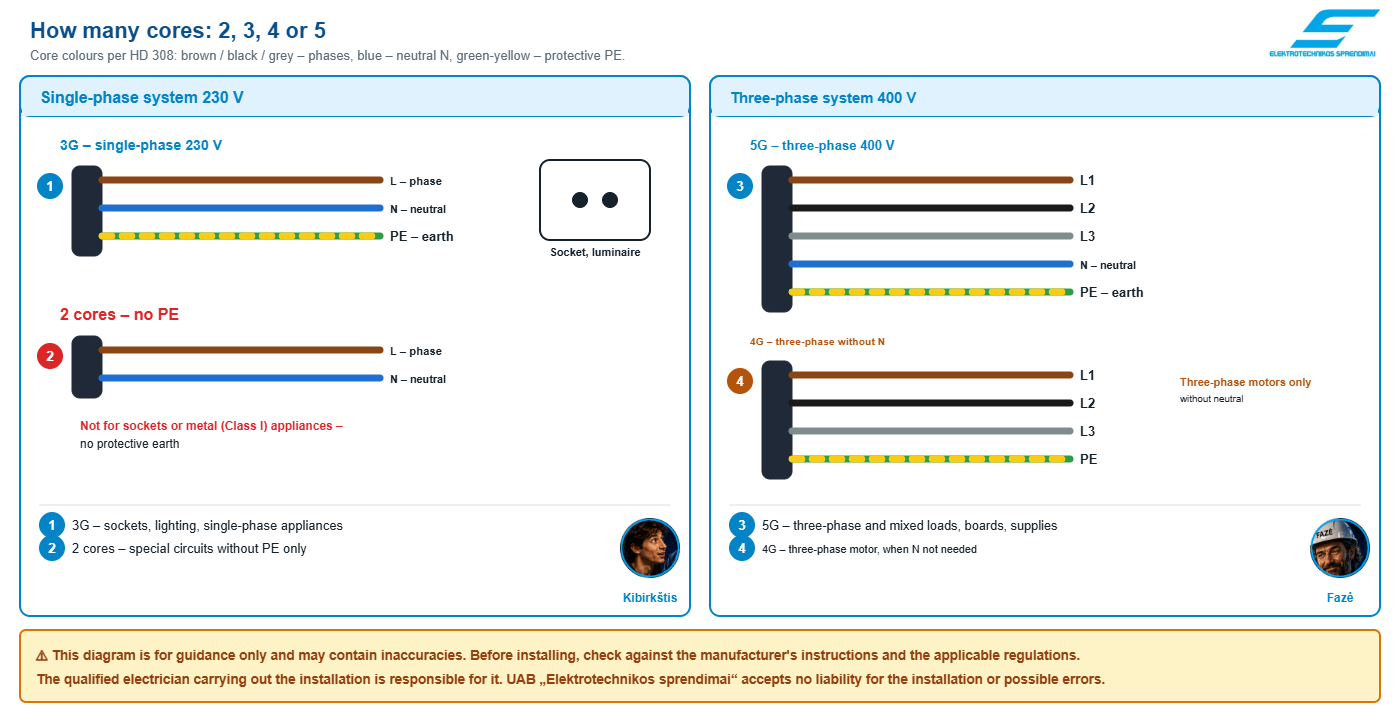
Diagram. Number of cores and colours in single-phase and three-phase systems
☝ Click the diagram to open an enlarged version.
⚠ This diagram is for guidance only and may contain inaccuracies. Before installing, check against the manufacturer's instructions and the applicable regulations.
The qualified electrician carrying out the installation is responsible for it. UAB „Elektrotechnikos sprendimai“ accepts no liability for the installation or possible errors.
KibirkštisThe cooker is three-phase, but I want to supply a single-phase appliance from the same circuit too. Will 4 cores do?
FazėNo. A single-phase load needs a neutral, so take 5G. 4G is only for a purely three-phase motor.
Cross-section by load current and power
Indicative continuous current-carrying capacity Iz for copper PVC-insulated cable according to IEC 60364-5-52, at +30 °C ambient temperature and a single circuit. Method B2 – multi-core cable in conduit on a wall, C – cable clipped directly to a wall or ceiling.
|
mm² |
B2, 230 V (2 loaded cores) |
B2, 400 V (3 loaded cores) |
C, 230 V |
C, 400 V |
Typical MCB* |
Power 230 V** |
Power 400 V** |
|
1,5 |
16.5 A |
15 A |
19.5 A |
17.5 A |
10 A (B10) |
2.3 kW |
6.9 kW |
|
2,5 |
23 A |
20 A |
27 A |
24 A |
16 A (B16) |
3.7 kW |
11.1 kW |
|
4 |
30 A |
27 A |
36 A |
32 A |
20–25 A |
4.6–5.8 kW |
13.9–17.3 kW |
|
6 |
38 A |
34 A |
46 A |
41 A |
32 A |
7.4 kW |
22.2 kW |
|
10 |
52 A |
46 A |
63 A |
57 A |
40 A |
9.2 kW |
27.7 kW |
|
16 |
69 A |
62 A |
85 A |
76 A |
50 A |
11.5 kW |
34.6 kW |
⚠ Important: * the MCB is selected according to the rule IB ≤ In ≤ Iz (load current ≤ MCB rated current ≤ cable current-carrying capacity). Cables grouped in bundles, in thermal insulation or at higher temperatures have a lower current-carrying capacity – correction factors apply. The table does not replace an electrical design.
** Power – the load allowed by the typical MCB: single-phase P = 230 V × I, three-phase P = √3 × 400 V × I, at cos φ = 1 (heaters, water heaters, cookers). For motors and pumps cos φ is usually 0.8–0.9, so the actual connectable power is lower, and the starting current is several times higher.
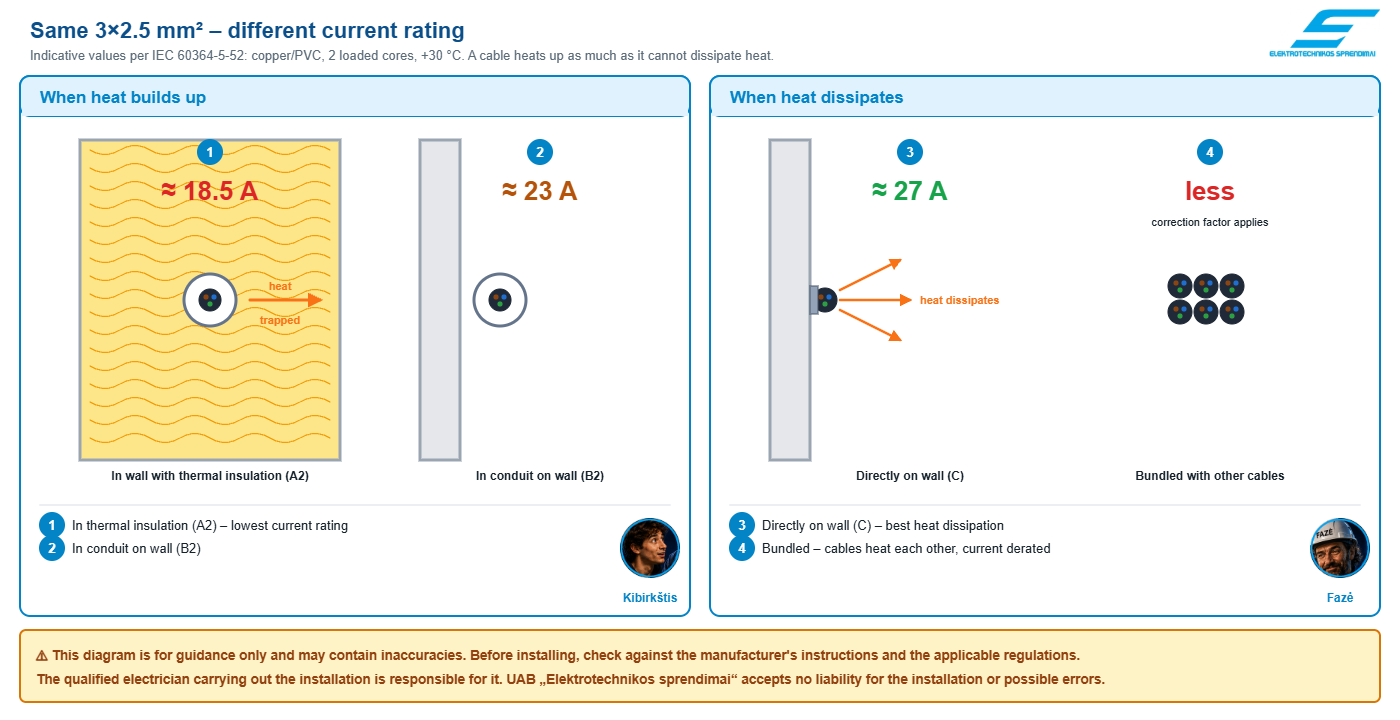
Diagram. Installation method and current-carrying capacity
☝ Click the diagram to open an enlarged version.
⚠ This diagram is for guidance only and may contain inaccuracies. Before installing, check against the manufacturer's instructions and the applicable regulations.
The qualified electrician carrying out the installation is responsible for it. UAB „Elektrotechnikos sprendimai“ accepts no liability for the installation or possible errors.
KibirkštisThe same 3×2.5, yet the current-carrying capacity differs by almost one and a half times. How come?
FazėA cable heats up to the extent it cannot dissipate heat. In thermal insulation or in a bundle it “suffocates”, so check the MCB and cross-section against the actual installation method.
Length and voltage drop
On a long circuit part of the voltage “stays” in the cable: motors struggle to start, luminaires flicker, chargers reduce power. The table shows the indicative maximum circuit lengthat which the voltage drop does not exceed 3 %, with a load equal to the typical MCB current (copper, +70 °C conductor temperature, cos φ ≈ 1).
|
mm² |
Load |
230 V single-phase – up to |
400 V three-phase – up to |
|
1,5 |
10 A |
≈ 25 m |
≈ 45 m |
|
2,5 |
16 A |
≈ 25 m |
≈ 50 m |
|
4 |
20 A |
≈ 30 m |
≈ 60 m |
|
6 |
32 A |
≈ 30 m |
≈ 60 m |
|
10 |
40 A |
≈ 40 m |
≈ 75 m |
|
16 |
50 A |
≈ 50 m |
≈ 100 m |
Example: socket circuit 3×2.5 mm², 30 m, 16 A load → ΔU ≈ 2 × 30 × 16 × 0.0225 / 2.5 ≈ 8.6 V (≈ 3.7 %) – more than 3 %. With 3×4 mm² the drop on the same circuit is ≈ 5.4 V (≈ 2.3 %), so for such a run a larger cross-section is worth choosing.
Formula: single-phase ΔU = 2·L·I·ρ / S, three-phase ΔU = √3·L·I·ρ / S; ρ ≈ 0.0225 Ω·mm²/m (copper, +70 °C).
Cable in the ground and overhead: how to do it right
In walls and under plaster
Most common use: lighting and socket circuits in houses, flats, offices.
In conduits and trunking
Switchrooms, plant rooms, workshops – the cable is easy to replace or add to.
In the ground
To a garage, outbuilding, yard lighting – depth, sand, protection, warning tape.
Outdoors on facades and overhead
On a facade – with clips; between buildings – only on a catenary wire or with overhead line cable.
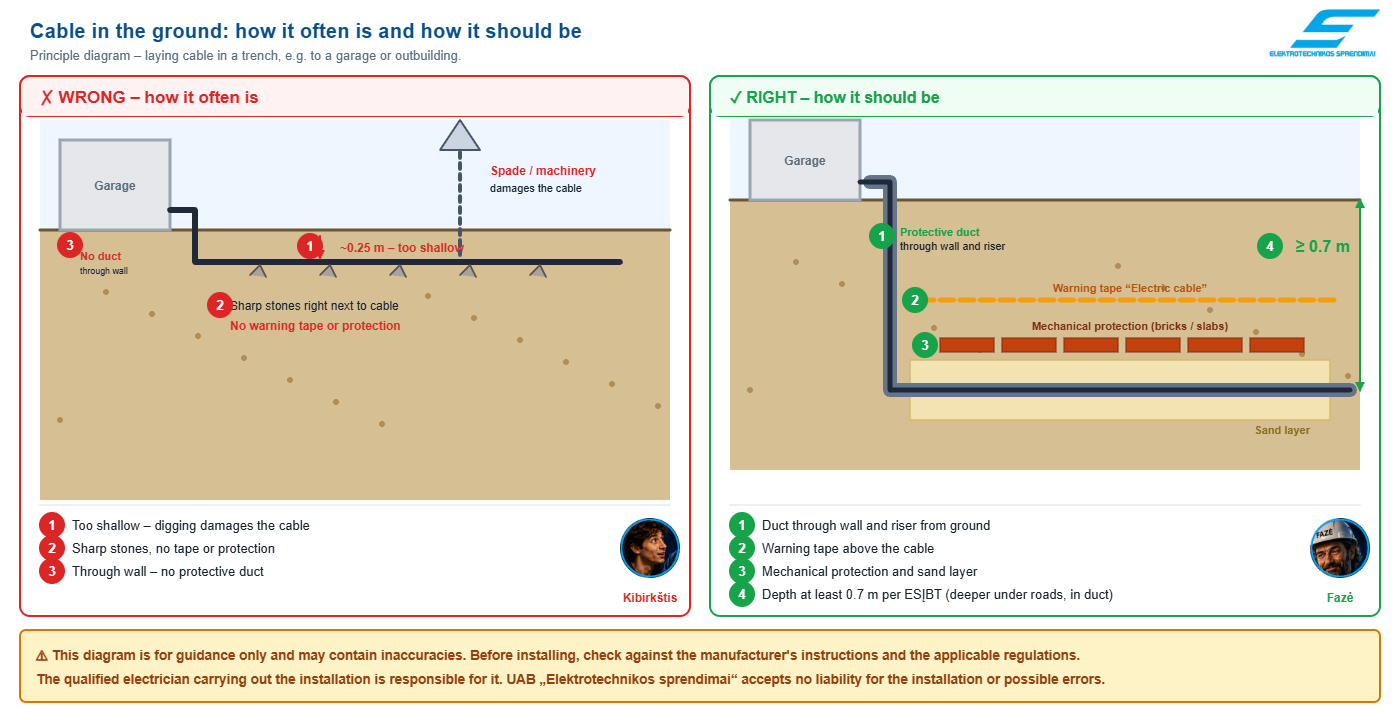
Diagram. Cable in the ground – how it often is and how it should be
☝ Click the diagram to open an enlarged version.
⚠ This diagram is for guidance only and may contain inaccuracies. Before installing, check against the manufacturer's instructions and the applicable regulations.
The qualified electrician carrying out the installation is responsible for it. UAB „Elektrotechnikos sprendimai“ accepts no liability for the installation or possible errors.
KibirkštisIs it enough to bury CYKY a spade deep? It has a thick sheath, after all.
FazėThe sheath protects against moisture, not against a spade. Lay it no shallower than 0.7 m, on sand, with mechanical protection and warning tape, and through walls – only in a duct.
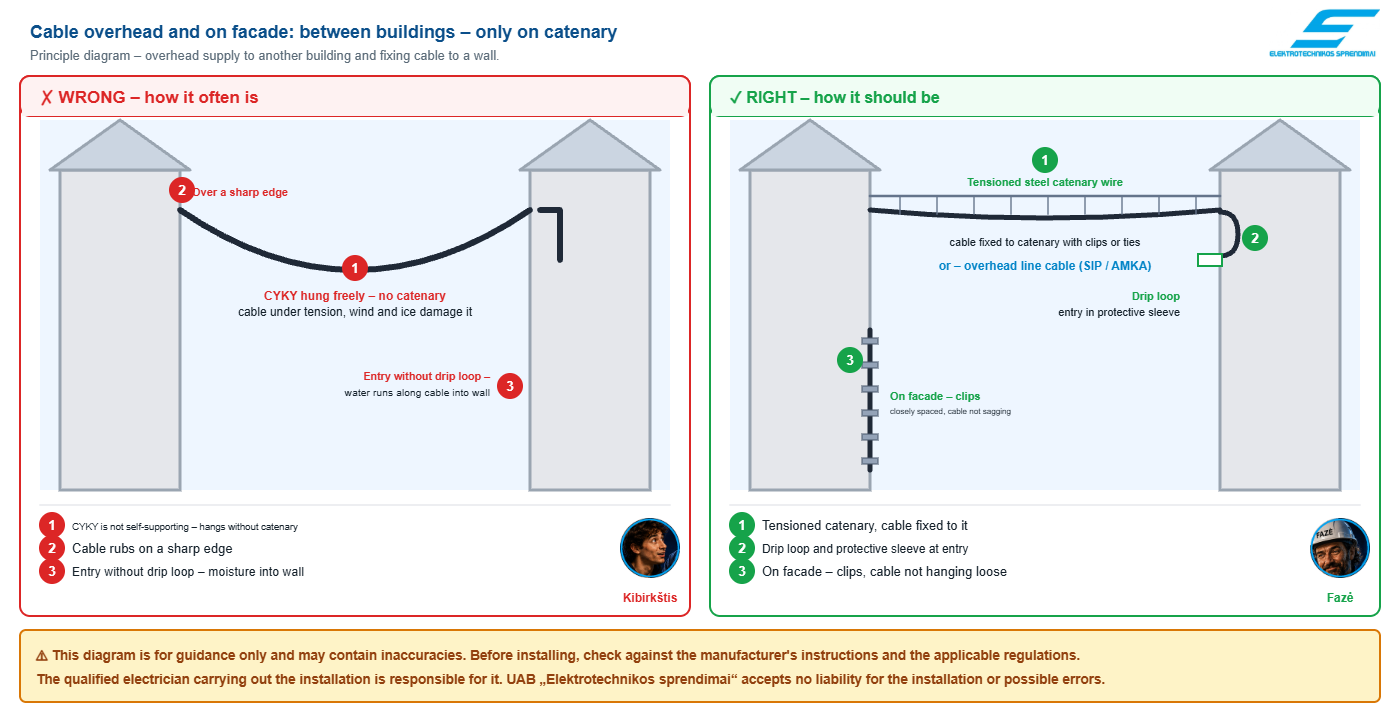
Diagram. Cable overhead and on a facade
☝ Click the diagram to open an enlarged version.
⚠ This diagram is for guidance only and may contain inaccuracies. Before installing, check against the manufacturer's instructions and the applicable regulations.
The qualified electrician carrying out the installation is responsible for it. UAB „Elektrotechnikos sprendimai“ accepts no liability for the installation or possible errors.
KibirkštisIt's 15 m to the garage. Why not just run CYKY overhead between the buildings?
FazėCYKY is not a self-supporting cable. Overhead – only fixed to a tensioned catenary wire, or choose an overhead line cable. Underground is often simpler and more reliable.
Construction and general data
|
Product type |
Copper power cable CYKY-L for fixed installation |
|
Conductors |
Solid or stranded annealed copper conductors (depending on cross-section and manufacturer) |
|
Insulation and sheath |
PVC core insulation, filler, black PVC sheath |
|
Core colours |
According to HD 308: green-yellow – PE, blue – N, brown / black / grey – phases |
|
Rated voltage |
Stated on each product page according to the manufacturer's data; the rated voltage of „Lietkabelis“ CYKY-L is 450/750 V |
|
Conductor temperature |
Up to +70 °C in continuous operation, up to +160 °C during a short circuit (≤ 300 mm²) |
|
Installation temperature |
Not below −5 °C – in the cold the PVC sheath may crack |
|
Bending radius |
Not less than 12 times the cable diameter (for multi-core cable) |
|
Installation |
In walls, under plaster, in conduits, trunking, surface-mounted, outdoors, in the ground – following the laying rules |
|
Sales |
By the metre – we cut the length you need |
CYKY-L or another cable?
|
Cable |
When to choose |
Limitation |
|
CYKY-L (this group) |
Universal: indoors, outdoors, in conduits, in the ground with protection |
PVC – emits smoke and halogens when burning |
|
NYM-J (KH05VV-U) |
Indoor wiring in residential and office premises |
Not suitable for direct burial |
|
NHXMH-J |
Public buildings, escape routes, where halogen-free cables are required |
More expensive than PVC cables |
|
H07V-K |
Single-core flexible wires for panel wiring and conduits |
No overall sheath – only in conduit or in a panel |
|
Aluminium |
Large cross-sections, long supply runs where price matters |
Requires a larger cross-section and suitable Al connectors |
⚠ What to check before buying
KibirkštisBefore buying I always check these points – it saves both money and a second trip to site.
-
System: 230 V single-phase → 3 cores; 400 V three-phase → 5 cores (4 – only without neutral).
-
Load: appliance power (kW) and load current (A), allowing for future expansion.
-
Length: measure the full route from the board to the load and add a margin for termination.
-
Installation method: in a wall, in conduit, in thermal insulation, bundled with other cables or in the ground.
-
Protection: the MCB and RCD must match the cable cross-section.
-
Project requirements: public buildings may require halogen-free cables.
Most common mistakes and their cost
|
✗ Mistake |
Consequence |
|
1.5 mm² cable used for sockets with a 16 A MCB |
The cable overheats, insulation ages, fire risk |
|
Length not considered – 2.5 mm² on a 60 m run |
High voltage drop, motors and pumps struggle to start |
|
4-core cable used for a three-phase circuit with single-phase loads |
No neutral – a new cable has to be run |
|
2-core cable for sockets or a metal-cased appliance |
No protective earth – risk of electric shock |
|
Cable buried without protection and warning tape |
Cable damaged by digging or machinery |
|
Installed in the cold, below −5 °C |
PVC sheath cracks, moisture gets into the cable |
⚡ Safe installation – Fazė's advice
FazėA good cable won't help if it is installed in a hurry. These points are not a formality – they are what protects against faults and electric shock.
-
Before work, isolate the supply, secure it against reconnection and verify that no voltage is present.
-
When laying in the ground, keep to the specified depth, use a sand bed, mechanical protection and warning tape above the cable.
-
Do not bend the cable tighter than the bending radius allows and do not damage the sheath when pulling it through conduits.
-
Before energising a new circuit, measuring the insulation resistance is recommended.
-
Electrical installation work must be carried out by a qualified electrician with the appropriate competence.
For installers and projects
✂ Exact lengths
We cut the length you need – you only pay for what you lay.
■ Project quantities
For larger quantities and projects we prepare an individual quote.
FAQ
Asked by Kibirkštis, answered by Fazė.
KibirkštisCan CYKY-L cable be laid in the ground?
FazėYes, provided the requirements for laying depth, mechanical protection and warning tape are met.
KibirkštisWhat cable is needed for socket-outlets?
FazėUsually 3×2.5 mm² with a 16 A MCB; for a long circuit – 3×4 mm².
KibirkštisWhat is the difference between 4-core and 5-core cable?
Fazė5-core has a neutral N, so it also suits mixed loads; 4-core – only for three-phase loads without a neutral.
KibirkštisCan it be installed in winter?
FazėThe cable should be laid at a temperature not below −5 °C; in the cold it must be warmed up first.
KibirkštisHow do I choose the cross-section for a garage 40 m away?
FazėBased on load and voltage drop – for a three-phase supply 5×4 or 5×6 mm² is often chosen.
KibirkštisDo you sell by the metre?
FazėYes, all CYKY-L sizes are sold by the metre; for larger quantities we provide a quote.
CYKY-L copper power cables
2–5 core CYKY-L cables 1.5–16 mm² for lighting, socket, three-phase and supply circuits. Sold by the metre; we help select the cross-section by load and length.
☎ +370 620 72733✉ info@elsprendimai.eu


 1 - 7 of 7Price 9.55 € VAT incl.( 7.89 € VAT excl. )


 CYKY 5x6.0 | Copper power cable | CYKY-L 5G6 | 1m | blackCode: 91950613


