


Voltage relays modular | mounted in electrical distribution boxes | panels
-
Turbo guide: voltage relay – when it protects and when it does not
A voltage monitoring relay continuously measures the mains voltage. If the voltage goes outside the set limits, the relay disconnects the load and reconnects it once the voltage has returned to normal and the set delay has elapsed. This protects refrigerators, boilers, heat pumps, electronics and motors against the most common supply faults: a broken neutral, overvoltage or undervoltage, phase loss. However, a voltage relay is not protection against lightning, short circuit or electric shock – other devices exist for that, and this guide shows clearly which device protects against what.
Blue – information Green – benefit to you Orange – ⚠ check Red – ⚡ safety and mistakesContents- What do you need? Quick selection
- What the relay protects against – and what not
- Broken neutral – the most common cause
- Surges and lightning: why you need an SPD
- When the surge comes in through the earthing
- Power or control relay?
- Ideal: a relay with a display – you see the whole network
- Selection and settings in 5 steps
- ⚠ What to check before buying
- ✗ Most common mistakes
- Diagram: protection in the distribution board – wrong and right
- FAQ
What do you need? Quick selection
Situation Solution Where to find it Flat or house with 1 phase, the whole incoming supply to be protected 1-phase power relay, current ≥ rating of the incoming MCB 1-phase 40 A · 1-phase 80 A Load limiting is also needed (e.g. limited supply capacity) 1-phase relay with current monitoring (VA type) VA 40 A · 1–63 A Three-phase supply to a house or workshop 3-phase power relay or 3-phase control relay + contactor 3-phase 63 A · 3-phase 63 A (alternative) Three-phase motor, pump, compressor Phase sequence and asymmetry relay – controls the contactor coil 3-phase 8 A C/O · ABB CM-PVE · ABB CM-MPS Three-phase supply, but a single-phase load must keep running when a phase is lost Automatic phase selector 3-phase → 1-phase Phase selector 63 A You want to open the board and see the voltage and consumption of each phase Relay with display: V, A, kWh (1-phase or 3-phase) 1-phase with kWh · 3-phase V+A The house is far away, you want to see the voltage and events on your phone Wi-Fi voltage and current relay Wi-Fi 63 A Automation, 12 V / 24 V / 48 V supply Control relay for the corresponding voltage 12 V DC ⚡ Thunderstorms, lightning, voltage spikes when switching heavy equipment Not a voltage relay, but a surge protective device (SPD) T1 / T2 / T3 SPD T2 / T3 · SPD T1 What you gain by installing a voltage relay- When the neutral is lost, the relay disconnects appliances before they are exposed to up to ~400 V for long. The fastest digital relays do this within ~0.02 s, others after the set delay (up to a few seconds).
- Compressors and pumps do not run at undervoltage, when motors overheat and burn out.
- When the voltage returns, equipment is reconnected only after the set delay, once the voltage has stabilised. This avoids frequent on/off switching during unstable voltage and starting the compressor before the pressure has equalised.
- Digital relays display voltage and current – you see what is happening in the network.
⚡ What endangers life – and what a voltage relay does NOT protect against- Electric shock (leakage current through a person) – protection only by a residual current device (RCD).
- Broken PEN conductor – voltage appears on enclosures and pipes. More ↓
- Touch and step voltage during a thunderstorm near lightning protection down conductors, the earth electrode, metal pipes. More ↓
- L and N swapped – when the relay trips, the phase remains on the equipment. More ↓
- Fire – with a broken neutral and ~400 V, appliance power supplies overheat and ignite; overheated terminals in the board.
- Live working in the board – install the relay, SPD or RCD only after isolating the supply and verifying that no voltage is present.
What the relay protects against – and what not
The most important table on this page. Each hazard has its own protective device, and they do not replace one another.
Hazard Duration Voltage relay What protects Broken neutral (phase voltages “shift” up to ~400 V) seconds – hours ✓ Voltage relay Sustained overvoltage (e.g. 250–270 V) minutes – hours ✓ Voltage relay Undervoltage (e.g. < 190 V) minutes – hours ✓ Voltage relay Phase loss, incorrect phase sequence, asymmetry sustained ✓ 3-phase Three-phase voltage / phase sequence relay Overload (excessive load current) seconds – minutes partially MCB. A relay with current monitoring can additionally limit the load, but does not replace the MCB Short circuit milliseconds ✗ MCB or fuse ⚡ Leakage current, electric shock – danger to life sustained; an RCD trips within ≤ 0.3 s (typically 20–40 ms) ✗ Residual current device (RCD) – the leakage function of a multifunction relay does not replace it ⚡ Lightning and switching surges (thousands of volts) microseconds – milliseconds ✗ Surge protective device (SPD) ⚡ Direct lightning strike on the building microseconds ✗ Lightning protection (air termination, earthing) + SPD T1 Broken neutral – the most common cause
In a three-phase supply, single-phase appliances are distributed across the three phases and return through a common neutral conductor. If the neutral breaks (burnt contact in the board, damaged cable, overhead line fault), the phase voltages redistribute according to the loads. A lightly loaded phase can receive 300–400 V, a heavily loaded one 100–150 V. Within a few seconds, power supplies, TVs and boiler electronics burn out.
1. Neutral breaks
Contact in the board or in the line→2. Voltage shifts
380 V on one phase, 150 V on another→3. Relay disconnects
From ~0.02 s to a few s (depending on model)→4. Reconnects after delay
When the voltage is normal again⚠ In a three-phase house, install single-phase relays on every phase that supplies single-phase equipment, or choose a three-phase relay. A broken neutral endangers all phases, not just one.⚡ Danger to life. In a TN-C-S system, if the PEN conductor breaks upstream of the service entrance, a dangerous voltage can appear on equipment enclosures, pipes, the bathtub and other parts connected to PE. A voltage relay does not protect against this – a reliable PEN connection and repeated earthing at the service entrance are required. If you feel a “tingle” when touching an enclosure, isolate the supply immediately and call an electrician.Surges and lightning: why you need an SPD
In everyday use, “overvoltage” refers to two different phenomena. Sustained overvoltage (250–400 V for seconds or hours) – this is the job of the voltage relay. Transient (impulse) overvoltage – an impulse of thousands of volts caused by lightning or switching of large loads, lasting microseconds. Only a surge protective device (SPD) can limit it to a level safe for equipment (Up), diverting the impulse current to earth within nanoseconds.
Impulse (standard waveform) Front time Time to half value Where it is used Direct lightning current 10/350 µs 10 µs 350 µs SPD T1 test (Iimp) Induced lightning current 8/20 µs 8 µs 20 µs SPD T2 test (In, Imax) Combination wave 1.2/50 µs (voltage) + 8/20 µs (current) 1.2 µs 50 µs SPD T3 and equipment immunity test (Uoc) Switching overvoltage 250/2500 µs 250 µs 2500 µs (2.5 ms) Switching of heavy loads, motors, capacitors in the network Fastest voltage relay ~20 000 µs (0.02 s) – hundreds or thousands of times longer than the impulse The relay “sees” the impulse when it has already passed The designation “10/350 µs” means: the current reaches its peak in 10 µs and falls to half in 350 µs. An SPD responds within nanoseconds – faster than the front of any impulse.
By the time the relay “learns” of the impulse, it has already passed – including through the relay’s internal electronics. That is why the relay itself also needs an SPD upstream of it.
SPD type Where installed When needed Where to find it T1 (or T1+T2) In the main incoming board Mandatory for a building with a lightning protection system, recommended when supplied by an overhead line SPD T1 / T1+T2 T2 In the main or a distribution board For almost every house and site – the basic protection SPD T2 / T3 T3 Next to sensitive equipment, when it is more than ~10 m of cable from the T2 Servers, security systems, boiler and heat pump controllers SPD T3 The SPD is selected according to the earthing system (TN-C-S – 3+0 / 4+0, TT – 3+1 / 1+1 with N-PE spark gap). A back-up fuse or MCB as specified by the manufacturer is installed upstream of it.
Complete protection in the board – 4 devices, each with its own job
Surge protective device (impulses) + MCB (overload, short circuit) + voltage relay (sustained over/undervoltage, neutral) + RCD (personal safety). For a building with a lightning protection system or overhead line – also external lightning protection and earthing.When the surge comes in through the earthing
It is commonly assumed that surges arrive via the supply conductors. In the case of lightning, however, they often come “from below” – through the earthing and the PE conductor. This happens when the building’s earth potential suddenly rises, while the network neutral (earthed at a substation hundreds of metres away) remains at almost zero potential. A difference of several or several tens of kilovolts appears between PE and the L/N conductors, and it discharges through the equipment.
How much the earth potential rises
U = I × R. Example: a 10 kA share of the lightning current flows into the earth electrode, earthing resistance 10 Ω → theoretically up to 100 kV between the building earth and the remote network neutral. Even at 1 Ω it is 10 kV, while the impulse withstand of typical household equipment is 1.5–2.5 kV. That is why a low earthing resistance alone does not help – equipotential bonding and SPDs are needed.When the impulse comes through the earthing What happens How to protect Direct strike on the lightning conductor or roof About half of the current flows into the earth electrode; the rest “seeks” a path via equipotential bonding through the incoming conductors into the network SPD T1 / T1+T2 at the service entrance, connected to the main equipotential bonding bar Lightning strikes nearby (tree, adjacent building, ground up to ~100 m away) Current spreads through the soil, the building’s earth potential rises – the impulse travels from PE through the equipment into L/N SPD T2 between all conductors and PE, common equipotential bonding Several separate, unconnected earth electrodes (lightning protection, outbuilding, solar PV frame, outdoor camera) During lightning their potentials differ by kilovolts – equipment connected between them fails (data cables, controllers) Bond all earth electrodes into one system via an equipotential bonding bar Data, antenna and signal lines between buildings (Ethernet, RS-485, gate automation, cameras) The impulse bypasses the power SPD and enters the equipment via the data cables Data line SPDs at both ends of the line, screen connected to the bonding bar ⚡ Danger to life – touch and step voltage. When lightning current flows into the earth electrode, a large voltage difference appears on the ground surface around it and on metal parts. During a thunderstorm, do not touch lightning protection down conductors, metal poles, fences or pipes, do not stand closer than 3 m to the earth electrode and do not work in the board. Where people walk near down conductors, insulation and equipotential bonding are used (according to LST EN 62305-3).⚡ Important: a voltage relay does not detect such an impulse and does not stop it – it passes within a few microseconds. Protection against impulses via the earthing = common equipotential bonding + SPDs on all conductors entering the building (power, data, antenna) + properly installed earthing. In a TT system – an SPD in the 3+1 / 1+1 configuration with an N-PE spark gap.Power or control relay?
Feature Power relay Control relay How it works The entire load current flows through the relay contact The relay contact (4–16 A, depending on model) controls a contactor coil or a signal Current 16–150 A (depending on model) Load – as much as the contactor allows Suitable for Flat, house, a separate circuit – simple to install Motors, pumps, large incoming supplies, automation panels How to recognise it The name states 25 / 40 / 63 / 80 A The name states “1 C/O”, “2NO/NC”, 4–16 A, “mechanical”, “phase sequence” ⚠ A heavy load (boiler, heater, motor) must not be connected directly to the 4–16 A contact of a control relay – the contact will weld or burn out. For such a load, use a contactor whose coil is controlled by the relay.Ideal: open the board – and see what is happening in the network
Best of all is a relay that not only protects but also displays: the voltage of each phase, how much current flows, how much energy is consumed and the reason for the last trip. On opening the board, it is clear within seconds whether the problem is in the network or in the installation, and which phase is overloaded.
What it displays Who benefits Examples 1-phase: voltage, current, energy consumed (kWh) Flat, single-phase house, a separate circuit (boiler, heat pump) 63 A with kWh · 80 A with kWh 3-phase: voltage of each phase on the display Three-phase supply – you immediately see which phase has the problem 3-phase 63 A, three displays 3-phase: voltage and current in each phase, imbalance Workshop, farm – you see which phase is overloaded and where to move load 3-phase 1–100 A 3-phase + on the phone: V, A, kW, kWh, temperature, events Country house, rental property, unattended site 3-phase 4P Wi-Fi Phase voltages only (does not disconnect) A board where protection is already installed – an additional “window” into the network 3-phase voltage indicator What you can see from the readings – before a fault occurs- Phase voltages “drift apart” (e.g. 248 V – 231 V – 209 V) while the loads on the phases differ greatly – a common sign of a deteriorating neutral contact. It is worth checking the neutral connections before the neutral breaks completely.
- One phase is constantly loaded several times more – move some single-phase circuits to other phases: the incoming supply runs cooler and the voltage drop is smaller.
- Voltage drops below 207 V (230 V −10 %) – this is no longer just a “weak network” but a network problem: the voltage is outside the EN 50160 limits. Record the readings (date, time, each phase) and contact your distribution network operator – it is obliged to fix this. The same applies if the voltage exceeds 253 V (+10 %).
- Consumption (kWh) – you see how much the boiler or heat pump “eats” without a separate meter.
⚡ Measure first. Voltage relay limits are easier to set when you know the real voltage fluctuations on site. Rent a Smart-MAIC D103 power network analyser for 7 or 14 days – analyser rental.Selection and settings in 5 steps
- 1-phase or 3-phase? According to the supply and the equipment being protected. For three-phase motors – always with phase sequence and asymmetry monitoring.
- Power relay current – not lower than the rating of the upstream MCB, ideally one step higher (32 A → 40 A, 40 A → 63 A). An MCB carries up to 1.13–1.45 × In for a long time, so the relay must withstand this too.
- Voltage limits. The EN 50160 standard allows 230 V ±10 % (207–253 V). In practice, U> ≈ 255–260 V and U< ≈ 180–195 V are commonly set. If the network is “weak” (rural area, long line), first measure the voltage for several days and only then set the limits – in a weak network they may need to be widened. However, if the voltage regularly drops below 207 V (−10 %), this is a network fault, not a settings issue: do not “stretch” the limits – record the measurements and require the network operator to restore normal voltage.
- Reconnection delay. For refrigerators, freezers, air conditioners and heat pumps – no shorter than 3 min (180 s), so that the compressor does not start against high pressure. For lighting and electronics, 10–30 s is sufficient.
- Display and measurements: choose a relay that displays the voltage and current of each phase, ideally also kWh and the reason for the last trip (more ↑). Additionally – current limit (VA type), Wi-Fi monitoring, temperature protection.
⚠ What to check before buying
 Kibirkštis: “I bought a voltage relay and thought that now even lightning was no threat. After a thunderstorm, neither the boiler nor the relay itself works…”
What to check Why Power or control relay Control relay contact is 4–16 A – a heavy load needs a contactor Relay current vs MCB rating The relay In must not be lower – otherwise the contacts overheat Supply voltage (230 V AC, 3×400 V, 12/24/48 V DC) A relay designed for another voltage will not work or will burn out Adjustable limits and delay Compressors need a reconnection delay of ≥ 3 min Width in DIN modules Power relays often take up 2–4 modules Is there an SPD in the board Without it, the relay and the equipment remain unprotected against lightning impulses ✗ Most common mistakes
Mistake Consequence The voltage relay is considered lightning protection During a thunderstorm both the equipment and the relay can burn out – an SPD was needed Relay current lower than the MCB rating Contacts overheat, the relay fails A heavy load connected via the 4–16 A contact of a control relay The contact welds – the protection no longer works A reconnection delay of 5–15 s set for compressors The compressor starts before the pressure equalises, overheats and fails Limits set too narrow on a weak network The relay trips needlessly several times a day A 3-phase relay without N connection chosen for the house supply It measures only the line-to-line voltage, so it does not trip when the neutral breaks ⚡ L and N swapped at the relay terminals Danger to life: the relay disconnects the neutral while the phase remains connected to the equipment – electric shock is possible during servicing  ⚡ Safe installation – Fazė’s tip
Before installation, isolate the supply and verify that no voltage is present. Connect the power relay downstream of the incoming MCB, and the SPD upstream of the relay, closer to the service entrance. The conductor cross-section must match the relay current; tighten the terminals to the torque specified by the manufacturer. After switching on, check the voltage shown by the relay with a meter and set the limits and delay. The work must be carried out by a qualified electrician.☝ Elsprendimai.eu recommends- Together with a voltage relay – a T2 surge protective device, and for a building with a lightning protection system or overhead line – T1 / T1+T2.
- Don’t know your network voltage? Rent a network analyser and measure before setting the limits.
- For personal safety – an RCD, for three-phase motors – contactor + phase sequence relay.
- Need an assembled board? We will assemble it to your diagram.
Diagram: protection in the distribution board – wrong and right
Kibirkštis: “I have a voltage relay – why do I need an SPD as well?”
Fazė: “Because the relay protects against long voltage deviations, and the SPD against lightning impulses. They work together.”✗ WRONG① Supply L, N, PE↓② Incoming MCB↓③ Voltage relay – the only protection↓ ⚡ lightning impulse④ The relay and equipment may burn out✓ RIGHT① Supply L, N, PE↓② Incoming MCB↓③ SPD T2 → PE bar↓④ Voltage relay↓⑤ RCD → circuit MCBsWhy – explanation by diagram numbers- Wrong ③–④: the voltage relay responds within ~0.02 s, while a lightning impulse lasts microseconds. The impulse passes through the relay and damages both the relay itself and the equipment.
- Right ③: the T2 SPD is installed upstream of the relay and the RCD. It diverts the impulse to the PE bar via the shortest possible conductor (total SPD connection length recommended ≤ 0.5 m, no more than 1 m).
- Right ④: the relay protects against what the SPD does not catch – a broken neutral, overvoltage or undervoltage lasting seconds or longer.
- Right ⑤: the RCD protects people, the MCBs protect the cables against overload and short circuit. For a building with a lightning protection system or overhead line – a T1+T2 SPD instead of T2.
⚠ The diagram is for guidance only. Check the wiring against the manufacturer’s instructions and the design. Installation is carried out by, and is the responsibility of, a qualified electrician. UAB „Elektrotechnikos sprendimai“ accepts no liability for the connection or possible errors.FAQ
Kibirkštis: Does a voltage relay protect against lightning?
Fazė: No. A lightning impulse lasts microseconds, while the relay responds within hundredths of a second. Protection against lightning and switching impulses is provided by a surge protective device (SPD), and against a direct strike on the building – by lightning protection. A voltage relay protects against sustained deviations: a broken neutral, overvoltage or undervoltage.
Kibirkštis: I have good earthing – do I still need an SPD?
Fazė: Yes. During lightning, even good earthing rises by kilovolts relative to the network neutral, and the impulse travels through PE into the equipment. Only an SPD connected to the common equipotential bonding bar, with all the building’s earth electrodes bonded together, provides protection.
Kibirkštis: What current rating should I choose?
Fazė: Not lower than the rating of the MCB upstream of the relay. E.g. 25 A supply – 32 or 40 A relay.
Kibirkštis: What limits should I set?
Fazė: Most commonly U> about 255–260 V and U< about 180–195 V. If the relay trips frequently for no reason, first measure the network voltage and only then adjust the limits.
Kibirkštis: What reconnection delay should I set for a refrigerator or heat pump?
Fazė: No shorter than 3 minutes. The compressor needs time for the pressure to equalise – otherwise it starts under load and overheats.
Kibirkštis: The relay has a leakage function – can I do without an RCD?
Fazė: No. Where required (socket-outlet circuits up to 32 A, damp locations, etc.), an RCD to EN 61008 / EN 61009 is mandatory. The leakage function of a multifunction voltage relay provides additional information only.
Kibirkštis: Three-phase house – one three-phase relay or three single-phase relays?
Fazė: A three-phase relay (in most models) disconnects all phases together – this is essential for three-phase motors. Three single-phase relays disconnect only the phase with the problem – convenient when all equipment is single-phase and you want the other phases to keep working.
Kibirkštis: What is the difference between a phase selector and a voltage relay?
Fazė: A voltage relay disconnects the load, while a phase selector switches it to another, healthy phase. This way single-phase equipment (boiler, pump) keeps running even when one phase is lost.
Sources: EN 50160 (voltage characteristics of electricity supplied by public distribution networks); HD 60364-4-443 and HD 60364-5-534 (protection against overvoltages, selection and installation of SPDs); EN 61643-11 (low-voltage surge protective devices); EN 61000-4-5 (surge immunity, 1.2/50 µs and 8/20 µs); IEC 60060-1 (switching impulse 250/2500 µs); LST EN 62305 (lightning protection); technical data from elsprendimai.eu product pages. Checked 2026-10-15.
We will select complete protection for your board
Tell us your supply (1-phase or 3-phase, current), whether there is a lightning protection system or overhead line, and what equipment you want to protect. We will tell you which voltage relay, SPD and other protection you need, and provide a quote.
Get a quote → 1 - 16 of 94
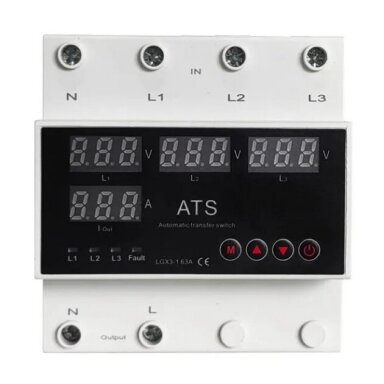
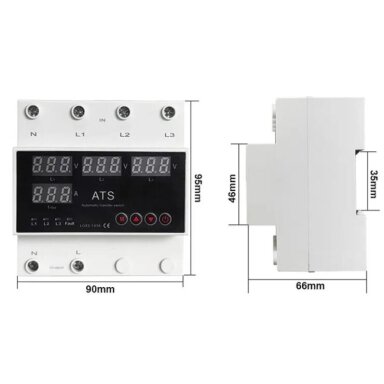
 Digital Voltage Control | Protection Relay | 3P | 63A | 230VCode: ESATS-BEYQH3Price 121.36 € VAT incl.( 100.30 € VAT excl. )
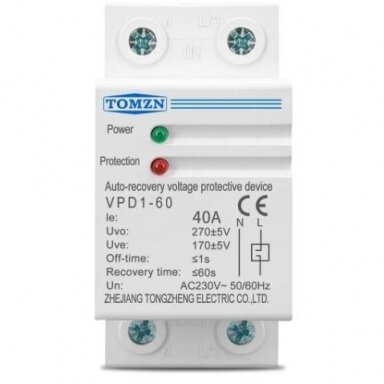
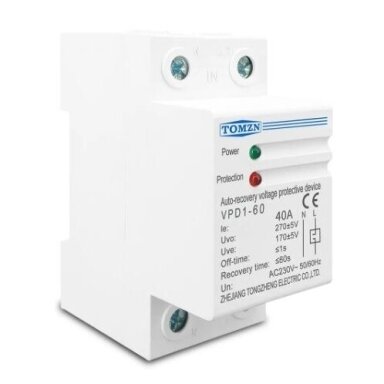
 Price 18.15 € VAT incl.( 15.00 € VAT excl. )Price 90.57 € VAT incl.( 74.85 € VAT excl. )Price 81.51 € VAT incl.( 67.37 € VAT excl. )Price 72.45 € VAT incl.( 59.88 € VAT excl. )Modular | Digital | Voltage Monitoring | Phase Sequence Protection Relay | 3x380V | 260-370V | 400-510V | DINCode: ES-GKT-03FPrice 29.43 € VAT incl.( 24.32 € VAT excl. )Modular Voltage | Phase Sequence Monitoring | Protection Relay | 3x380V | 260-360V | 400-460V | DINCode: ES-GK-04FNPrice 33.69 € VAT incl.( 27.84 € VAT excl. )Modular | digital | voltage monitoring | protection relay | 230V | 230-280V | 150-210V | DINCode: ES-DGK-01Price 29.48 € VAT incl.( 24.36 € VAT excl. )
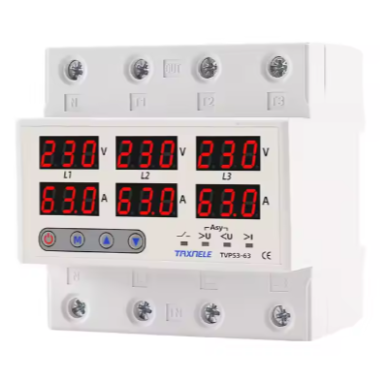
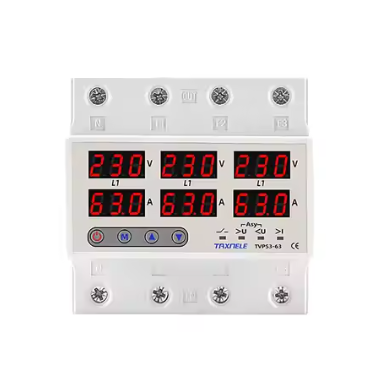 Modular | digital voltage and current monitoring | protection | phase sequence imbalance relay | 3-phase | 1-100A | 380V | DIN railCode: ESTVPS3-100Price 125.65 € VAT incl.( 103.84 € VAT excl. )
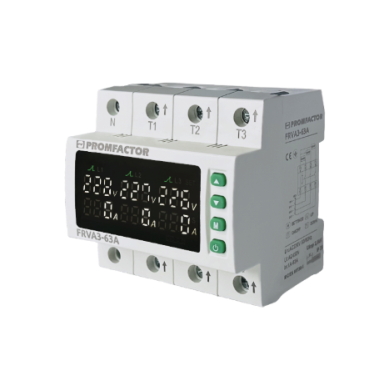
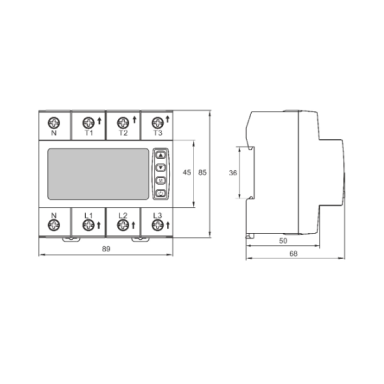 Modular voltage control relay | digital | 3 phase | 63A | 220V | DIN | overvoltage | undervoltage | current protection | TAXNELE (Kopija)Code: ES-FRVA3-63APrice 108.90 € VAT incl.( 90.00 € VAT excl. )Modular | digital | multifunctional voltage | current control | protection relay | 63A | 230V | DIN | ESTVPS1-63SCode: ESTVPS1-63SPrice 39.95 € VAT incl.( 33.02 € VAT excl. )
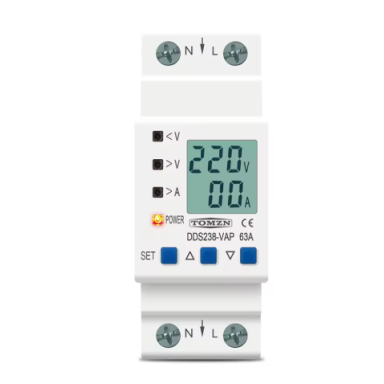 Modular voltage control relay | digital | overvoltage and undervoltage protection | 80A | 230V AC | DIN | voltmeter | ammeter | kWh measurementCode: ES-DDS238-VAP80Price 73.87 € VAT incl.( 61.05 € VAT excl. )
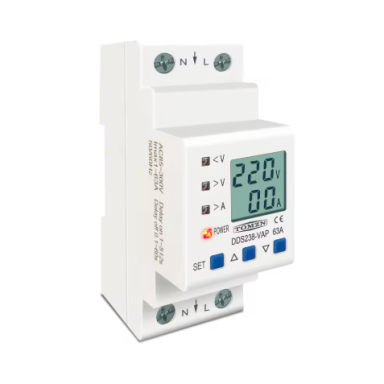
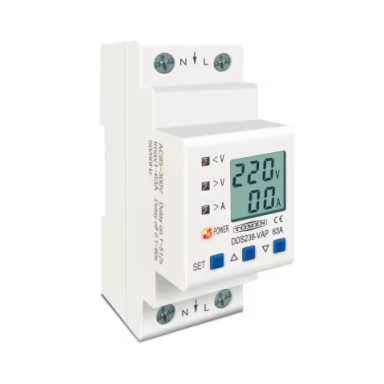
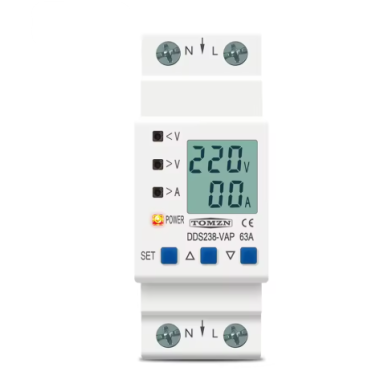 Modular voltage control relay | digital | overvoltage and undervoltage protection | 63A | 230V AC | DIN | voltmeter | ammeter | kWh measurementCode: ES-DDS238-VAP63Price 69.41 € VAT incl.( 57.36 € VAT excl. )
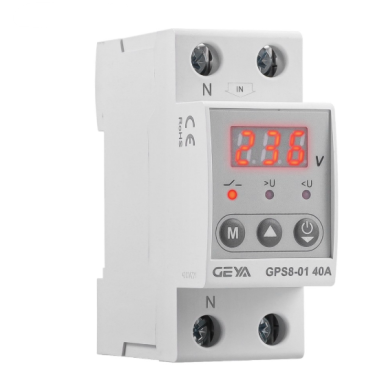
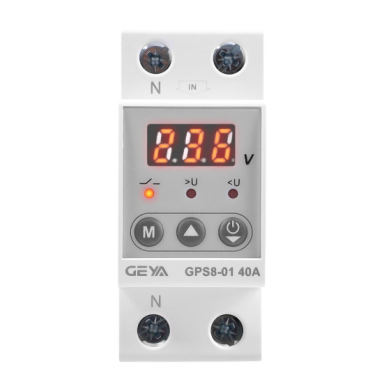 Modular voltage control relay | digital | overvoltage and undervoltage protection | 1P | 63A | 230VAC | DIN | automatic resetCode: ES-GPS8-01-63APrice 14.81 € VAT incl.( 12.24 € VAT excl. )
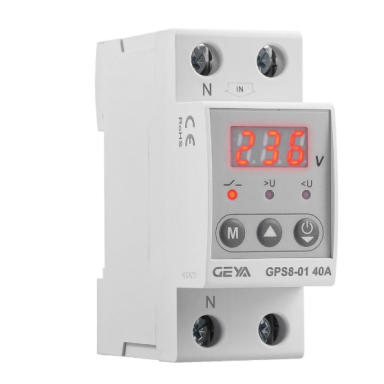
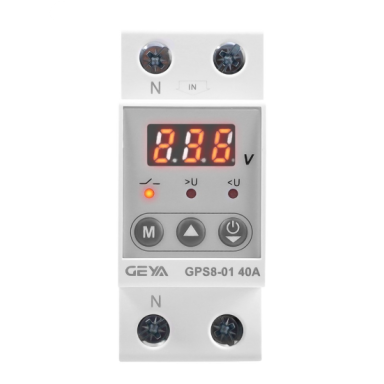 Modular voltage control relay | digital | overvoltage and undervoltage protection | 1P | 50A | 230VAC | DIN | automatic resetCode: ES-GPS8-01-50APrice 14.81 € VAT incl.( 12.24 € VAT excl. )
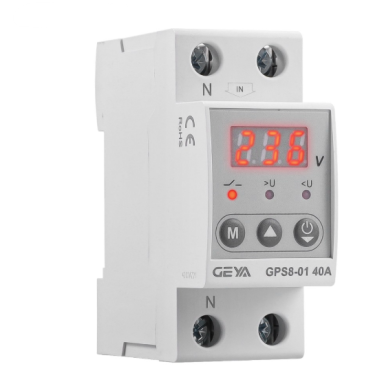
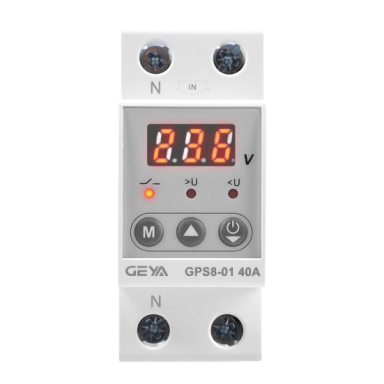 Modular voltage control relay | digital | overvoltage and undervoltage protection | 1P | 40A | 230VAC | DIN | automatic resetCode: ES-GPS8-01-40APrice 14.81 € VAT incl.( 12.24 € VAT excl. )


